

U.S. business-jet activity in 2024 remained approximately 13.3% above its 2019 pre-pandemic level, with 5,134,988 operations compared with 4,533,920. That higher baseline matters more to charter buyers than the dramatic rebound that followed the pandemic dip: it points to a market that settled at a larger scale, not one that returned to normal.
That growth isn't uniform across regions, aircraft types, or routes. For someone booking a flight, the practical questions are where suitable aircraft are based, what mission they can perform, and whether sustainability or safety claims can be verified at the point of booking. Those distinctions are central to understanding business aviation trends and turning them into better sourcing decisions.
Why the Post-Pandemic Baseline Matters More Than the Rebound
U.S. business-jet operations rose from 4,533,920 in 2019 to 5,134,988 in 2024, leaving activity about 13.3% above its pre-pandemic baseline. The path was uneven: operations fell to 3,501,192 in 2020, a 22.78% decline, then climbed to 5,099,528 in 2021, up 45.65% year over year, and peaked at 5,369,454 in 2022 (FAA business-jet activity data).
The rebound drew attention; the plateau is more useful for buyers. Activity was nearly flat from 2023 to 2024, but the market remained above its earlier scale. That sustained level makes aircraft positioning and schedule fit more relevant than a headline about recovery. A request for a specific cabin, route, or departure time depends on where suitable aircraft are available, not just on the national total.
| Year | U.S. business-jet operations | Year-over-year change | Compared with 2019 |
|---|---|---|---|
| 2019 | 4,533,920 | Baseline | Baseline |
| 2020 | 3,501,192 | −22.78% | Below baseline |
| 2021 | 5,099,528 | +45.65% | Above baseline |
| 2022 | 5,369,454 | +5.29% | About 18.4% above |
| 2023 | 5,139,626 | −4.28% | Above baseline |
| 2024 | 5,134,988 | −0.09% | About 13.3% above |
The geographic split complicates the national picture. Domestic operations increased from 3,836,578 in 2019 to 4,399,320 in 2024, while international operations rose from 697,342 to 735,668 over the same period (FAA business-jet activity data, cited above). U.S. growth therefore accounts for more of the higher total; it does not establish that international markets have the same demand or aircraft availability.
For a charter buyer, a higher U.S. baseline can mean less spare capacity in popular departure markets than before the pandemic. The quote still depends on aircraft location, mission capability, and schedule alignment. Those factors can produce different outcomes on routes even when the broader market appears strong.
Buyer implication: “Recovered” leaves out the sustained increase in U.S. activity. Start a search by checking route, timing, and aircraft proximity, rather than assuming national growth translates into availability for a particular trip.
Fleet Composition Is Shifting Toward Larger Cabins
New aircraft deliveries are growing, but the change in market value is outpacing unit growth. Manufacturers delivered 764 business jets in 2024, up 4.7% from 2023, while reported business-jet billings rose 15% to $22.8 billion. Preliminary 2025 shipments reached 854 jets, up 11.8%, exceeding 800 units for the first time since 2019 (GAMA annual data).
That gap between unit growth and billing growth points to a shift in the mix of aircraft being delivered. Higher-value midsize, super-midsize, large-cabin, and ultra-long-range jets appear to be carrying more weight in the market than a simple delivery count suggests. GAMA's preliminary data also put total aircraft-delivery value across reported general-aviation segments at $35.7 billion in 2025, up 14.6%. The buyer-facing implication is not that every route will suddenly have more large jets available. It's that the expanding fleet is adding capability as well as volume.
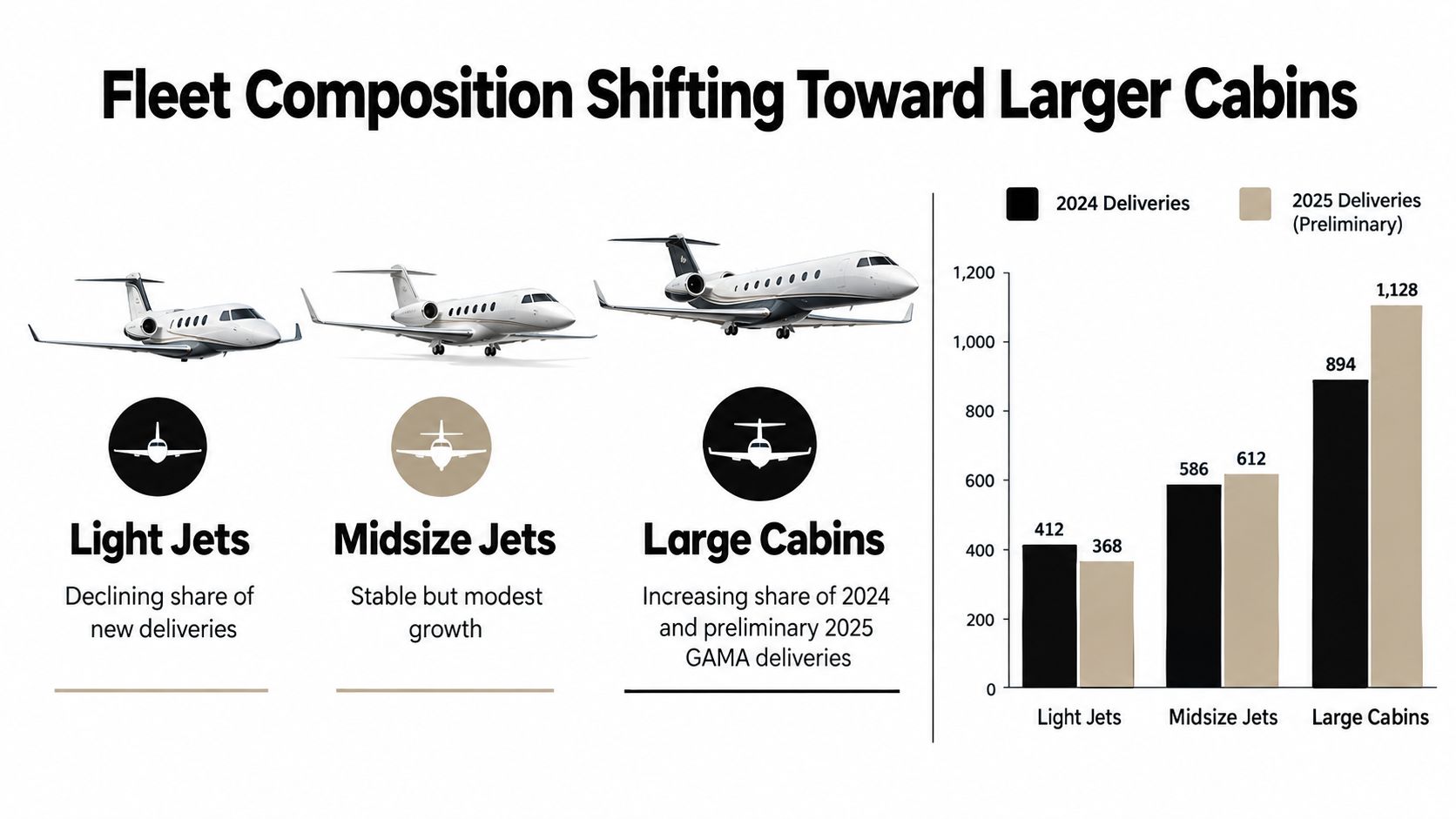
A wider mix of high-end aircraft can give charter providers more options for long-distance missions, larger groups, and cabin-specific requests. But the available charter pool depends on which aircraft owners make available, where those aircraft are positioned, and whether they're free for the requested dates. A production increase doesn't automatically translate into a matching increase in local charter supply.
As travelers compare aircraft, the category name alone may not be enough. Range, payload, cabin layout, and onboard requirements all shape whether a jet is suitable. Buyers looking to understand how aircraft production and specialized manufacturing fit into the wider aviation supply chain can consult this overview of American Additive Manufacturing aviation.
The most useful takeaway is not that large cabins are always the right choice. It's that aircraft capability is becoming a more important part of sourcing. A buyer who specifies the actual mission, rather than asking only for a broad category, gives a provider more room to find an aircraft that fits without paying for capacity the trip doesn't need.
SAF and Sustainability Adoption Versus Reality
Sustainability has become a real aircraft-selection consideration, but the available fuel supply puts limits on what a charter buyer can accomplish today. In Honeywell's 2025 operator survey, 81% of respondents considered more fuel-efficient aircraft and engines at least moderately effective for meeting sustainability goals. Among operators taking proactive steps, 60% were acquiring more fuel-efficient aircraft, 56% were using sustainable aviation fuel (SAF), and 31% were flying at more efficient cruise speeds (Honeywell's 2025 business-jet outlook).
Those actions aren't interchangeable. Efficient aircraft and engines reduce fuel burn per nautical mile, and operators can trade some block-time performance for lower consumption by optimizing cruise speeds. SAF's climate benefit depends on its feedstock and production pathway, so a lifecycle-emissions claim isn't the same thing as a direct reduction in emissions from a particular flight.
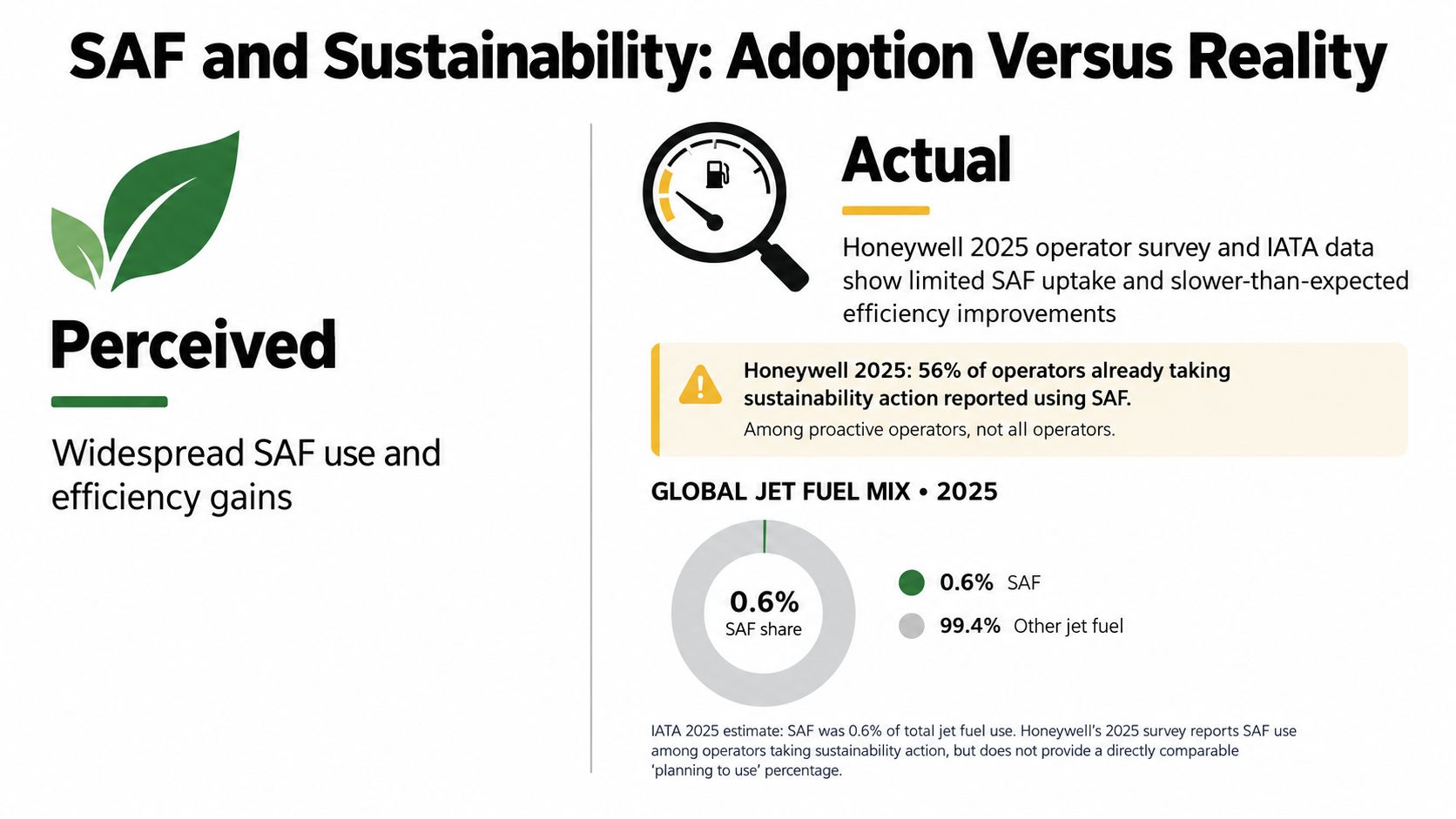
Supply is the hard constraint. IATA projected 2025 SAF production at 1.9 million tonnes, roughly 0.6% of total jet-fuel consumption, while industry updates put current SAF at less than 0.1% of global jet-fuel supply (IATA sustainability information). These figures use different measures, but both show why a general promise of “green fuel” doesn't establish that SAF will be available for a specific charter flight.
A better booking conversation starts with specifics. Ask the operator about estimated fuel burn for the aircraft and mission, whether SAF can be supplied at the relevant airport, and how any emissions claim is calculated. If the claim relies on a certificate or book-and-claim accounting rather than fuel physically supplied to the aircraft, ask the provider to make that distinction clear. For a fuller explanation of fuel pathways and their trade-offs, see Haute Jets' guide to what sustainable aviation fuel is.
Matching aircraft size, range, and payload to the trip can also avoid needless fuel use. A sustainability claim is more credible when it identifies what will happen on the flight, rather than relying on a broad label.
Regional Demand Divergence and Route-Level Implications
Global activity can rise while specific regional markets move sideways. WingX recorded approximately 860,000 global business-jet and turboprop flights in January and February 2025, up 2% year over year. January was reportedly the busiest January on record, but the U.S. and Europe did not follow the same pattern: U.S. business-jet departures were up 3%, while European activity was broadly flat and remained well below its post-2022 peak in some measures (WingX and BBGA 2025 market data).
That difference matters at the booking level. A global total can look healthy even when a particular departure city has fewer suitable aircraft or weaker local demand. Reports also identified especially strong growth in Brazil, Colombia, Venezuela, the Philippines, and Japan, a reminder that demand worth tracking isn't limited to the familiar U.S.-Europe corridors.
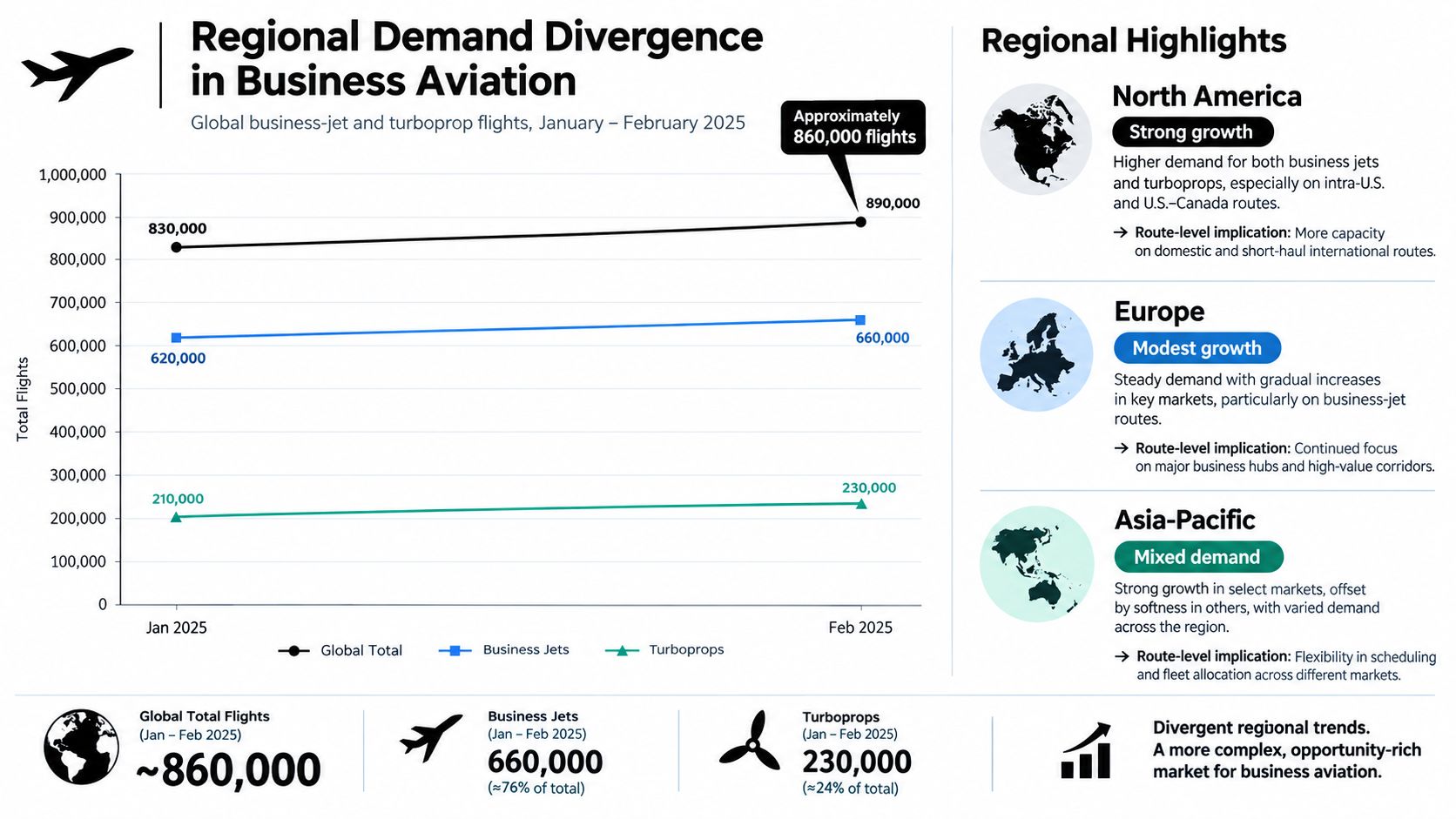
Regional divergence makes aircraft location as important as aircraft type. A jet based near the departure airport may avoid an unnecessary repositioning leg, while a suitable aircraft based farther away may add time and cost before the passenger even boards. The right sourcing pool therefore changes with the route, local supply, and mission requirements. Buyers planning travel in Japan, for example, may also need to weigh the private-flight option against ground and commercial-air alternatives; this guide to the best way to reach Hokkaido provides useful context for that decision.
A provider shouldn't infer route-level availability from global growth alone. Ask where the proposed aircraft is based, whether it needs to reposition, and whether an alternative departure time or nearby airport would open up a more suitable local option. Those details convert broad market trends into a quote that reflects the actual trip.
Empty-Leg Economics and the Repositioning Premium
An empty leg is a flight an aircraft must make without passengers, often because it's moving to meet a later booking or returning after a one-way trip. A traveler may be able to use that flight, but the itinerary is constrained by the aircraft's existing schedule. That's different from a charter quote that includes the cost of moving an aircraft into position before the passenger's trip.

When a broker or jet-card program needs to reposition an aircraft to serve a booking, that ferry leg can raise the charter price. The supplied Haute Jets service information describes repositioning fees as inflating prices by 20–40% in traditional broker and jet-card programs. The precise effect depends on the aircraft's location and itinerary, so buyers should ask whether a quote includes a ferry leg rather than assume every one-way trip carries the same cost.
The sourcing question is therefore geographic as well as operational. If an appropriate aircraft is already near the departure city, a provider may avoid or shorten the repositioning leg. If the nearest suitable aircraft is far away, a lower headline rate may not reflect the total trip cost once the aircraft's movement is included.
For a practical explanation of how these flights work, see the guide to empty-leg flights. Before accepting an empty-leg offer, check that its departure time, destination, and schedule flexibility match the trip. A low fare doesn't make it a substitute for a charter itinerary if the aircraft must operate on a fixed repositioning schedule.
Local sourcing can change the economics without changing the mission. When comparing proposals, ask for the aircraft's location, any ferry segment, and whether another locally based aircraft can meet the same cabin and range requirements.
Safety Audits as a Procurement Filter, Not a Buzzword
Third-party safety ratings are useful only when buyers treat them as a way to screen operators, not as a substitute for asking how the flight will be operated. Wyvern Wingman and ARGUS Gold or Platinum ratings are presented by Haute Jets as the highest third-party safety audit standards in private aviation. Its service information says its operator network is limited to operators holding one of those ratings.
A buyer can use that information in a practical way. Start by asking which operator will perform the flight and whether the rating applies to that operator, rather than assuming an aircraft listing itself establishes the operator's status. Request the audit reference or other verification details so the rating can be checked as part of the booking decision.
A safety rating should be a gate, not a decoration on a quote.
Ratings can help focus comparisons, but they don't replace the rest of the procurement conversation. Confirm the aircraft, crew, and operational details for the proposed trip, and clarify who is responsible for the flight. If a quote changes operators or aircraft, confirm that the new arrangement still meets the buyer's stated standards.
A restricted sourcing pool may reduce the number of options available for a particular departure city or date. That's a real trade-off, especially when the route is unusual or the timing is tight. For many corporate and high-net-worth missions, however, starting with audit-rated operators gives buyers a clearer quality threshold before comparing price and cabin fit.
Haute Jets describes its operator network as using Wyvern Wingman or ARGUS Gold/Platinum-rated operators; buyers can review its private aviation safety guidance when deciding how to verify safety information during a charter search. The useful question is not whether a provider displays a rating. It is whether the buyer can confirm which operator holds it and whether that operator is the one assigned to the flight.
Fintech, Crypto, and Operator Modernization
Digital payment options are a niche feature of charter, not a universal change in how private flights are bought. They matter most to crypto-forward travelers and some corporate clients who value faster invoicing, digital escrow, or multi-currency settlement. For those buyers, the main benefit is payment flexibility and transaction handling, not anonymity.
The evidence provided for this topic doesn't establish how widely operators accept digital assets, or how quickly adoption is growing. It's more accurate to treat crypto payments as a signal that some operators are adapting their back offices to serve customers with different settlement preferences, rather than a defining trend across the whole charter market.
Payment tools can make a frequent charter program easier to administer when they support clear invoices and reliable reconciliation. But they don't answer the core operational questions: which aircraft will fly, where it is based, what the itinerary costs, and who is responsible for the flight. A modern checkout process is useful only if it accompanies transparent service and booking terms.
Travel managers assessing digital payment methods can use this 2026 fintech payment guide as background on the broader payments market. Before adopting a new settlement method, confirm how the provider records the transaction, handles refunds or itinerary changes, and documents the final cost for accounting.
Fintech adoption is best understood as one part of operator modernization. It may indicate greater flexibility in customer service, but buyers should evaluate that flexibility through the entire booking process, from quote and aircraft confirmation to final settlement.
What These Trends Mean for Charter Buyers in 2026
The market signals point to a practical buying approach, not a single aircraft class or payment method that suits every traveler. U.S. demand remains above its pre-pandemic baseline, aircraft deliveries are adding capability, SAF supply remains limited, and regional activity varies. Those facts make a disciplined sourcing process more useful than choosing by headline trend.
Price against the market. Treat the higher post-pandemic U.S. activity level as context for availability, not as a guarantee that a specific route will be tight. Compare quotes with the aircraft's location and any repositioning included.
Specify the mission before choosing a cabin. Tell the provider the route, passenger needs, range, payload, and cabin requirements. A larger jet isn't automatically better; it has to fit the trip.
Ask for evidence behind sustainability claims. Request fuel-burn information for the proposed aircraft and ask whether SAF is available for the specific flight. Clarify whether any emissions claim concerns physical fuel or lifecycle accounting.
Make safety ratings a procurement filter. Identify the operating company, verify its Wyvern Wingman or ARGUS Gold/Platinum status, and confirm that the rated operator will perform the trip.
Compare local sourcing with repositioning. Ask where the aircraft is based and whether a nearby alternative can serve the same mission. A locally sourced aircraft can avoid or shorten a ferry leg, which may affect the total quote.
The broader conclusion is that a buyer shouldn't treat charter as a fixed menu of aircraft hours. The better question is which suitable, verified aircraft can serve the requested mission from the right location, with clear costs and substantiated operating details. That sourcing-led approach connects the industry's changing demand and fleet mix to what matters at booking.
Haute Jets connects charter buyers with owner-operators and lets them specify the aircraft and cabin they want, without requiring a membership or jet card. For a route-specific search and a quote that accounts for aircraft location, visit Haute Jets.