Last updated October 25, 2026 · By Seth Semilof
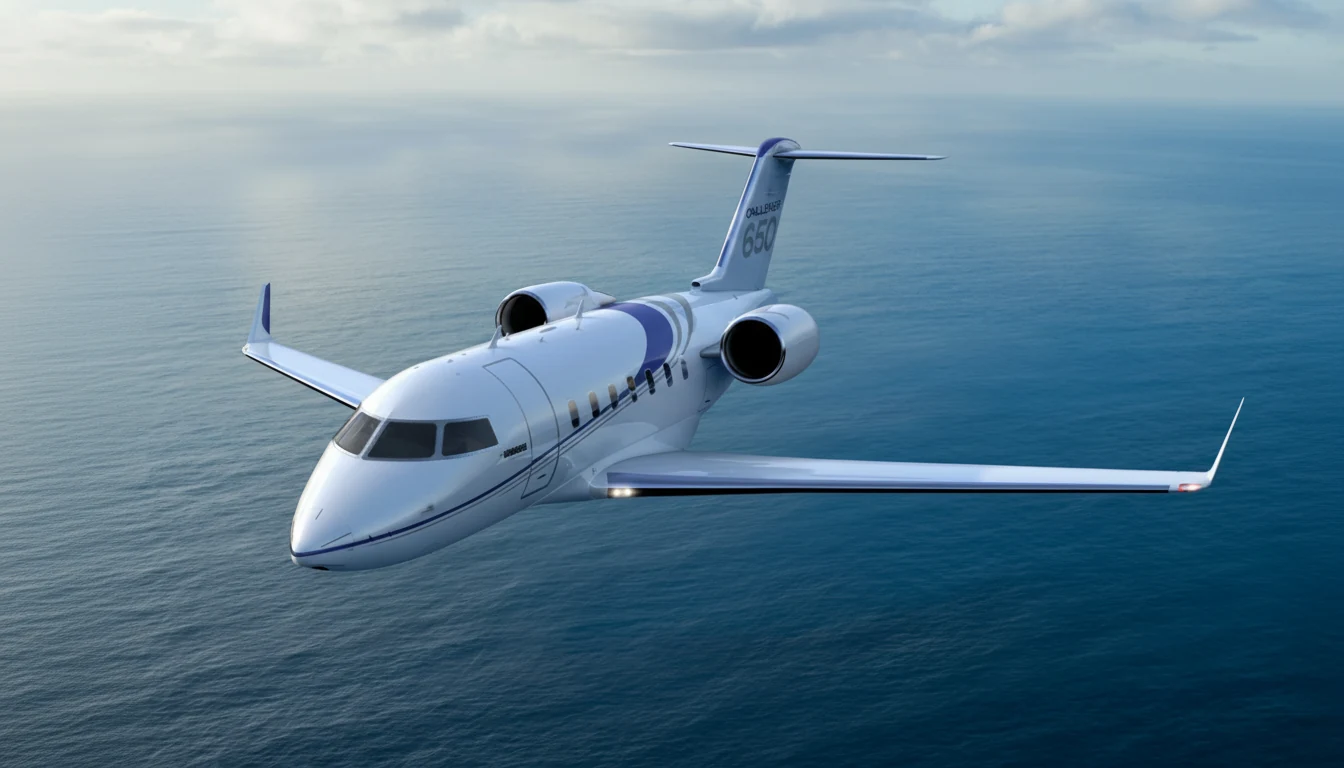
The Challenger 3500 is Bombardier's update of the Challenger 350, one of the most common super-midsize jets in charter fleets. Both use the same airframe, the same Honeywell HTF7350 engines and the same cabin cross-section, so the differences come down to the cabin experience and a modest gain in published range. This review compares the two side by side using Bombardier's published specifications and explains when the difference matters for a charter.
Haute Jets is a private jet charter broker, not an operator. We arrange flights with Wyvern- and ARGUS-rated FAA Part 135 operators, with access to 3,500+ vetted aircraft. No jet cards and no membership fees. Most quotes arrive within 60 minutes.
Challenger 3500 vs Challenger 350: specs side by side
| Spec | Challenger 3500 | Challenger 350 |
|---|---|---|
| Class | Super-midsize | Super-midsize |
| Published range | 3,400 nm (4 passengers, 2 crew, M 0.77, NBAA IFR reserves) | 3,200 nm (8 passengers, NBAA IFR reserves, per Bombardier's launch release) |
| Passengers | Up to 10 | Varies by aircraft layout; confirm with the operator |
| Engines | 2 × Honeywell HTF7350, 7,323 lbf each | 2 × Honeywell HTF7350, 7,323 lbf each |
| Top speed / high-speed cruise | M 0.83 / M 0.82 | M 0.83 / M 0.82 |
| Cabin altitude | 4,850 ft at 41,000 ft | Maximum 7,850 ft at 45,000 ft as originally certified |
| Cabin height × width | 6 ft 0 in × 7 ft 2 in | Same cabin cross-section |
| Cabin length (excluding baggage) | 25 ft 2 in | Same airframe |
| Takeoff distance (SL, ISA, MTOW) | 4,835 ft | 4,835 ft |
| Maximum operating altitude | 45,000 ft | 45,000 ft |
| Signature cabin features | Nuage seats, voice-controlled cabin, 24-inch 4K display, wireless charging | Lufthansa Technik nice HD cabin management system, larger windows than the Challenger 300 |
Sources: Bombardier Challenger 3500 specifications; Bombardier Challenger 350 launch release (2013); Transport Canada CL30 operational evaluation report; aerokurier. Ranges are Bombardier's published figures under different passenger loads, so they are not a like-for-like comparison. Charter aircraft vary by year, options and layout.
What actually changed with the Challenger 3500
Lower cabin altitude
The biggest passenger-facing change is cabin pressure. Bombardier lists the Challenger 3500's cabin altitude at 4,850 ft when cruising at 41,000 ft, which it compares to being on the ground in Denver. Bombardier says that is a reduction of more than 2,000 ft compared with the Challenger 350, and a 31% improvement. A lower cabin altitude is one reason passengers report feeling less tired after longer flights.
One nuance: Transport Canada records a 2021 modification for the Challenger 300/350 type that reduces maximum cabin altitude from 7,850 ft to 5,850 ft at 45,000 ft for affected aircraft. If cabin altitude matters to you on a Challenger 350 trip, ask the operator whether that specific aircraft has it.
Nuage seats and a new cabin
The Challenger 3500 brought Bombardier's patented Nuage seat, first developed for the Global family, into the super-midsize class. Bombardier describes it as the industry's first zero-gravity seat position. The 3500 cabin also adds what Bombardier calls the industry's first voice-controlled cabin, the largest 4K display in its class, wireless phone chargers, and available Ka-band and 4G air-to-ground internet.
More published range
Bombardier lists 3,400 nm for the Challenger 3500 and launched the Challenger 350 at 3,200 nm. But the 3500 figure assumes four passengers and the 350 figure assumes eight, so the real-world gap with a full cabin is smaller than the headline numbers suggest. Both fly the same engines with the same thrust, and both have the same published takeoff distance and ceiling.
What stayed the same
The fuselage, cabin cross-section and flat floor carry over. Bombardier describes the 3500 cabin as the widest in its class at 7 ft 2 in, with 6 ft 0 in of headroom. Speeds, engines, takeoff distance and maximum altitude match. For most passengers, a well-kept Challenger 350 and a Challenger 3500 will feel similar in size; the 3500 feels newer.
Inside the Challenger 3500 cabin
Bombardier's standard Challenger 3500 interior is laid out in three zones. Here is what the manufacturer lists, though individual charter aircraft vary by options:
- Entrance and galley: a galley with an available two-tiered ice drawer, wine chiller and crystal storage, support for an off-the-shelf espresso machine, and a microwave or available high-temperature oven. A wardrobe serves passengers and crew.
- Quiet zones: a sound-insulating entry door, a sliding door between the entrance and the main cabin, and cockpit closeout curtains.
- Main cabin: executive club seating in Nuage seats, concealable side tables, and an available three-place divan that can be made into a bed.
- Fresh air: Bombardier says the air system replenishes the cabin with fresh air in under two minutes, the fastest in its class.
For overnight trips, ask whether the aircraft has the berthing divan and how many passengers can lie flat, as this varies widely between charter aircraft.
Real-world missions for both jets
Both aircraft are built for coast-to-coast trips in the US. With 3,200 to 3,400 nm of published range, they cover routes such as New York to Los Angeles and Miami to the West Coast nonstop in typical conditions. Headwinds, weather, passenger load and baggage all reduce real range, and your operator confirms the plan for each trip.
- Transcontinental US: both are common choices. See our best jets for Los Angeles to New York.
- Transatlantic: on paper, the Challenger 3500's published range covers New York to London nonstop, but the trip depends on winds, load and reserves. See smallest private jets that can cross the Atlantic.
- Ski and event trips: both have short-field performance that suits many resort airports. Read our Aspen ski season guide for ASE's aircraft limits, and our Super Bowl LXI private jet guide.
Which should you charter?
For most trips, the deciding factor is not the model but the specific aircraft: its year, interior condition, Wi-Fi, layout and operator. Here is how we suggest thinking about it.
- Choose the Challenger 3500 if cabin comfort on a long flight is the priority. The lower cabin altitude, Nuage seats and newer connectivity matter most on four-plus-hour legs and overnight trips.
- Choose a Challenger 350 if you want a proven super-midsize cabin with wide availability. There are many more 350s in service, which often means more options on busy dates.
- Either works for most domestic trips of two to five hours with six to eight passengers and normal baggage.
When we quote a super-midsize trip, we list the specific tail number, year of manufacture, operator rating and amenities so you can compare like for like. Read more about the earlier model in our Challenger 350 guide and see the Challenger 350 aircraft page. Comparing a different jet? See Citation Longitude vs Challenger 350 and Citation Longitude vs Citation X.
How to compare two charter quotes
- Check the tail number and year. A Challenger 350 can be a decade older than a new Challenger 3500.
- Ask about the cabin layout. Seat count, divan and berthing options vary by aircraft.
- Confirm Wi-Fi type. Ka-band and air-to-ground systems perform differently, especially over water.
- Confirm the operator's safety ratings. We work with Wyvern- and ARGUS-rated operators.
- Ask about cabin altitude. On a Challenger 350, ask whether the reduced cabin altitude modification is installed.
Get a quote
Request a quote for a Challenger 3500, Challenger 350 or a comparable super-midsize jet, or call (800) 257-5661. Most quotes arrive within 60 minutes.
FAQs
What is the difference between the Challenger 3500 and Challenger 350?
The Challenger 3500 is an update of the Challenger 350 with a lower cabin altitude (4,850 ft at 41,000 ft), Nuage seats, a voice-controlled cabin and a higher published range of 3,400 nm. The airframe, engines, cabin size and speeds are the same.
What is the range of the Challenger 3500?
Bombardier lists a maximum range of 3,400 nm with four passengers and two crew at Mach 0.77 with NBAA IFR reserves. Real range depends on weather, passenger load and options.
What is the range of the Challenger 350?
Bombardier launched the Challenger 350 with a range of 3,200 nm carrying eight passengers. Real range depends on weather, load and the specific aircraft.
How many passengers does a Challenger 3500 seat?
Bombardier lists seating for up to 10 passengers. Many charter layouts seat fewer, so confirm the layout of the specific aircraft with the operator.
Is the Challenger 3500 cabin bigger than the Challenger 350?
No. Both share the same fuselage and cabin cross-section, 7 ft 2 in wide and 6 ft 0 in tall. The 3500's improvements are in the cabin systems, seats and pressurization.
Can a Challenger 3500 fly New York to Los Angeles nonstop?
In typical conditions, yes. Its published range of 3,400 nm exceeds the distance between the two cities, but winds, load and reserves decide each trip. Your operator confirms the flight plan.
Sources
- Bombardier, Challenger 3500 specifications: bombardier.com
- Bombardier, Challenger 3500 brochure (2021), via GlobalAir: globalair.com
- Bombardier, Challenger 350 launch release (May 20, 2013): bombardier.com
- Bombardier, first Challenger 3500 firm order and 31% cabin altitude improvement (2022): globenewswire.com
- Transport Canada, Bombardier CL30 (Challenger 300/350) operational evaluation report: tc.canada.ca
- aerokurier, Challenger 350 specifications: aerokurier.de