
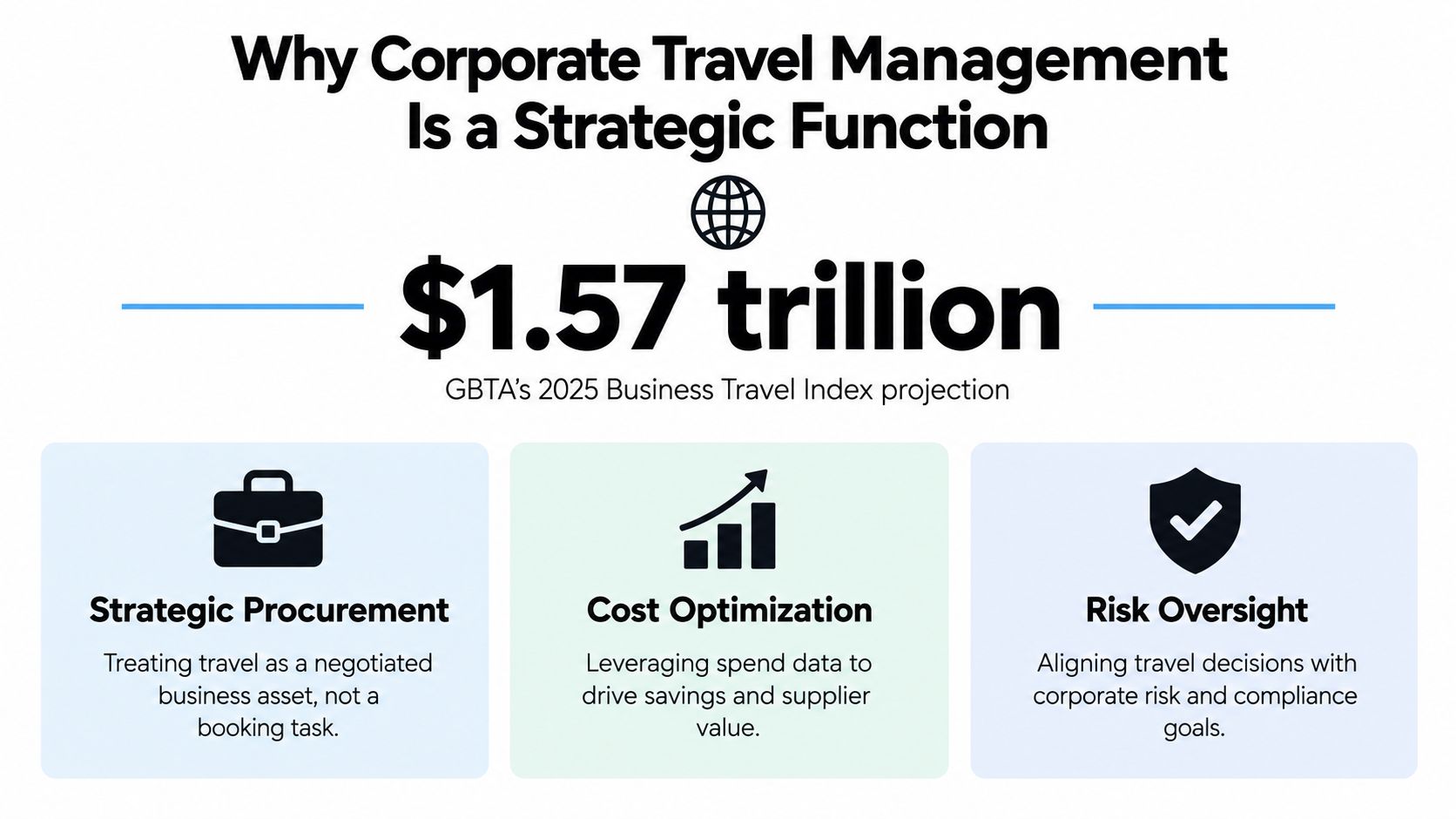
Worldwide business-travel spending was projected to reach approximately $1.57 trillion in 2025, up 6.6% year over year, while inflation-adjusted spending remained expected to be 14% below 2019 levels, according to GBTA's 2025 Business Travel Index. For travel managers, that scale makes an executive itinerary more than a booking to approve. It is a procurement and risk decision: routing, supplier terms, traveler safety, and schedule value must all be weighed. Even choosing an on-demand owner-operator charter to avoid repositioning fees applies the same governance logic at the trip level.
Why Corporate Travel Management Is a Strategic Function
Corporate travel management is procurement with people and operational risk attached. GBTA projects global business-travel spending could exceed $2 trillion by 2029, a scale that makes travel a material purchasing function. Companies make connected decisions across air, lodging, ground transportation, and meetings. A centralized program can consolidate spend, negotiate supplier agreements, track travelers, and monitor policy compliance. Separate employee bookings obscure total trip costs and weaken the company's negotiating position.
The return extends beyond savings. A well-run program helps leaders prioritize trips tied to commercial goals, gives finance a clearer view of commitments, and helps teams locate travelers during disruption. It also provides data for supplier negotiations, policy reviews, and contingency planning. Those capabilities matter when plans change or a time-sensitive meeting is at risk. A program should account for trade-policy uncertainty, geopolitical disruption, and economic volatility, not rely on fixed annual targets alone.
A one-percent slippage in a large program can erode margin. Yet blunt restrictions can also weaken customer relationships or interrupt critical operations. Managers need to weigh the purpose and full cost of each trip, rather than judge it by the ticket price alone.
Program director's rule: Judge a trip by its purpose and full cost, not by the ticket line alone.
The same governance logic applies from the annual supplier contract to one executive itinerary. At program scale, managers assess terms, compliance, and total spend. At trip scale, they compare mission cost, including connection time, ground transfers, and disruption exposure. An on-demand owner-operator charter may avoid repositioning fees, but the decision still depends on the full itinerary cost and operational need. The travel program's job is to apply consistent oversight at both scales.
Building a Travel Policy That Actually Gets Followed
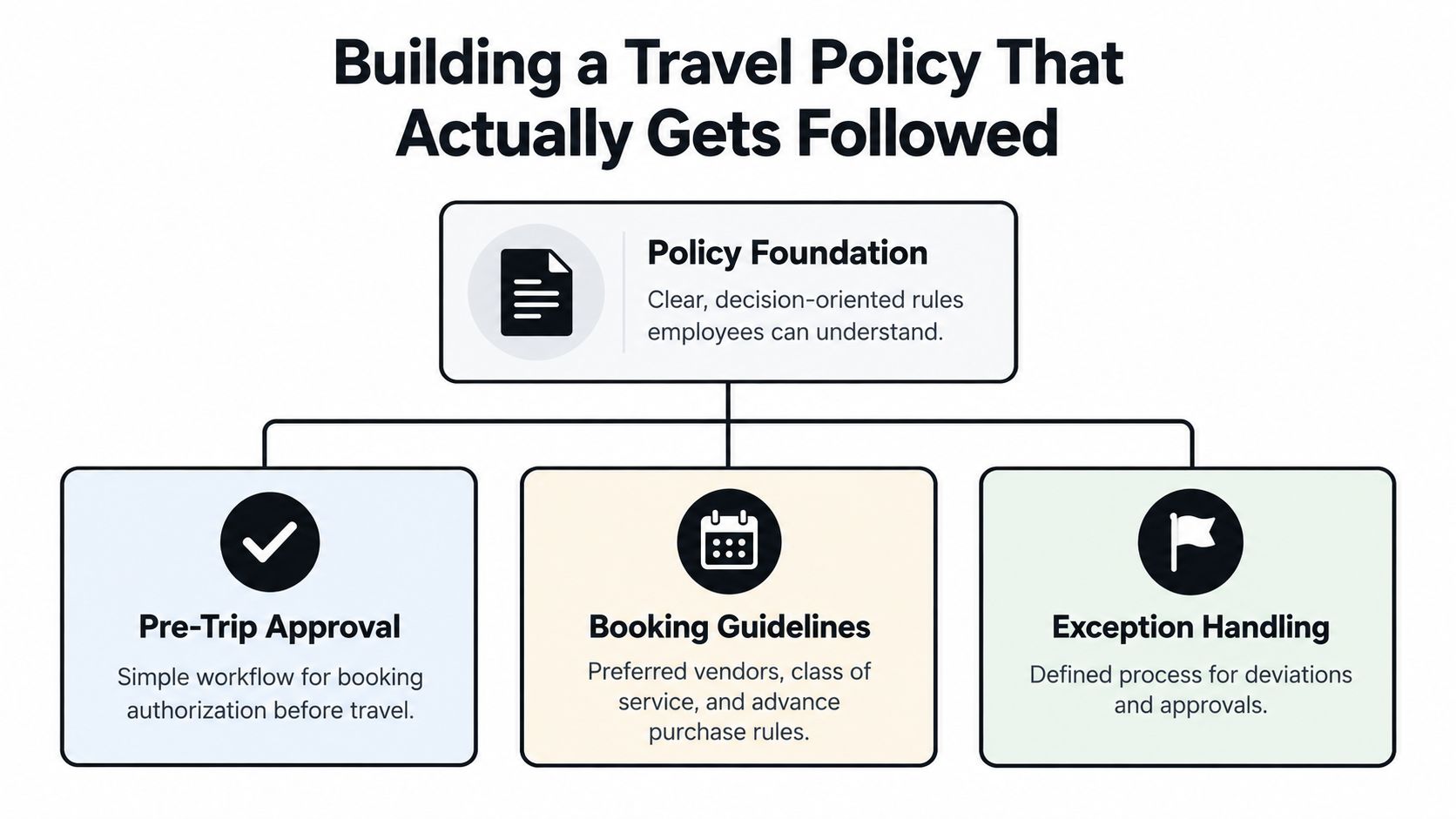
A travel policy works when employees can use it to make a decision while booking. If travelers need to interpret legalistic language or hunt through email threads for approval, they'll route around the process. The policy should translate the company's priorities into a clear workflow, with the booking channel capturing the decision and the reason for any exception.
Set rules by trip value and purpose
Begin with pre-trip approval thresholds tied to business purpose and expected value. A routine internal meeting may follow tighter limits than a client visit tied to a live opportunity. Define preferred suppliers and negotiated rate caps, then state which booking channels employees must use so the company can see the reservation and support the traveler.
Uniform cuts often look simple and prove costly. Deloitte's 2025 corporate travel study found that among companies spending more than US$7.5 million annually on travel, 59% expected budgets to increase, while one in five expected declines (Deloitte's 2025 corporate travel study). That split argues for segmenting travel by purpose, seniority, route economics, and contribution to revenue rather than applying the same reduction to every department.
Make exceptions visible and useful
A good policy doesn't pretend every trip fits a standard case. It defines who can approve an exception, what evidence the approver needs, and how the decision is recorded. For an executive itinerary with limited schedule options, the exception might document the business value and the cost of a missed meeting. For a routine trip, a more expensive option may need a clear operational reason.
Review exception patterns as part of policy maintenance. If employees repeatedly request the same deviation, the rule may be unrealistic or the preferred supplier may not serve the route well. For teams arranging extended stays, a local lodging option such as corporate accommodation Norwich can help compare accommodation needs against the policy's rate and location criteria without treating hotels as the only choice.
The video below offers another view of how travel policy and booking decisions can be organized in practice.
The test is straightforward: can a traveler understand what to do, can a manager approve or decline quickly, and can finance later see why the decision was made? If not, rewrite the workflow before adding more rules.
Forecasting Demand and Governing the Travel Budget
Corporate travel budgets govern a large procurement function, but their value is determined one trip at a time. Deloitte's 2024 corporate-travel study found 73% of travel managers expected corporate travel spending to increase in 2024, while 58% expected growth in 2025. Organizations anticipating increases expected an average rise of 14% to 15% per year (Deloitte's 2024 corporate-travel study). Use those expectations to build a forecast by business purpose, rather than treating the budget as a spending ceiling or approving every request.
Forecast by the work the trip supports
Conference attendance, client development, and executive mobility follow different patterns from routine internal travel. Deloitte's study also found that 63% of business travelers expected to attend at least one conference in 2024, and one in five said they traveled at least monthly for client work or relationship development. A flat cut can reduce outlays while removing trips that support sales pipelines, customer retention, or delivery milestones.
Forecast requests by department, purpose, route, and timing. Review actual activity against the forecast quarterly, separating price changes from volume changes. More trips, higher fares, and time-critical itineraries affect the total differently, so each requires a different budget response.
Measure what the trip produces
Connect travel activity to outcomes. Track cost per productive travel day, policy-exception rate, cancellation leakage, and revenue influenced per travel dollar. For client travel, record whether the meeting occurred and which commercial milestone it supported. For project travel, note whether an on-site visit helped complete delivery or resolve a blocker.
Executive reporting should show where travel was deployed and what outcomes followed, without claiming that travel alone caused revenue. GBTA's 2025 company benchmarking analysis reported an association between managed travel spending and revenue, while cautioning that association does not establish causation (GBTA and ASTA company benchmarking report).
Apply the same governance at the itinerary level. Compare total trip cost with traveler time, schedule flexibility, and disruption risk. When commercial flights cannot meet an executive's schedule, an on-demand owner-operator charter may avoid repositioning fees, but the manager still needs to compare the full itinerary cost against other options. Haute Jets' private jet charter cost information can inform that evaluation. Approvals should follow company rules and reflect the trip's business purpose.
Duty of Care and Compliance Beyond the Booking Record
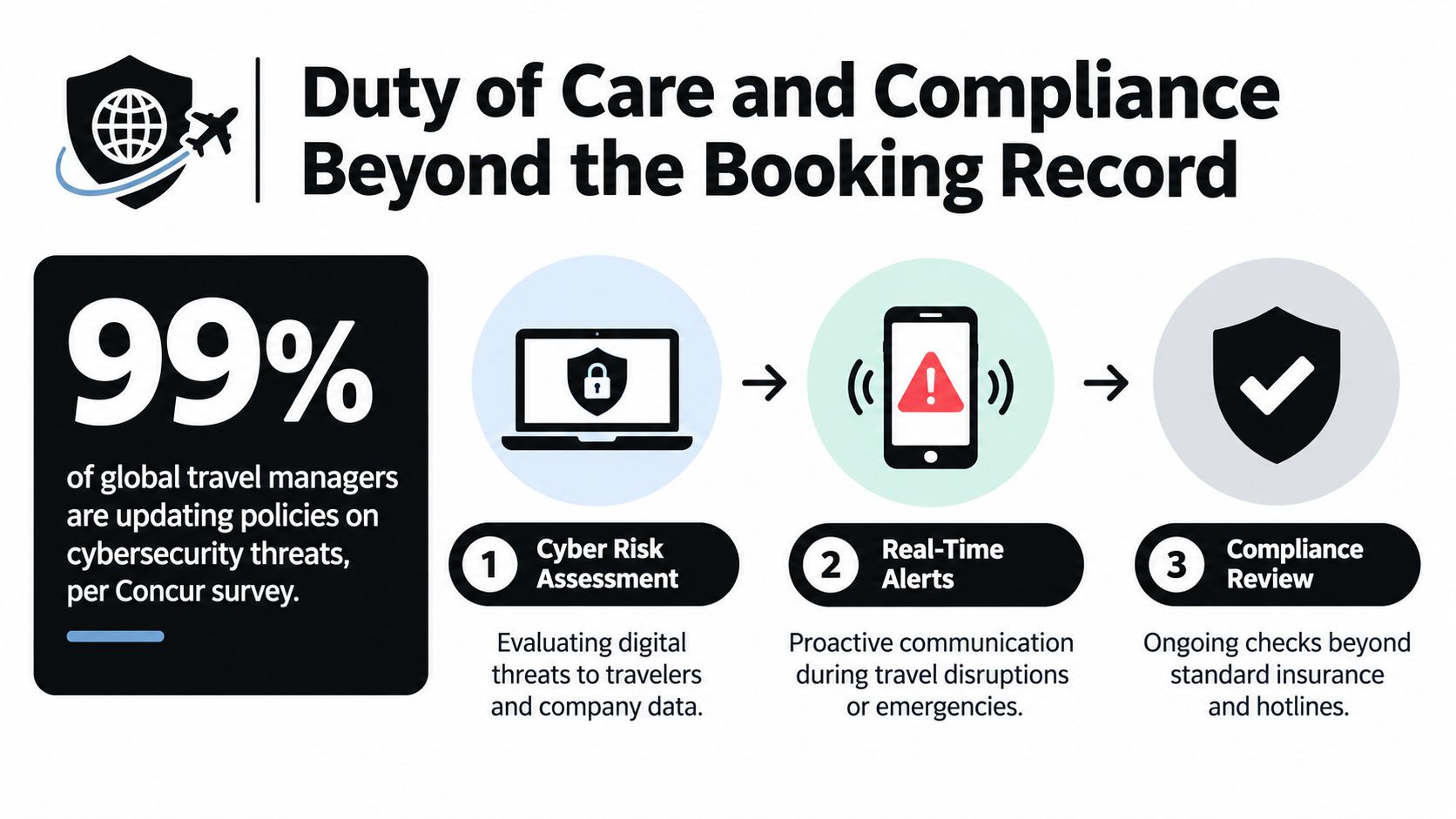
A booking record isn't a complete safety plan. It may show a traveler's flight and hotel while leaving critical gaps about ground transportation, local contacts, or who has authority to change the itinerary. Duty of care requires clear ownership before departure, during disruption, and after an incident.
Concur's survey reports that 99% of surveyed global travel managers said their company had updated, was updating, or was considering updates to policies or training addressing cyber threats during international travel. The same report says 53% of CFOs saw traveler safety as a priority opportunity, while geopolitical conflict and employee reluctance to travel each affected 45% of companies (Concur's survey on travel managers). Those concerns call for operating controls, not a hotline in a policy document.
Build checkpoints around the journey
Before travel: Approve the trip's risk level and verify provider credentials. Confirm the passenger list, itinerary, local contacts, and traveler communication preferences. For nonstandard transport, make sure the company has the operator and vehicle details it needs, rather than relying on a generic reservation record.
Before departure: Set a defined confirmation point. For a charter itinerary, that may include the tail number, crew information, weather briefing, and passenger manifest. For ground transport, confirm vehicle and driver details through the provider. Keep privacy rules explicit: collect and share only information needed to support safety and operations.
During and after travel: Assign a named owner for disruption decisions, including who can approve rerouting and how the traveler can reach that person. Record changes and incidents after the trip so the company can improve its response. A tool such as the 3rd-i app for airport safety may be relevant to an employee's personal airport-safety planning, but it doesn't replace the company's provider checks or escalation process.
Control point: Visibility is useful only if someone is responsible for acting on it.
For companies assessing private aviation, a written process should specify how safety standards are checked and who receives operational updates. Haute Jets' private aviation safety practices can inform that evaluation alongside the company's own requirements. The goal is to make every travel mode fit a consistent duty-of-care framework.
Commercial Aviation, Fractional Ownership, and Jet Cards Compared
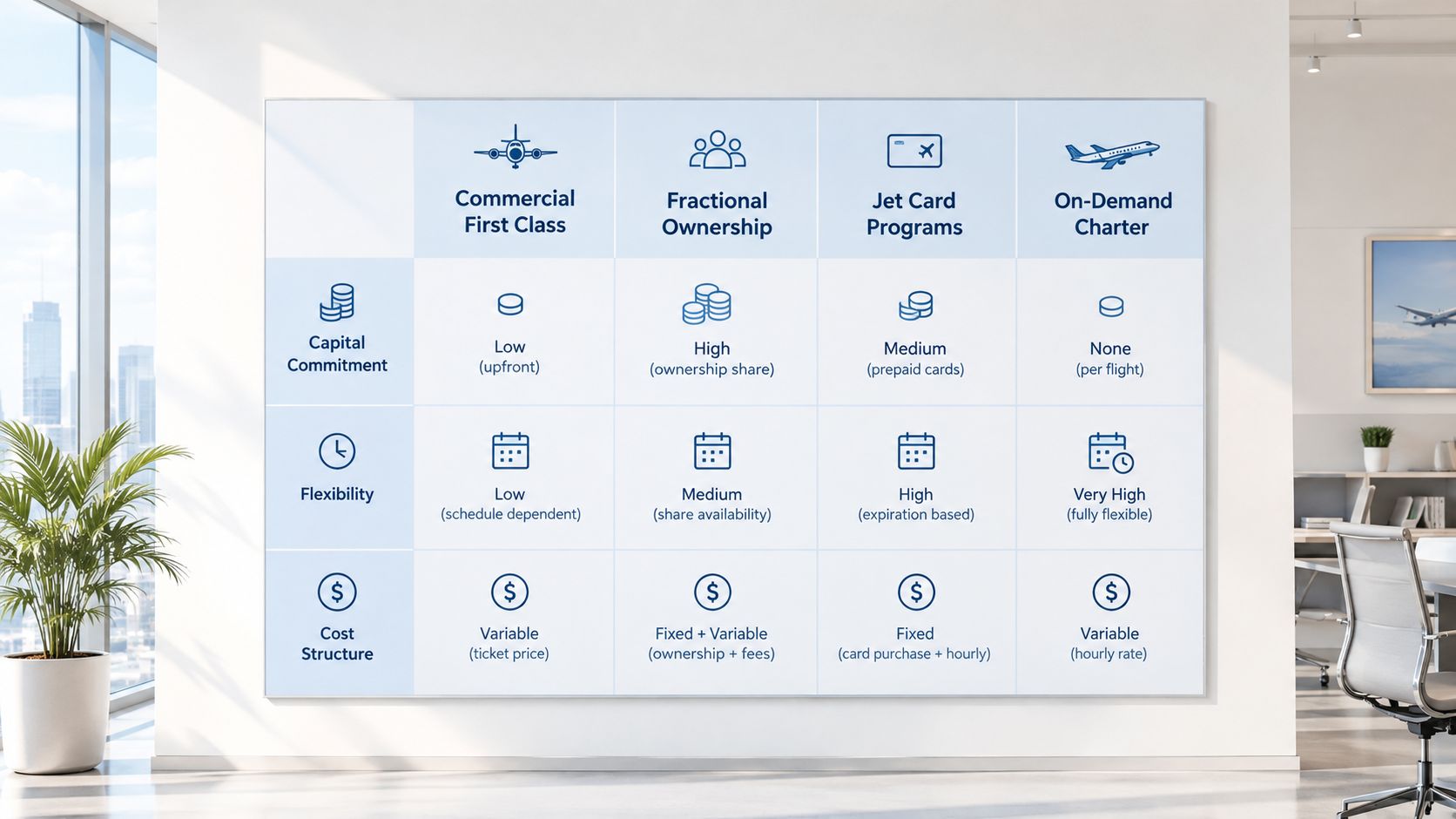
Travel managers should compare aviation options using the same questions they apply to other suppliers: What capital must the company commit? How predictable is the cost? How much control does the traveler have over timing and routing? What happens when plans change?
| Option | Cost structure | Flexibility | Best fit |
|---|---|---|---|
| Commercial first class | Pay for each ticket; typically the lowest per-trip cost among these choices | Broad airline schedules, limited routing control | Predictable routes with workable schedules |
| Fractional ownership | Significant ownership commitment and ongoing obligations | Access depends on the program and aircraft availability | Frequent, repeatable use that supports ownership economics |
| Jet card | Prepaid hours or program commitment | May include program rules, availability limits, or blackout dates | Recurring travel where defined terms and access matter |
| On-demand charter | Pay for the specific flight booked | Route and aircraft selection can be matched to the itinerary | Irregular, time-sensitive, or unusual missions |
Commercial first class usually wins on per-trip price and airline frequency, but the traveler must work within the airline network. Fractional ownership and jet cards can suit repeat use, yet their commitments make the economics less attractive when utilization is uncertain or schedules vary. Before signing, examine termination terms, aircraft substitutions, blackout rules, and how a last-minute change affects the total cost.
On-demand charter avoids recurring membership or prepaid-hour requirements when the company books a single trip. Haute Living reported that Haute Jets operates on an on-demand basis, allowing travelers to book without annual commitments, prepaid hours, or blackout-date restrictions (Haute Living's report on Haute Jets). For a travel manager, that model is easier to assess when the need is occasional: price the actual itinerary, then compare it with the cost and operational consequences of the alternatives.
The comparison changes when a jet card sits idle or a commercial itinerary adds connections that make the business schedule impractical. Neither premium aviation nor first class is automatically the right answer. The decision should reflect utilization, total trip cost, timing, route access, and the business consequence of arriving late or missing the meeting.
For companies that need a broader view of how aviation fits into travel planning, corporate aviation solutions offers a starting point for reviewing the operational choices.
How On-Demand Private Aviation Fits a Corporate Program
A charter quote can look competitive or expensive for reasons that have little to do with the passenger's route. If the aircraft has to fly empty to reach the departure airport, repositioning can add a material cost. The central sourcing question is whether a suitable aircraft is already near the origin, not just what aircraft category appears on a quote.
Haute Jets says its network draws on more than 3,500 aircraft across 175 countries, sourced from owner-operators, and that local sourcing can avoid repositioning fees that inflate traditional charter prices by 20–40%. Those are provider claims, so a travel manager should verify the operator, aircraft, and full quote for each mission rather than assume every route delivers the same economics. A sound comparison includes the aircraft's location, repositioning, ground transfers, schedule risk, and passenger time.
Use charter for defined operational triggers
On-demand charter belongs in a managed program when the trip has a clear operational case. Consider it when a canceled commercial flight leaves an executive unable to make a critical meeting, when a multi-city day could otherwise require extra hotel nights, or when a production or event team needs to move together. Confidential travel may also warrant a different departure process, depending on the traveler's security and privacy needs.
The program should set eligibility criteria before a disruption occurs. Name the approver, define what information the quote must include, and require a comparison against feasible commercial alternatives. That stops “urgent” from becoming a blanket exception and gives finance a record of why the company chose the itinerary.
Treat operator screening as a policy control
Aviation sourcing can also be governed through provider requirements. Haute Living describes Haute Jets' network as having access to more than 3,500 aircraft, with each aircraft carrying a Wyvern or Argus rating (Haute Living's fleet and ratings report). A corporate policy can specify acceptable third-party standards, while still requiring the travel team to confirm the exact operator and aircraft for each booking.
That distinction matters: a network-level screening threshold doesn't remove the need to review trip details. Managers should verify the confirmed aircraft, crew, passenger manifest, ground arrangements, and escalation contacts through the company's duty-of-care process. On-demand charter then becomes a governed sourcing option for trips where schedule and routing justify the premium, not an ad hoc luxury purchase.
Sustainability, Productivity, and the Charter Trade-Off
Sustainability rules lose credibility when a company asks employees to reduce emissions but can't compare the actual itinerary choices at booking time. Deloitte's 2025 research found that the share of travel managers prioritizing airlines that use sustainable aviation fuel rose from 33% in 2024 to 43% in 2025, while organizations tracking SAF use fell from 48% to 25% and those tracking carbon emissions per flight fell from 38% to 30% (Deloitte's 2025 corporate-travel survey). Stated priorities and usable measurement are moving in different directions.
A practical program needs a route-level scorecard. Compare total travel time, estimated emissions, available aircraft or carrier data, SAF availability, ground-transfer distance, cancellation exposure, and the business value of attendance. Record why the selected itinerary won, especially when a lower-fare option includes extra connections or a greater chance of disrupting the meeting.
That doesn't mean a charter flight is more sustainable than commercial travel. It means a travel manager should evaluate the actual mission rather than relying on labels such as “premium,” “direct,” or “low fare.” A shorter charter itinerary may protect productive hours and reduce disruption exposure, but the company should document emissions and passenger utilization before treating that trade-off as justified.
Scheduling is part of the same calculation. Teams coordinating meeting windows and travel can use this schedule optimization resource to think through how itinerary timing affects the working day. Bring that schedule evidence together with cost, safety, and emissions data, then apply the same governance logic used for other supplier decisions.
Haute Jets arranges on-demand private charter flights and can support corporate travel teams evaluating flexible aircraft sourcing for specific itineraries. Review your program's routing, approval, and safety requirements, then visit Haute Jets to discuss a trip that needs a more direct or adaptable option.