

Stop shopping for the cheapest category on a private jet from Miami to LA and calling that a plan. That popular advice fails on this route because the cheapest quote often buys a jet that can't carry your passengers, bags, and reserve fuel nonstop into westbound winds. You're not buying cabin photos. You're buying range margin, the right airport pair, and a legal operator. Get those three wrong and the low price becomes a fuel stop, a longer drive, or a rebooked aircraft.
Why a Miami to LA Jet Is a Range Decision
A nonstop private jet from Miami to LA runs roughly 5 hours in the air over approximately 2,034 to 2,035 nautical miles between Miami-Opa Locka Executive Airport (OPF) and Van Nuys Airport (VNY), or about 2,341 to 2,342 statute miles, according to the Miami to Los Angeles route distance and flight time data. Treat that as a true transcontinental mission, comparable in planning discipline to a New York to Los Angeles run. It's not a regional hop where almost any jet works.
Use a fuel gauge analogy. A short hop is a drive to the grocery store, where a quarter tank is fine. This route is a drive across a state with few gas stations you trust, so you start by asking whether the vehicle reaches the destination with reserve, not whether the seats look good. Aircraft range, fuel margin, and weather performance decide whether private aviation delivers its main benefit here, a nonstop arrival at a general aviation airport instead of a large airline terminal.

Why Westbound Takes Longer
Direction matters because prevailing upper level winds commonly move from west to east. One route estimate places Miami to Los Angeles at approximately 5 hours 25 minutes and the eastbound return at about 4 hours 40 minutes under typical conditions, using the same source cited above. Published estimates also vary from about 5 hours 00 minutes to 5 hours 48 minutes depending on aircraft category, winds, routing, and whether taxi, climb, and descent are counted.
Don't argue over a single headline time. Ask which definition the quote uses, wheels up time or block time, and whether it assumes your actual load. From here, judge every option by three variables only. First, can the specific aircraft fly the distance nonstop with reserves. Second, does the airport pair shorten your total trip. Third, what's the actual door to door time once ground handling and driving are included.
Choose the jet for the westbound wind and your full load, not for the brochure range on a calm day with an empty cabin.
Which Jets Fly Miami to LA Nonstop
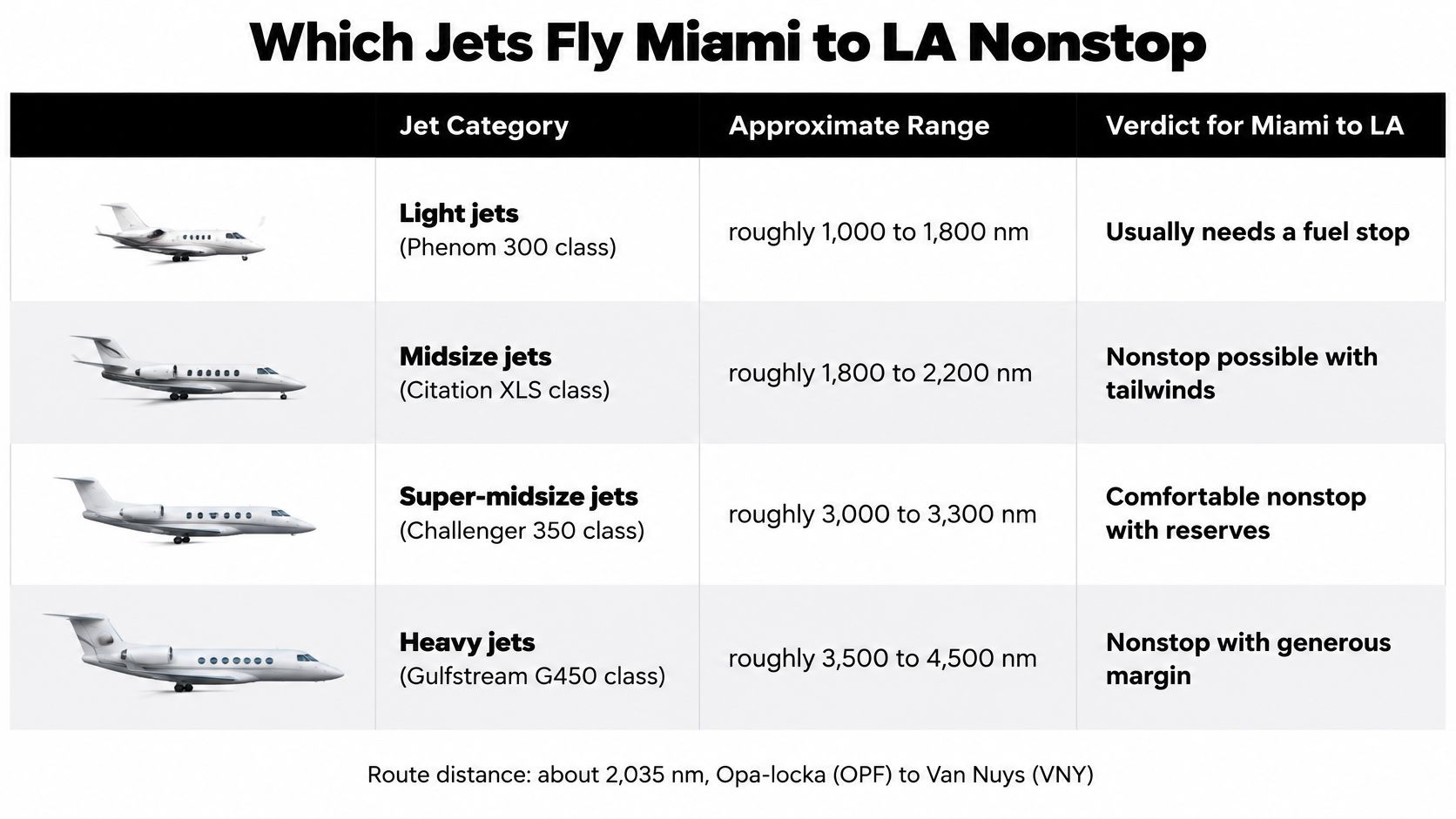
Verdict first, then check your load against it. Super-midsize jets and larger are the reliable nonstop choice for this route. Light jets lack the legs for it, and midsize jets sit in the marginal zone where passengers, bags, pets, and headwinds can force a fuel stop.
Nonstop feasibility by jet category, Miami to LA
| Category | Example aircraft | Range position vs. this route | Miami to LA nonstop? |
|---|---|---|---|
| Light jet | Phenom 300 class | Below the route distance even at maximum published range | No, fuel stop required |
| Midsize jet | Citation XLS class | At the edge, your load decides | Marginal, may need a fuel stop |
| Super-midsize jet | Challenger 350, Citation Latitude | Comfortable margin with a normal load | Yes, with planned load and reserves |
| Heavy jet | Gulfstream G550 class | Large margin | Yes, strong margin |
| Ultra-long-range jet | Gulfstream G650 class | Largest margin | Yes, largest margin |
The route itself explains the split. The Miami to Los Angeles leg runs approximately 2,034 nautical miles (about 2,341 statute miles), with typical nonstop airborne time of about 5 hours 00 minutes to 5 hours 48 minutes, according to the MIA to LAX route distance and timing data. Plan fuel and schedule against the flown distance: airways routing, weather deviations, and traffic sequencing all stretch the actual track past the direct line.
The Payload Range Trade-off You're Actually Buying
A jet doesn't lose range in the abstract. It loses usable margin when you add weight and when the crew must protect reserve fuel for a diversion. Six adults, checked bags, golf clubs, production cases, or a large pet can move a marginal midsize jet from nonstop on paper to a technical stop in practice. Westbound headwinds and seasonal weather then shrink that margin further.
That's why category level answers are useless on this route. A seller who says a midsize jet flies Miami to LA hasn't answered your question. Your question is narrower and more useful. Will this specific tail number fly OPF to VNY nonstop on your date, with your passengers, your baggage, your pets, and required reserves if winds are unfavorable.
- Light load, flexible timing: A midsize jet may work, but only if the operator confirms planned load range in writing and you accept a possible fuel stop.
- Full cabin or fixed arrival: Book super-midsize or larger and remove the fuel stop risk from the itinerary.
- Heavy bags or cabin space priority: Move to a heavy jet for margin, baggage volume, and a calmer five hour cabin plan.
- Ultra-long-range request: Pay for it when you want the largest range buffer and cabin; the route doesn't require that class in every case.
What to Ask Before You Approve the Aircraft
Ask for the planned load range of the specific tail number instead of the category brochure figure. Ask whether the quote assumes a fuel stop, what payload limit applies at departure, and how the operator handles a stronger than forecast headwind. If the answer stays vague, treat the quote as not comparable.
Practical rule: If an operator can't state the nonstop payload limit for your exact passenger and bag count, don't compare that price against a confirmed nonstop super-midsize quote.
My recommendation is direct. Default to super-midsize for a serious nonstop private jet from Miami to LA with a normal load. Choose heavy when the cabin is full, bags are substantial, or arrival time can't slip. Use midsize only with a light load, favorable conditions, and written confirmation. Skip light jets entirely on this leg.
Choosing Between OPF, VNY and the Major Airports
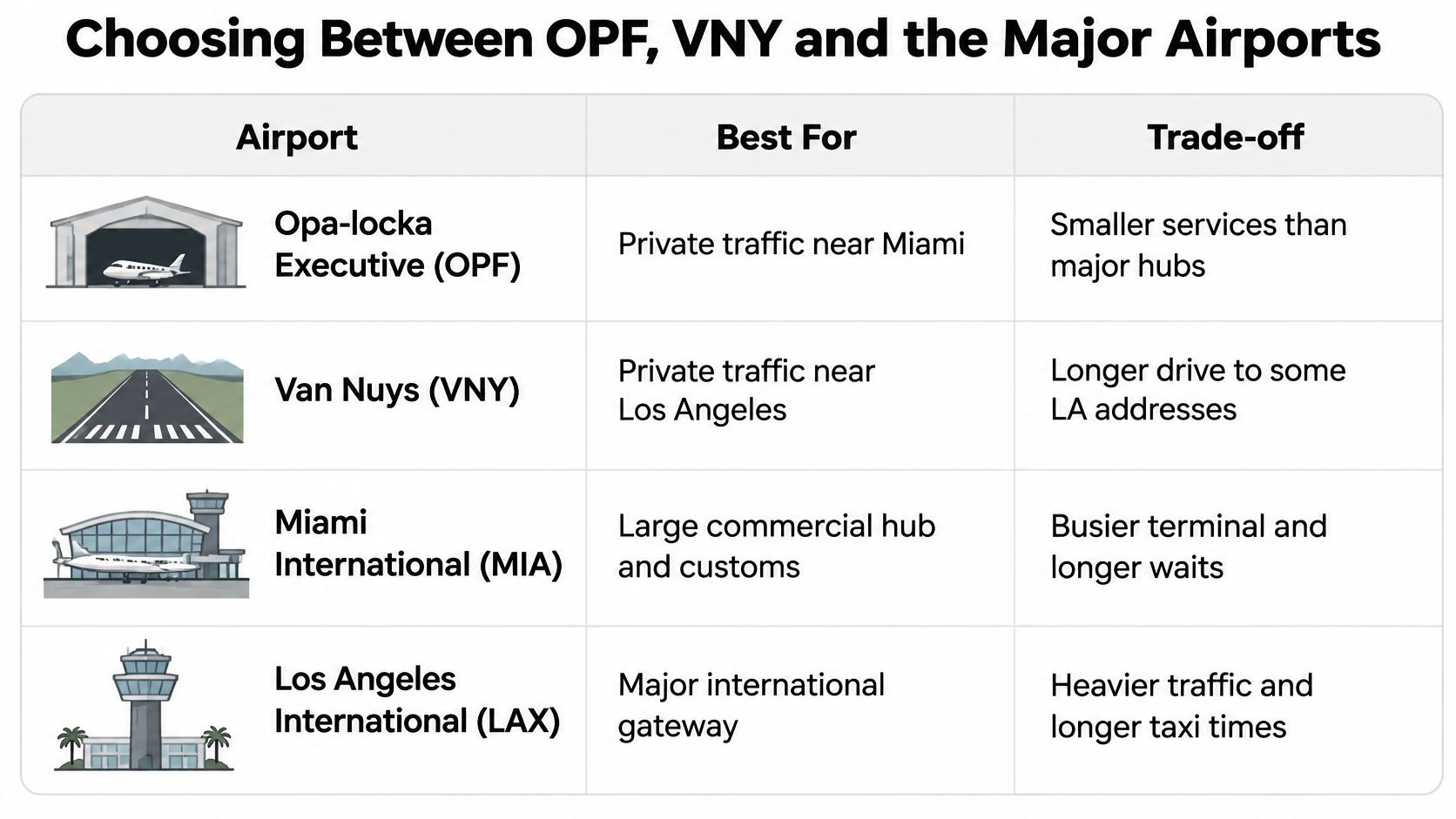
Do not book OPF to VNY on autopilot. It is often the right pairing, but the right pairing depends on your street address at both ends and the total door to door time, not on which airports carry the biggest private aviation reputations. Private aircraft can use FBO based facilities at Miami-Opa Locka Executive (OPF) and Van Nuys (VNY) instead of relying only on Miami International (MIA) and Los Angeles International (LAX), as explained in this guide to FBO private jet terminals. That choice changes ground handling, ramp access, and driving time, not just the flight map.
Airport pairings for a private Miami to LA trip
| Airport pair | Miami end | Los Angeles end | Best fit |
|---|---|---|---|
| OPF to VNY | Opa-locka Executive (OPF) | Van Nuys (VNY) | Often the first pairing to check for Valley or central LA plans |
| MIA to LAX | Miami International (MIA) | Los Angeles International (LAX) | Large-hub handling, often longer ground time |
| OPF to LAX | Opa-locka Executive (OPF) | Los Angeles International (LAX) | Strongest when your LA destination sits near LAX or the coast |
| MIA to VNY | Miami International (MIA) | Van Nuys (VNY) | A Miami origin near MIA paired with a Valley destination |
Booking activity adds useful context, though it does not pick your airport for you. One industry dataset ranked Opa-locka second among the busiest U.S. private jet airports in 2026 with 242 recorded flights and activity 62% higher year over year, while Van Nuys ranked third with 182 flights and 27% growth, according to the ranking of the busiest private jet airports in the US. The same material puts Opa Locka at 67.1% of tracked Miami area empty leg listings and Van Nuys at 68.8% of tracked Los Angeles area listings, compared with 4.4% for LAX. Read those figures as a signal of where charter supply and pricing competition concentrate. They say nothing about which airport shortens your specific trip.
Ground Time Decides More Than Airborne Minutes
An FBO can streamline ramp access, fueling, catering, and ground transport because the facility is built for general aviation. Fast handling on the ramp does not guarantee a fast trip. Congestion, curfews, runway availability, handling capacity, and the distance from the arrival airport to your final Los Angeles address can outweigh a small airborne advantage.
Airport choice works like a highway exit. The exit nearest your destination beats the largest interchange, even if the interchange looks more important on the map. If your meeting, hotel, residence, or production site is poorly served by Van Nuys, price an alternative. Travelers comparing options on the Los Angeles end can work through the Los Angeles private jet charter guide before requesting quotes.
My advice is concrete. Request two pairings every time, such as OPF to VNY and OPF to LAX or MIA to LAX, then compare total itinerary time and price on the same aircraft basis. Private charters can use smaller regional airports closer to a final destination and avoid lengthy commercial airline transfers, a point covered in this overview of private jet destinations for business and leisure. Use that flexibility deliberately, then lock the exact airport and FBO in the confirmation.
What a Miami to LA Charter Costs by Jet Category
Expect the useful nonstop conversation to start around the super-midsize level, even if a midsize headline looks cheaper. One published route table lists approximately $31,700 for a midsize jet, $35,000 for a super-midsize jet, $43,500 for a heavy jet, and $52,000 for an ultra-long-range aircraft, while noting the midsize option may require a fuel stop, according to the Miami to Los Angeles private jet route pricing table. Compare those figures only after you confirm which ones fly nonstop with your load.
Route estimates and hourly bands by category
| Category | Route estimate, Miami to LA | Hourly band | Note |
|---|---|---|---|
| Light jet | No comparable nonstop estimate | No comparable nonstop band | Not nonstop on this route |
| Midsize jet | About $31,700 | $6,000 to $8,000 per flight hour | May need a fuel stop |
| Super-midsize jet | About $35,000 | Quoted by specific aircraft | Nonstop capability with reserves |
| Heavy jet | About $43,500 | Quoted by specific aircraft | Strong nonstop margin |
| Ultra-long-range jet | About $52,000 | Quoted by specific aircraft | Largest range and cabin |
| Charter entry point | Varies by aircraft and date | From about $3,500 per hour | Starting rate across categories |
The hourly context matters. Midsize jets are listed at $6,000 to $8,000 per flight hour with seating for approximately 7 to 9 passengers, charter prices can start around $3,500 per hour, and a comparable New York to Los Angeles coast to coast example is estimated at $18,000 to $35,000 depending on aircraft and trip conditions, according to the empty leg and charter pricing guide. For a fuller breakdown of how charter pricing is built, use the private jet charter cost guide.
Why There's No Fixed Fare
A quote is a market price for a specific aircraft on a specific date. It changes with aircraft availability, travel date, route, fuel costs, positioning, taxes, and operator fees, using the pricing factors in the guide cited above. The same category can price differently because one jet is already near Miami and another must reposition, or because your date leaves fewer suitable aircraft in the pool.
- Positioning: Ask where the aircraft starts and whether empty flying to Miami is included.
- Fuel stop risk: Price a marginal midsize quote with the stop included, not as if it were guaranteed nonstop.
- Taxes and operator fees: Require an all in figure so two quotes use the same basis.
- Cabin requirements: Confirm Wi-Fi, seating layout, baggage capacity, and pet policy before you treat prices as equivalent.
Empty legs can reduce a one way price when an aircraft is already moving in the right direction. They aren't on demand inventory. The date, route, and aircraft are fixed by the underlying trip, so an empty leg works only when your schedule fits it and the jet still meets the nonstop and payload test. Don't build a fixed arrival plan around an empty leg you haven't secured.
Read every quote the same way. Confirm the exact airports, block time assumption, positioning, taxes, fees, fuel stop assumption, payload limit, and tail specific nonstop capability. If one quote is cheaper because it stops, carries less, or starts farther away, it isn't the same product. On this route, the $35,000 super-midsize estimate is often the cleaner comparison point than a lower midsize number with conditions attached.
Paperwork, Permits and Security for a Domestic Flight
Miami to Los Angeles is a domestic flight, so customs clearance and international permits never enter the picture. That simplicity tempts people to relax. Don't. The checks that remain decide whether you board on time, whether your bags fit the weight limit, and whether your charter is legal at all.
The Checks That Actually Apply
- Government photo ID: Every passenger should travel with identification matching the passenger manifest the operator prepares before departure.
- FBO security screening: Confirm screening procedures in advance because requirements depend on aircraft and operator procedures.
- Pet policy and documents: Confirm the specific operator policy and any health documents it requires before you quote the trip as pet friendly.
- Baggage tied to payload: State passenger count, bag count, and unusually heavy items early because payload affects nonstop feasibility.
- Operating certificate and tail number: Verify that the flight operates under FAA Part 135 for on demand charter and confirm the actual aircraft assigned.
Timing still needs discipline. Use the planning figures established earlier, about 5 hours 25 minutes westbound and about 4 hours 40 minutes eastbound, and build the manifest and ground plan around the longer westbound leg. A fixed Los Angeles arrival time should be declared at the request stage, not after the aircraft is matched.
An informal offer to sell a spare seat on this route is a red flag. Treat it that way.
The warning has a regulatory basis. Part 135 is the certificate under which on demand charter legally operates, and an operator flying under Part 91 or the fractional program rules of Part 91K cannot sell you charter capacity. If a seller can't identify the Part 135 operator, certificate, and tail number, walk away and request a properly documented charter.
Safety ratings add a separate layer. Wyvern Wingman and ARGUS Gold or Platinum are third party safety audits worth asking about when you review an operator. Haute Jets works as a broker, arranging flights with FAA Part 135 operators rather than flying aircraft itself. That distinction matters because your contract, operator verification, and flight confirmation should name who operates the aircraft.
Demand makes early paperwork worth doing properly. North American business jet departures totaled 1,312,317 in the first half of 2025, up 3.5% from the same period in 2024, according to WINGX departure data reported for the first half of 2025. Send accurate names, identification details as requested, pet information, and baggage counts before the manifest deadline so a busy schedule costs you nothing at the FBO door.
How to Book the Right Jet Without Repositioning Fees
Book in sequence and don't let a seller jump straight to a category price. The right process protects you from the two common failures on a private jet from Miami to LA, a jet that can't make the trip nonstop with your load and a quote inflated by avoidable repositioning. The aircraft isn't assigned at the first request, so your job is to give the planner complete constraints, then stay firm on load and arrival requirements while remaining flexible on the exact tail.
The infographic below summarizes the booking flow before the detailed steps.
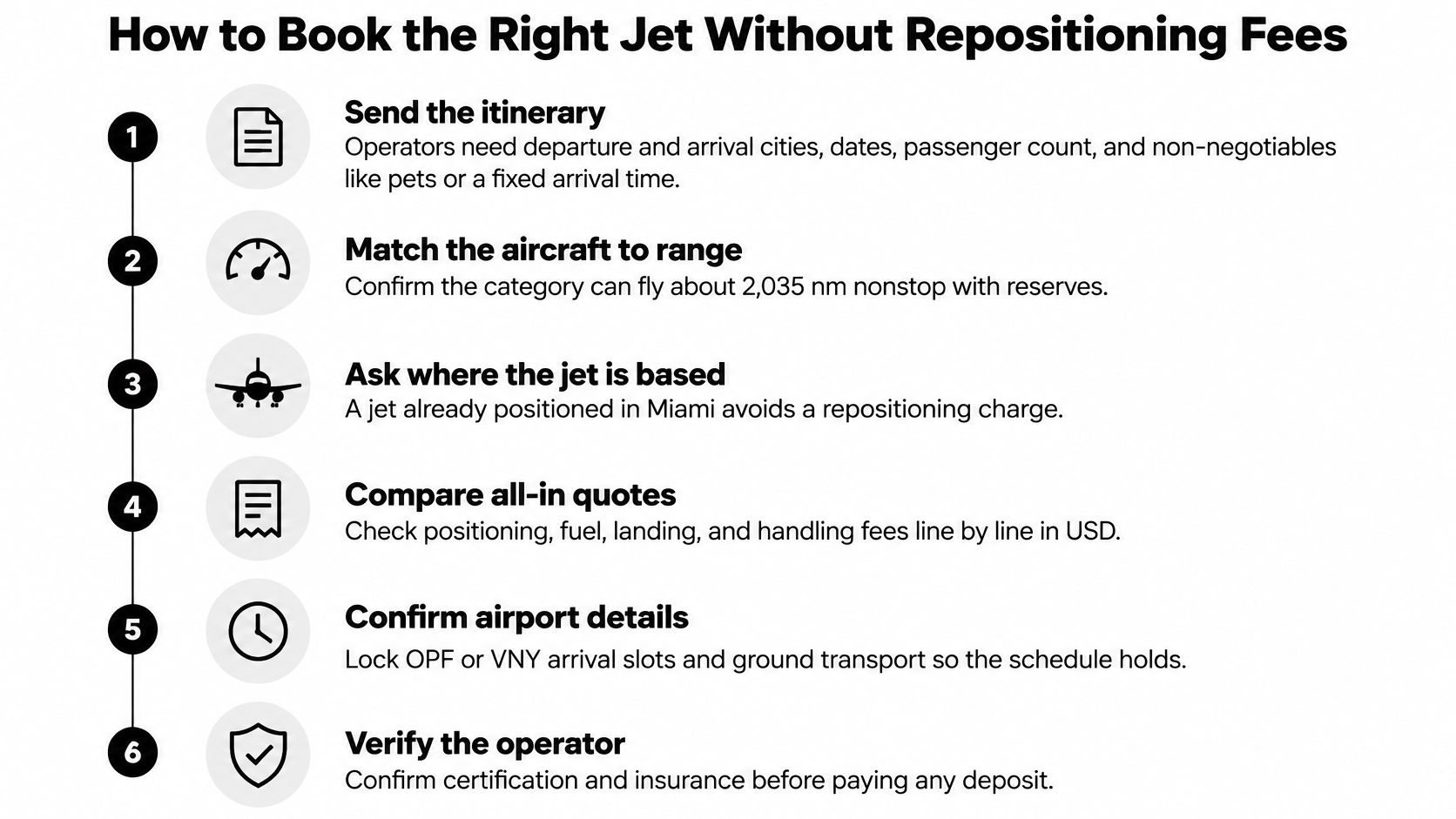
- Send the itinerary: Provide departure and arrival cities, travel dates, passenger count, and must-have requirements such as pets or a fixed arrival time, because the planner can't match range and payload without them. This is the request structure described in the guide to booking a private jet flight.
- Choose a category or exact aircraft: Specify a category, or the year, make, model, and cabin layout if those details matter, because category sets your nonstop margin.
- Match a jet near Miami: Ask the planner to source an aircraft already positioned near Miami, because local positioning avoids repositioning legs that add cost before boarding.
- Review the quote properly: Check the airport pair, block time, fuel stop assumption, positioning, taxes, and operator fees on an all in basis.
- Verify before you pay: Confirm the operator certificate, safety rating, tail number, Wi-Fi, catering, pet policy, baggage limit, and ground transport.
- Approve and pay per flight: Use the on demand model for this trip, with the price tied to the specific itinerary rather than a membership or prepaid arrangement.
- Receive final confirmation: Review the tail number, crew details, weather briefing, and passenger manifest before departure.
If you're comparing local availability before sending the request, the guide to finding a private jet charter near you is a useful starting point for framing departure options. Don't use it as a substitute for tail specific confirmation. Availability near Miami only helps if that aircraft passes the payload and reserve test for the westbound leg.
The short video below is worth reviewing before you finalize aircraft expectations with your planner.
Three Fixes That Save the Most Time
- Request early: Late requests shrink the pool of suitable aircraft already positioned near Miami.
- Name airports up front: State OPF, MIA, VNY, or LAX preferences at the start to avoid a requote after the aircraft is matched.
- Lock the passenger list: Send every passenger, pet, and major bag before the manifest deadline so payload and paperwork don't reopen the booking.
Planner advice: Be flexible on the tail number if an equivalent rated aircraft is better positioned, but don't be flexible on passenger count, baggage, pets, or a fixed arrival time after quoting.
Repositioning fees aren't mysterious. They appear when the aircraft you select has to fly empty to reach Miami or leave Los Angeles without a paying leg. You reduce them by requesting early, accepting a suitable locally positioned aircraft, comparing airport pairs, and asking whether positioning is included or itemized. If a quote hides positioning inside a single unexplained number, ask for the line item before you sign.
Request Your Miami to LA Quote Today
Request the quote this week with four details that settle the answer. Give the exact airports, passenger count and bags, pets, and required arrival time. Without those fields, any price for a private jet from Miami to LA is only a category estimate, not a bookable nonstop plan.
Use these decision rules. Choose a super-midsize jet or larger if you're traveling with a full load and need a nonstop flight with reserves. Accept a midsize jet only if the load is light, winds are favorable, the operator confirms planned load range for the specific tail, and you price in a possible fuel stop. Treat a light jet as unsuitable for a nonstop trip on this route.
Default to OPF to VNY unless your Los Angeles destination makes LAX or another arrival point faster door to door. If you're unsure, request two pairings and compare total itinerary time, not just airborne time. Don't let a slightly cheaper airborne quote push you into a longer drive or a weaker handling plan.
Before paying, complete three actions. Compare two quotes on the same all in basis, including positioning, taxes, fees, and fuel stop assumptions. Verify the tail number and operating certificate against the paperwork checklist, and confirm Wi-Fi, catering, pet policy, baggage, and ground transport. Then reconfirm flight details 24 hours before departure, including crew, weather briefing, manifest, airport, and FBO.
That's the standard I'd use as your planner. No mystery aircraft, no category only nonstop promise, and no cheap quote that becomes expensive once the wind, load, and repositioning are counted.
Send Haute Jets your exact airports, dates, passenger and bag count, pets, and arrival deadline, and the team will source a suitable aircraft for your Miami to LA itinerary with the operator and flight details confirmed before departure. Start your request with Haute Jets and ask for two all in airport pairings so you can choose on total trip time and confirmed nonstop capability, not headline price alone.