

You have a city pair, a date, and a small group that can't make the commercial schedule work. It might be a Monday meeting that starts before the first airline arrival, or a family weekend that only works if you leave after school. A private jet flight is built around that constraint. Where the airplane is sitting, who operates it, and what you confirm in writing all show up later as the invoice, the crew, and the cabin you end up boarding.
Treat the booking and the travel day as one chain. An airplane based in another city adds non-revenue time to the bill. An operator's audit status is the safety baseline you carry into weather and runway questions. Cabin, pet, and car details either get locked before assignment or become last-minute negotiations. The package you receive the day before tells you whether the plan still matches what you bought.
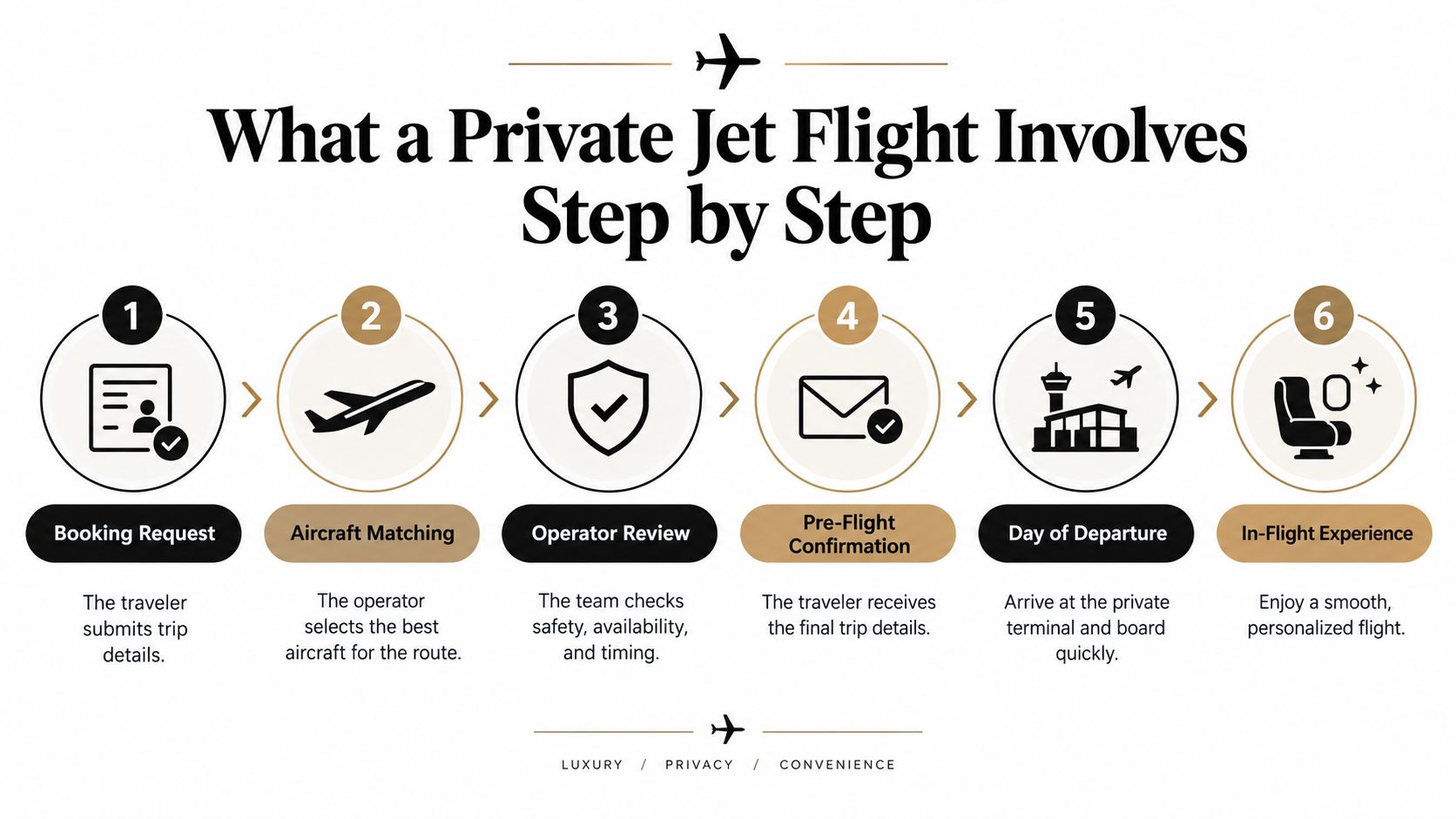
What a Private Jet Flight Involves Step by Step
Commissioning a private jet flight is closer to ordering a made-to-measure suit than buying one off the rack. Fabric, tailor, and fitting all happen before you wear it. Skip one of those and the finished piece doesn't sit right on the day you need it.
The booking request is the measurement. You send cities, dates, passenger count, and anything that isn't optional, such as a pet or a hard arrival time. No airplane is assigned yet.
Aircraft matching comes next. A planner looks for a specific jet that can fly your route with your people and bags, ideally one already near the departure city. Labels such as light, midsize, or long-range are only the shelf, not the suit.
What you settle before departure
Operator review checks the company that will fly the trip: safety screening, whether that tail is free, and whether the timing works. You're evaluating a certificate holder, not a stock photo of a model.
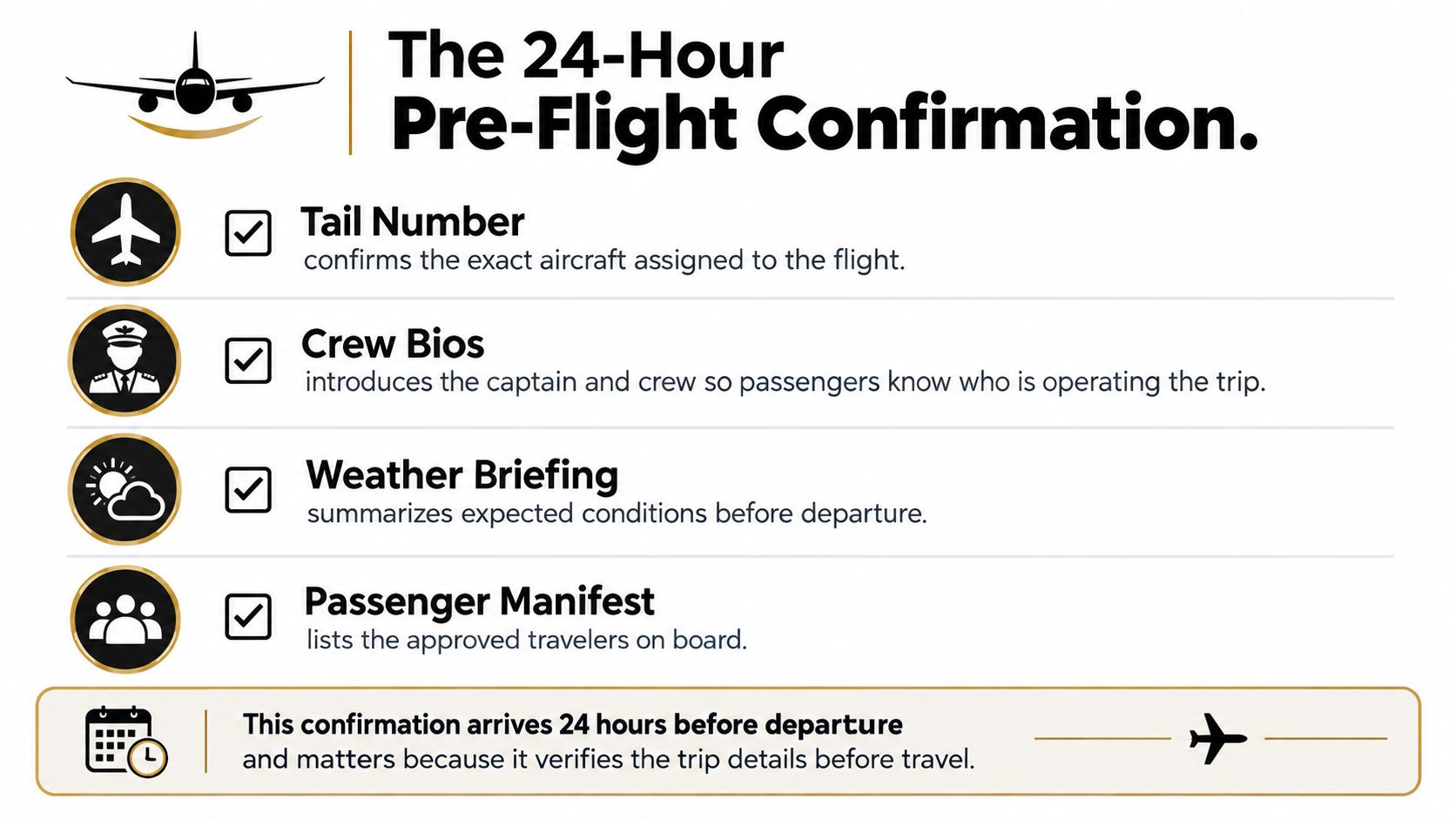
Pre-flight confirmation arrives about a day out. You get the tail number, who is in the cockpit, a weather picture, and the passenger list. This is the last quiet moment to catch a mismatch.
What the travel day actually is
On departure day you go to a private terminal, often called an FBO, clear a short security step, and board. The flight is the part travelers tend to picture first: a small cabin, a crew that already has your names, and a routing built for your party instead of a published timetable.
Landing is a short walk to a car that should already be waiting. If the trip crosses several time zones, plan how you'll adjust your sleep after long flights before you stack meetings on the far side.
Practical rule: Aircraft, operator, and cabin choices belong to the booking. The terminal, the flight, and the landing are where those choices show up. They aren't a second planning session.
Choosing the Right Aircraft for Your Route
A 90-minute empty positioning leg on a midsize jet priced at $7,000 per flight hour adds about $10,500 before your own passengers ever board, as Haute Jets Journal's one-way pricing example lays out. That charge isn't a surprise fee. It's the cost of flying the airplane to you with nobody in the seats.
Category is a rough filter. Year, make, model, and cabin layout decide whether the trip is comfortable and whether the jet can do the mission without a fuel stop. A short regional hop and a transatlantic crossing are different jobs. The first may suit a light or midsize cabin if the runway and payload fit. The second needs range, reserves, and a cabin people can sit in for hours. Two jets in the same category can differ in baggage volume, lavatory, and how many seats are actually usable once bags are aboard.

Location beats the brochure
Ask where the airplane is tonight, not only which types are "available." An aircraft based near your departure city can wipe out that positioning sector. One that must ferry in from another city puts non-revenue flight time on your invoice, even when the passenger route looks short.
Advertised range and a nominal cruise speed don't settle the quote. A heavy load, headwinds, required reserves, or a distant alternate can raise block fuel and force a stop. A credible estimate separates airborne time from block time and says whether fuel, positioning, landing, handling, and contingency assumptions are inside the number.
| Question to ask | What it changes on the day |
|---|---|
| Where is this tail based? | Whether you pay for an empty ferry before you fly |
| Which year, make, and model? | Range, baggage, and how the cabin actually fits your party |
| What is in the block-fuel assumption? | Whether a headwind or alternate turns into a fuel stop |
Looking through specific aircraft by year, make, and model is more useful than shopping a category name. You're matching one airplane to one route, not renting a label.
Safety Standards Behind Every Operator
Before comparing aircraft, check who operates them. A Gulfstream and a light jet may share the same certificate holder, so the operator's training, maintenance, and dispatch practices tell you more about how the company runs than the model name alone. That choice affects the safety checks behind your flight, while also helping you understand what is and is not confirmed before travel.
Haute Jets Journal's safety-record guide identifies Wyvern Wingman and ARGUS Gold or Platinum as significant third-party screening programs. A Wyvern review can examine operational history, pilot training, maintenance practices, procedures, and safety-management processes. It is an assessment of the operator's systems, not a label attached to one airplane.
Two ARGUS levels, in plain terms
ARGUS Gold uses remote validation. ARGUS Platinum includes an on-site audit that examines areas such as maintenance records, staff practices, safety-management systems, and organizational culture. The distinction is like checking plans and records remotely versus visiting the operation to see how those practices work in person. These reviews help assess the company before you receive a tail number, but they do not confirm conditions for your specific flight.
Wyvern also conducts follow-up audits to check continuing compliance. Ongoing review matters because an operator's practices can change after an initial assessment. Ask about the operator's current audit status when you compare charter options. That early check can help you make a more informed booking decision, rather than relying on a rating alone.

An audit describes the operator's systems. The forecast, runway, and other mission conditions still need checking closer to departure. Before you fly, confirm those details for your route and travel day.
For a side-by-side explanation of how Wyvern and ARGUS standards are applied, review the criteria while considering your quote. This helps connect the operator's audit status to the checks you ask about before booking.
Comparing Charter Options and Empty Leg Flights
The right choice depends on what must stay fixed: your travel time, your route, or your budget. Each option moves cost and flexibility to a different part of the journey.
On-demand charter prices a specific trip. You give the route and date, then review an aircraft and its terms. If the aircraft needs to fly into your departure airport first, that repositioning is part of the quoted trip cost you agree to, rather than a separate fare due only if the flight happens. This gives you more control over timing, though the quote reflects the aircraft's location as well as your route.
Membership and jet-card programs ask you to commit money or prepaid hours in advance. In return, repeat bookings may follow a more familiar process, subject to each program's rules. Some programs have blackout dates when demand is high. This can suit regular travel on similar routes, while prepaid time may be less useful if your calendar changes often.
Empty-leg flights, also called dead-head flights, are repositioning trips without passengers, often after a one-way charter or before the aircraft's next job. Haute Jets Journal's empty-leg briefing explains why operators may offer these flights at a lower price: the aircraft is already scheduled to fly that route. Availability, route, and departure time depend on the underlying charter, so a lower fare comes with less control.
Who each option actually fits
An empty leg can work when your plans are flexible. The departure airport, destination, and time are generally set, and if the original charter changes or cancels, the empty-leg flight may disappear too. If you need to arrive for court, a performance, or school pickup, that uncertainty may outweigh the savings. For a flexible day, it may be a reasonable trade.
| Access type | Flexibility | Schedule certainty | How you pay |
|---|---|---|---|
| On-demand charter | You set route and time | High, once contracted | Per flight |
| Empty leg | Fixed city pair and time | Can disappear if the paid trip cancels | Lower-priced one-way |
| Membership or jet card | Depends on program rules | Blackout dates may apply | Fees and prepaid hours |
Before choosing an empty leg, review what empty-leg flights are and aren't. For an on-demand option, Haute Jets charges per flight, without requiring a membership or jet card. Comparing the aircraft's location and the quoted terms helps you see how the booking choice affects both the fare and the travel day.
Booking Details That Shape Your Experience
The call that sets your day sounds ordinary. You say six people, Thursday, Teterboro to Palm Beach, bags for a long weekend. The adviser asks what has to be true when you step aboard, because those answers decide which owner-aircraft can be offered.
Wi-Fi is a yes-or-no for the booking, not a hope at the door. Catering is the same: dietary limits, a simple breakfast, or nothing, written down so the galley isn't a guess. Ground transport is named for both ends, including whether a larger vehicle is required for golf bags or a stroller. If those items aren't on the request, they get discovered at the FBO, when the only fix is a delay.
Pets are an owner decision
Most aircraft are pet-friendly, and Haute Jets Journal's charter guidance is clear that the individual aircraft owner has the final say. Give breed and size with the request so the adviser can skip cabins whose owner won't allow that animal. Two jets in the same category can have opposite pet policies. Boarding permission also doesn't replace customs, health-certificate, vaccination, or quarantine rules at the destination.
Packing the dog's carry-on and checking the arrival country's entry list are two different jobs. Clearing the cabin doesn't clear the border.
Confirm both lists before an airplane is assigned. Changing pets, Wi-Fi, or cars after the tail is chosen often means starting the match over, which is how a comfortable booking turns into a rushed one.
The 24-Hour Pre-Flight Confirmation
About 24 hours before departure, the trip becomes a named aircraft with a specific crew. Review the tail number, crew bios, weather briefing, and passenger manifest in that order. The tail number confirms which aircraft is assigned, while the bios show who will operate it. Weather can affect the airport and timing, and checking the manifest helps catch a late-added passenger before boarding.
Questions, not a slogan
An operator audit describes company standards; it does not answer every question about your particular flight. Raw accident counts also do not account for how many flights or flight hours took place, so they cannot tell you the risk of one trip. Use the confirmation to ask about the conditions and people involved in yours.
- Runway and weather: Could runway limits or local weather affect the planned airport, and is the alternate practical?
- Route experience: Has the operator flown this aircraft type on a similar trip, beyond holding the relevant rating?
- Crew: Are two qualified pilots assigned, and how recent is their experience in this aircraft type?
- Control: Who makes maintenance and dispatch decisions if the forecast worsens overnight?
A short regional flight may depend more on airport conditions and weather than on the aircraft's headline range. For example, a nearby alternate is useful only if it remains practical under the expected conditions. If an answer is vague, ask for clarification while there is still time to adjust the plan. Pre-flight verification connects the aircraft and operator selected during booking to the conditions you will face on travel day.
Requesting Your First Private Jet Flight Quote
A quote starts with a route, but the aircraft's location can affect the cost before travel day. The operator's screening speaks to the standard behind the flight, while the pre-flight confirmation lets you check that the planned airport, crew, and manifest still match the trip. Sharing cabin and service needs early also helps ensure comfort details are considered before an aircraft is selected.
Before requesting a price, gather your route, travel date, passenger count, cabin or pet requirements, and timing flexibility. A flexible schedule may make an empty leg worth considering. If you need a fixed departure time, ask about a standard on-demand charter.
Haute Jets arranges on-demand charter by matching a specific aircraft to your route and providing per-flight pricing. For example, you can request a quote for New York to Miami or Los Angeles to Las Vegas. Before travel, the tail, crew, weather, and manifest details are sent for review.
Visit Haute Jets and request a quote for your city pair.