
A private jet best safety record is an operator level outcome, not an aircraft model ranking, and professionally operated corporate jets have recorded 0.014 deaths per 100,000 flight hours compared with 0.012 for scheduled airlines. The strongest signal you can buy is a current Wyvern Wingman or ARGUS Platinum audit combined with trip specific verification of the exact aircraft and crew assigned to you.
That reframe annoys people who want a simple shopping list. They want to hear that one Gulfstream, Bombardier, or Embraer model wins and everything else loses. It doesn't work that way, and pretending it does is how smart travelers end up on weak operations in beautiful cabins.
Why the Safest Private Jet Is Really the Safest Operator
Pick the most advanced jet on the ramp and hand it to an operator with sloppy dispatch, tired crews, and deferred maintenance questions nobody wants to answer. You've bought risk with leather seats. Pick an older, well maintained aircraft flown by a disciplined operator with recurrent simulator training and firm weather limits, and you've bought a completely different flight.
That's not theory. The National Transportation Safety Board separates accident data for air carriers, commuter and on demand operators, and general aviation because operating rules and mission type change the risk picture. Recent cases involving a Gulfstream G600 and a Textron 680A pointed to adverse weather continuation and inadequate ground clearance or post contact inspection. Advanced systems didn't override human and operational decisions.
A famous airframe doesn't file a flight plan, rest a crew, or refuse a bad approach. People and processes do.
What Actually Decides the Outcome
Most of the safety margin on your trip is created before you board. It's in who signed off the maintenance release, whether the captain is current in type, how dispatch handled the weather at a mountain airport, and whether anyone in the operation can say no without fearing the revenue consequences.
I've seen the pattern repeat. A traveler chooses a recognizable model, asks about Wi-Fi and cabin photos, and never asks who holds the operating certificate. Then a substitution appears, a crew they've never heard of shows up, and the questions start at the worst possible time, on the ramp with bags loaded.
The five factors that define operator safety are mapped below.
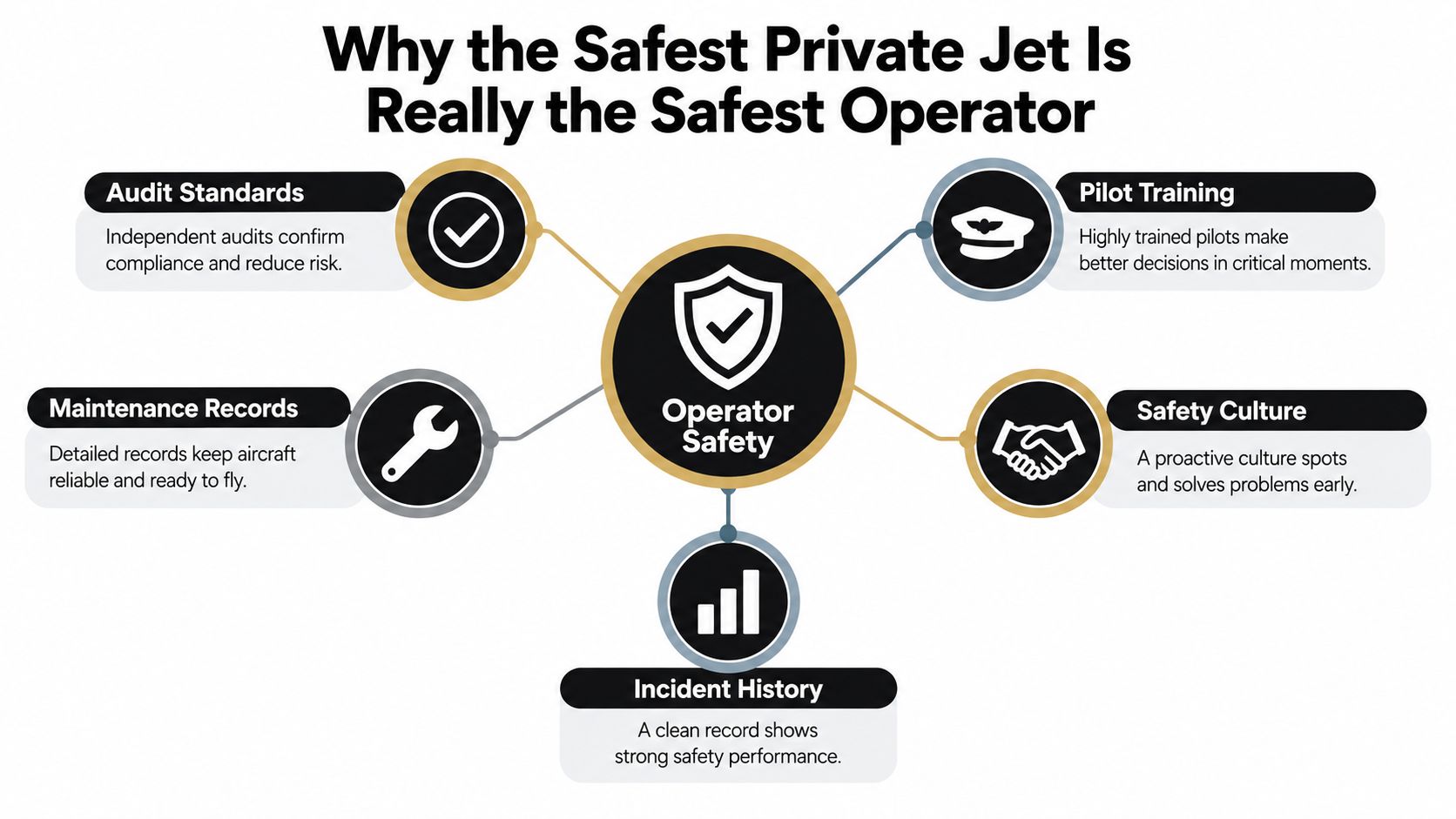
- Audit standards: Independent review of how the operation runs, not how the brochure describes it.
- Pilot training: Recurrent simulator work, type specific currency, and real experience on the route type you're flying.
- Maintenance records: Current airworthiness status on the specific tail number, not a fleet wide claim.
- Safety culture: Hazard reporting, corrective action tracking, and documented go or no go authority.
- Incident history: The operator's own record, reviewed at operator and flight level.
For readers of the Haute Jets Journal, the standard is simple. Don't ask which jet is safest in the abstract. Ask which operator can prove, with documents dated this year, that their system produces safe flights on ordinary Tuesdays when nobody important is watching.
The Private Aviation Safety Landscape Explained
Private aviation isn't one category. It's at least three different worlds sharing similar looking aircraft, and lumping them together is the first mistake most safety comparisons make.
Private healthcare works the same way. The sign on the door tells you very little. What matters is the credentials of the team inside the room, the protocols they follow, and who checks their work.
The Three Boxes Your Flight Can Fall Into
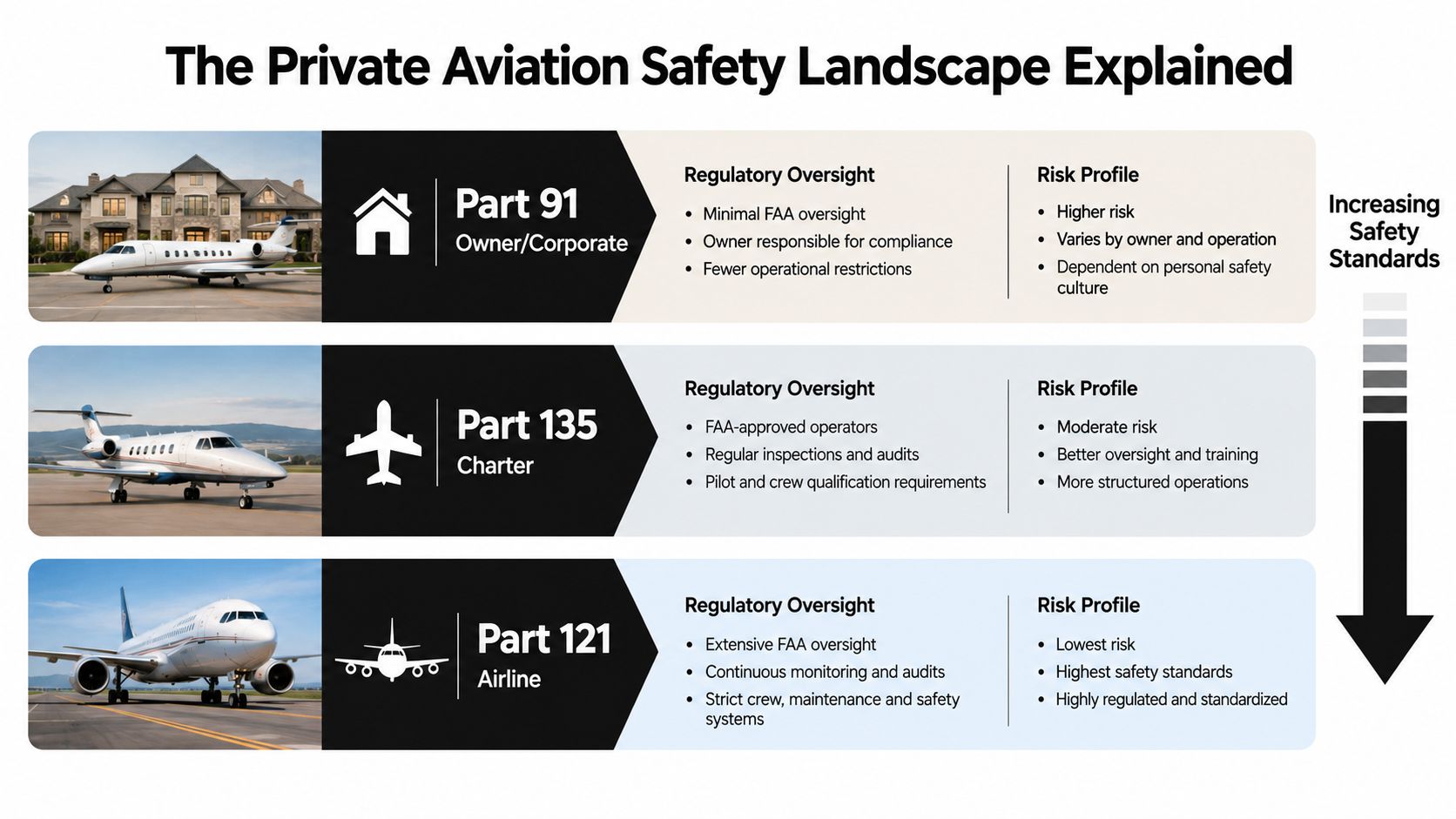
Part 91 covers owner flown and corporate operations, including positioning flights. Oversight is lighter because you're not supposed to be selling seats to the public. A strong corporate flight department can run an excellent Part 91 operation, but the rules don't force that standard.
Part 135 covers commercial charter, which is what you're buying when you pay for a charter flight. It imposes stricter requirements on crew duty, dispatch, maintenance, and operational control. If you want the regulatory details, read what FAA Part 135 requires of charter operators before you compare quotes.
Part 121 is the scheduled airline world, with the heaviest regulatory structure and the largest scale. It's the benchmark everyone cites, even when the comparison doesn't fit.
The hierarchy below shows how those categories differ in oversight.
Why the Box Matters More Than the Badge
The same executive aircraft can operate under Part 91 for a corporate or positioning leg and under Part 135 for your paid charter. Different rules, different dispatch requirements, different crew rest obligations, same paint scheme. If you don't know which part your flight operates under, you don't know what protections apply.
- Professionally crewed business jets: Two qualified pilots, formal training programs, structured maintenance control.
- Loosely managed air taxi flying: Highly variable standards, especially outside jet operations with regular passengers.
- Owner flown general aviation: The broadest risk spread in the entire category, and the data that pollutes most private flying headlines.
Your job as a buyer is classification, not admiration. Establish which box your trip sits in, which safeguards the law requires, and which ones the operator added voluntarily. Everything after that is refinement.
What the Safety Numbers Actually Tell You
The most useful historical comparison is also the most misquoted. A 2004 analysis reported in the Los Angeles Times comparison of corporate jet and airline fatal accident rates found corporate jets operated for employees at 0.014 deaths per 100,000 flight hours over the preceding five years, against 0.012 for airlines, roughly a 17% difference. Air taxi operators overall ran about five times the airline fatal accident rate, while air taxi services using jets for regular passengers performed nearly as well as airlines and corporate operators.
Read that carefully. The gap isn't private versus commercial. It's structured versus unstructured, inside the same broad category.
The Long Term Trend Is Real
Business aviation has also improved substantially over time. FlightGlobal's twenty year review of business aviation safety performance reported the fatal accident rate fell from roughly one fatal accident per 600 aircraft in the 1990s to one per 900 in the 2000s. In 2011 there were four fatal accidents with 16 deaths, about half the preceding decade's average of 7.6 fatal accidents per year, and fatalities per fatal accident dropped to four, compared with 23.4 during 2001 to 2010 and 35.4 in the 1990s.
Two things improved at once. Accidents became less frequent relative to fleet size, and the accidents that happened killed fewer people. That's decades of better certification, warning systems, navigation, training, and operational discipline compounding.
The Denominator Problem
Here's where brokers cherry pick. Rates per flight hour, per sector, per departure, and per aircraft in the fleet produce different rankings from the same underlying events. The IATA 2025 safety report covering commercial aviation accidents and fatality risk reported 51 accidents, a rate of 1.32 per million sectors, and fatality risk of 0.17 per million sectors. Rigorous numbers, wrong transplant. Airline sectors, aircraft classes, and operating environments don't map onto charter flying.
| Operating Category | Typical Denominator | Relative Risk Signal | Reporting Transparency |
|---|---|---|---|
| Scheduled airlines | Sectors or departures | Strongest large scale benchmark | High, standardized reporting |
| Corporate flight departments | Flight hours | Historically close to airlines | Moderate, varies by operator |
| Part 135 jet charter | Flight hours | Near the top when professionally managed | Moderate, audit dependent |
| Air taxi overall | Flight hours | Materially weaker than airlines | Mixed across aircraft types |
| Owner flown general aviation | Flight hours | Widest risk spread | Lowest consistency |
Practical rule: A low accident count proves nothing by itself. Fewer flights, incomplete reporting, or a different fleet mix can flatter any operation.
Demand the population and the denominator behind every safety claim you're quoted. If a broker can't explain both in plain language, they're selling you a number they don't understand either.
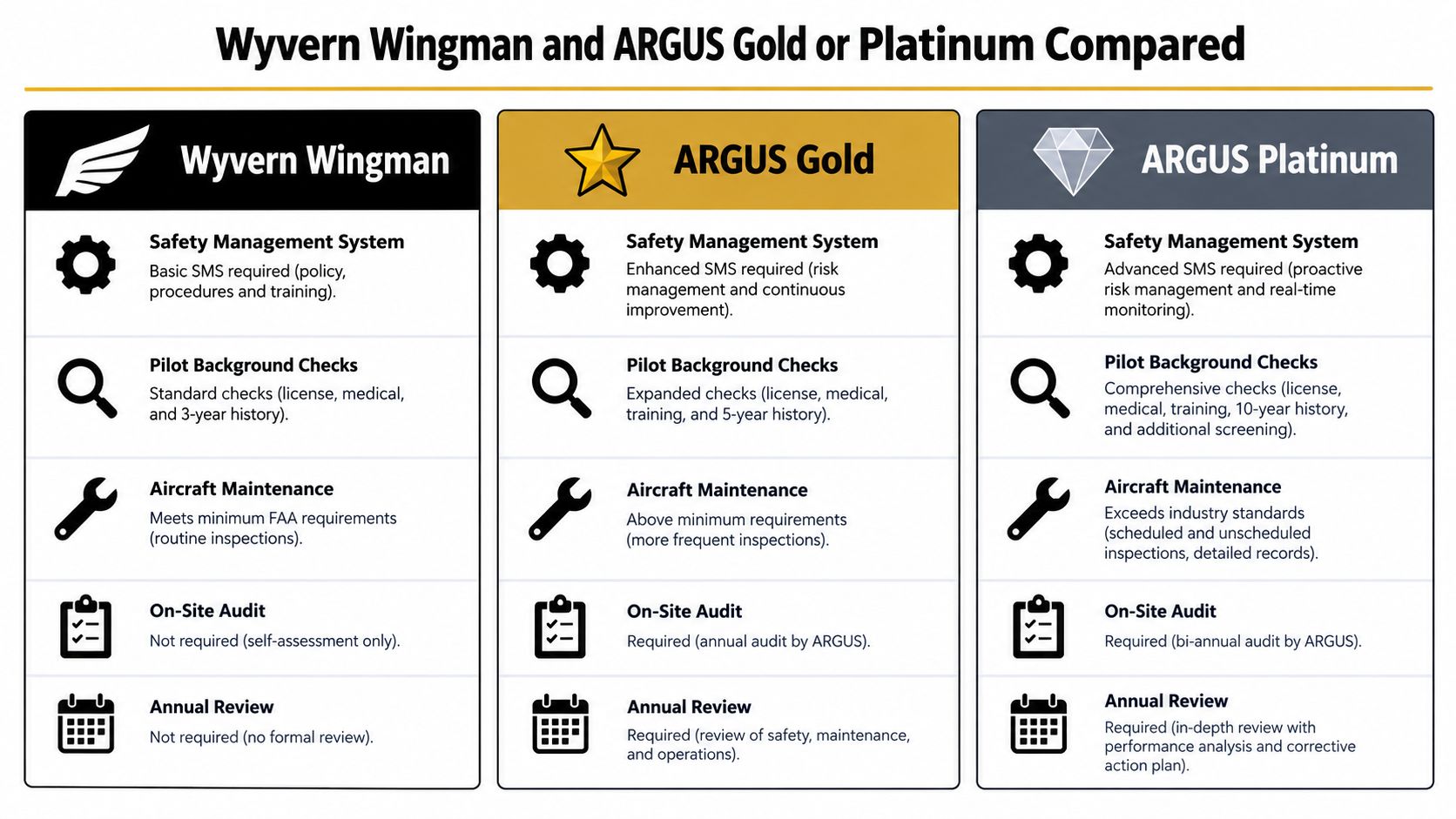
Wyvern Wingman and ARGUS Gold or Platinum Compared
These three labels get used interchangeably in sales calls. They're not interchangeable, and the differences are exactly where your protection lives.
The comparison below lays out what each designation requires.
What Wingman Actually Tests
Wyvern describes its Wingman audit assessment against rigorous real world safety criteria as an operational review, not a paperwork exercise. The published Wingman Standard requiring SMS Level 2 performance and safety culture evaluation requires a positive safety culture, a Safety Management System aligned with FAA or civil aviation authority requirements or ICAO Annex 19, and at least SMS Level 2 performance, assessed using the Safety Management International Collaboration Group evaluation tool.
That's a review of management behavior and risk controls. It asks whether hazards get reported, tracked, and fixed, which is harder to fake than a clean hangar.
Gold Versus Platinum Is a Depth Question
The ARGUS distinction is about how the verification happens. ARGUS Gold involves remote validation while Platinum requires a two day on site audit where auditors examine maintenance records, interview staff, assess the safety management system, and evaluate organizational culture. Gold reviews FAA compliance, pilot background checks, safety records, and an emergency response plan from a distance. Platinum watches the operation work.
Remote review catches missing documents. On site review catches the gap between documents and behavior, which is where weak operators get exposed.
This short video walks through how third party safety evaluation works in practice.
Where Every Audit Falls Short
None of these is a government operating certificate, and none guarantees an accident can't happen. A comparison of ARGUS and Wyvern ratings and what safety audits examine notes that audits examine pilot qualifications, maintenance practices, regulatory compliance, emergency planning, and safety management systems, and that Wyvern verifies continuing compliance through follow up audits every 24 months.
- Recency: An audit approaching its renewal window tells you less than one completed this quarter.
- Scope: Confirm whether your specific aircraft and crew were inside the qualification review.
- Tier honesty: If someone says fully audited, make them name the program, the tier, and the date.
Treat Wingman and Platinum as evidence of serious external scrutiny. Treat Gold as a legitimate but shallower screen. Treat any refusal to specify which one applies as your answer.
How to Verify an Operator Before You Book
You can run this check on any charter quote in about fifteen minutes, and you should, every time, regardless of who sent the quote.
Start with identity. Get the legal operator name, the operating certificate and the part it operates under, and the exact tail number of the aircraft assigned to you. Not the category, not a representative photo, the tail number. If the tail changes later, the verification starts again.
The Fifteen Minute Check
- Confirm the audit: Ask for the most recent Wingman or ARGUS audit letter, the tier, and the date it was issued.
- Verify the crew: Request captain and first officer names, type ratings, currency status, and the date of their last simulator check.
- Check the aircraft: Ask for current maintenance status on that tail, and read up on how aircraft maintenance records reveal an operator's real standards so you know what you're looking at.
- Test the policies: Ask for weather minimums, stabilized approach criteria, and who holds final go or no go authority.
- Confirm audit scope: Ask whether this crew and this aircraft were included in the operator's qualification review.
The image below shows the kind of desk level verification this involves. It's unglamorous work, which is precisely why weak operators hope you'll skip it.

What This Catches in Practice
Consider a Miami to Aspen trip in winter, a route that punishes casual dispatch. A traveler running this routine discovers the operator's Gold status rests on a remote paperwork review and the assigned captain's simulator currency is due for renewal. Nothing illegal, nothing dramatic, and absolutely not the standard the quote implied. That single phone call is the difference between assumed safety and verified safety.
If an operator hesitates to name the crew, the tail, or the audit date, don't negotiate. Move on.
Good operators answer these questions quickly because they answer them for corporate flight departments and insurers every week. Pushback is information.
How Haute Jets Enforces This Standard on Every Flight
Knowing the standard and enforcing it across a global charter network are different problems. Haute Jets was built to source aircraft from 3,500+ owner operators across 175 countries, which creates reach, but reach without a hard filter just creates exposure at scale.
The filter comes first. Every operator in the network must hold Wyvern Wingman or ARGUS Gold or Platinum status before an aircraft is ever presented to a client. That single rule removes the unvetted end of the market from consideration, which is where most of the category's risk concentrates.
Four Enforcement Layers
- Network level audit requirement: No current Wingman or ARGUS rating, no access to Haute Jets clients. The rating gets checked, not assumed from a logo on a website.
- Trip specific confirmation: The exact tail number and assigned crew get confirmed for your flight, so the audit evidence connects to the aircraft you'll board.
- Local sourcing: Aircraft based near your departure city eliminate the 20 to 40 percent repositioning surcharges common with traditional brokers, and they also remove long ferry legs flown by crews positioning unfamiliar aircraft into your trip.
- 24 hour pre flight package: You receive the tail number, crew bios, weather briefing, and passenger manifest a full day before departure, while there's still time to ask questions or change plans.
The thinking behind the audit requirement tracks how regulators frame the subject. FAA guidance defines a Safety Management System as an organization wide process covering safety policy, risk management, safety assurance, and safety promotion. If you want the deeper mechanics, this explainer on SMS safety management systems in charter operations covers how those four pillars work day to day.
Why Not Just Call a Wingman Operator Directly
You can, and for a single route you fly monthly that can work well. The broker layer earns its place when your trip doesn't match one operator's based fleet. Instead of accepting whatever aircraft a single operator needs to sell, you get specific aircraft from audited operators near your departure point, with year, make, model, and cabin layout confirmed rather than a generic category promise.
There's no membership and no jet card attached to that. You pay per flight at direct to owner rates, and the safety screen applies identically whether it's your first booking or your fiftieth. The standard doesn't flex with your spend, which is exactly how a safety standard should behave.
A Pre-Flight Safety Routine You Can Reuse
Compress everything above into five moves and run them on every charter, whoever books it for you.
- Identify the certificate: Confirm the operator's legal name and whether your flight operates under Part 135.
- Verify the audit: Wingman or Platinum preferred, named tier, current date, no exceptions for a good price.
- Lock the specifics: Exact tail number, named crew, simulator currency, and maintenance status on that aircraft.
- Review the limits: Weather minimums and stabilized approach criteria in writing, and for the decision framework itself, DuBois Aviation's go no go decision guide is a clear plain language resource worth reading once.
- Demand the package: Tail number, crew bios, weather briefing, and manifest 24 hours out.
The best safety record in private aviation isn't printed in a brochure. It's the one you verified yourself, on this operator, this aircraft, and this crew, before you boarded.
When you're ready to book, Haute Jets sources your exact aircraft from Wyvern Wingman and ARGUS Gold or Platinum rated operators across 175 countries, confirms the tail number and crew 24 hours before departure, and charges direct to owner rates with no membership or jet card required. Tell us your route and dates, and we'll present specific audited aircraft near your departure city so you can verify the safety record before you ever step on board.