
A “private jet” is not a single safety category. A corporate flight operated under Part 91, an on-demand charter under Part 135, and a scheduled airline flight under Part 121 can involve different operating rules, oversight, and safety data. For a charter buyer, the useful question isn't whether private flying is safe in the abstract. It's what the available numbers describe, and what they reveal about the specific operator and flight.
The Private Jet Safety Record Starts with the Right Baseline
The FAA estimated that the U.S. general-aviation fatal-accident rate reached 0.68 per 100,000 flight hours in fiscal 2024, the lowest rate since the agency began tracking the measure in 2009. The rate fell from 0.83 in fiscal 2017, an approximately 18% reduction. Those figures are an important safety benchmark, but they aren't a private-charter accident rate. The FAA's general-aviation category is broader than private jets, encompassing personal aircraft, helicopters, and experimental aircraft as well as business flying (FAA general-aviation safety data).
The denominator matters as much as the headline rate. Flight hours measure exposure to risk over time, making the rate more useful than a raw accident count when aircraft utilization changes. A count tells you how many accidents occurred. A rate per flight hour helps put that count in relation to how much flying took place. Neither measure, by itself, tells you the risk on a particular charter or establishes how one operator compares with another.
Read the population before the rate
Before using any aviation statistic, ask what aircraft and operations it includes, what period it covers, and how it measures exposure. A general-aviation rate can show broad sector movement, but it can't be presented as a private-jet-only figure. It also can't tell a buyer whether an on-demand charter operator has strong maintenance oversight, experienced crews, or effective procedures for challenging weather and runways.
That distinction is useful beyond aviation. When legal or regulatory questions involve complicated categories and definitions, an AI legal research platform can help users investigate the terminology and source material. In aviation safety, though, the first analytical step is simpler: identify the population behind the number.
For a charter customer, the FAA baseline is context, not a verdict. Pair sector-wide rates with operator-specific evidence, including the operating certificate, maintenance controls, crew qualifications, and accident and incident history. A broad rate can tell you that performance is changing across general aviation. It can't certify the safety of the aircraft you're about to board.
How the FAA Actually Classifies Private and Business Flying
The words “private jet” describe an aircraft or travel experience, not a single FAA operating category. For safety comparisons, the relevant distinction is how the flight is operated. Part 91, Part 135, and Part 121 describe different regulatory frameworks, and those frameworks affect what evidence a traveler should request.
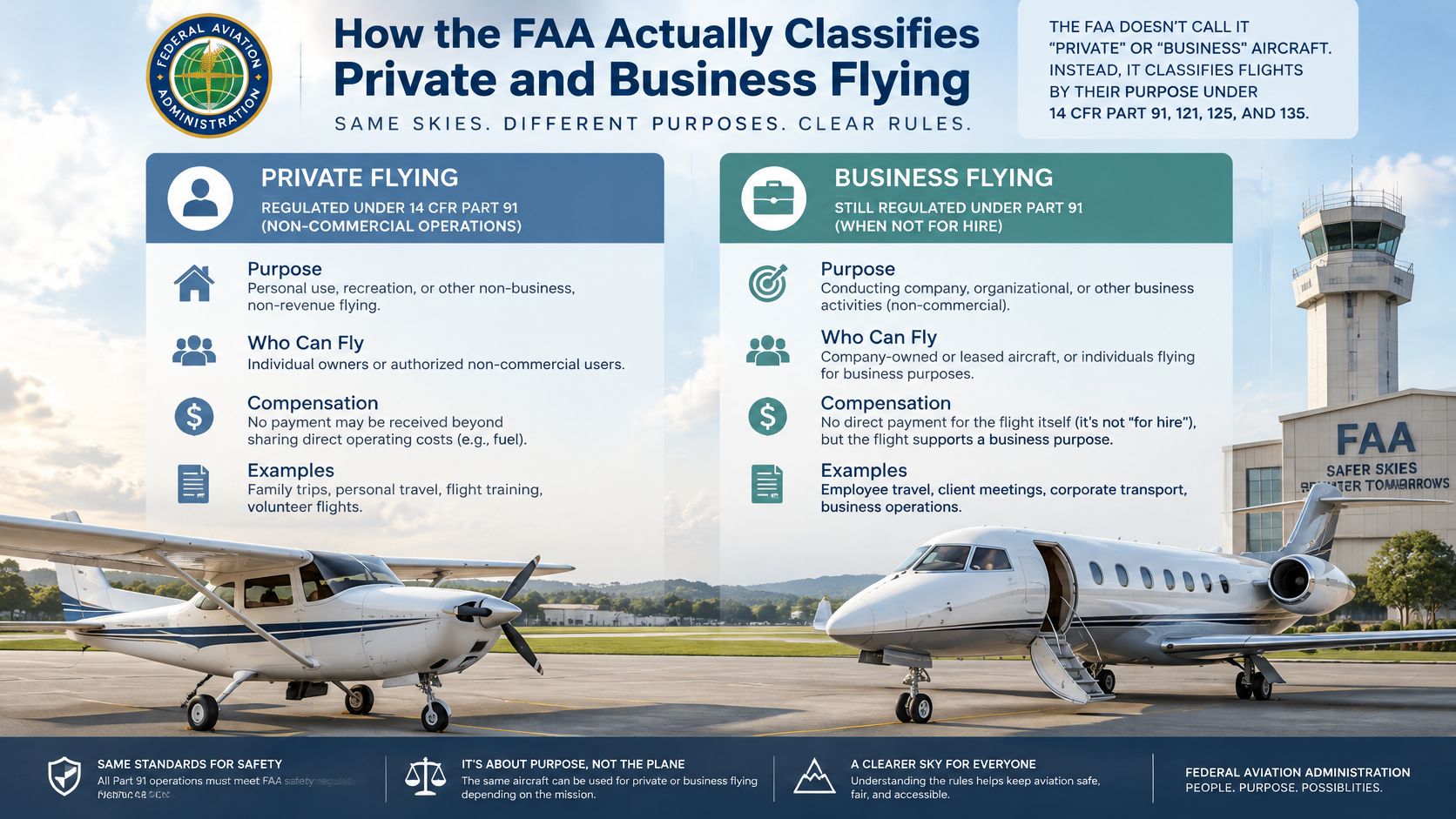
Part 91 covers personal and corporate flying. A company may operate an aircraft for its own business travel, while an individual may fly an aircraft they own. These flights aren't interchangeable with paid charter because the cabin or aircraft model looks similar. Who operates the flight, under what authority, and with what management and maintenance arrangements all matter.
Separate the flight from the aircraft
Part 135 applies to on-demand charter and air-taxi operations. The customer hires a service for a specific trip, so the identity and oversight of the legal operator matter directly. Part 121 governs scheduled airline operations. Airline statistics shouldn't be casually applied to on-demand charter: the operations and regulatory categories differ, even when passengers make similar comparisons between modes of travel.
A buyer should establish which certificate governs the actual flight, rather than relying on a broker's description or the aircraft brand. If a flight is arranged through a managed or fractional program, ask who holds operational responsibility and which rules apply to that trip. The label on the booking doesn't answer those questions. Haute Jets' guide to FAA Part 135 operators offers further context for understanding charter operations.
The historical data problem shows why classification isn't a technicality. In 1995, business flying recorded 99 accidents, including 32 fatal accidents, but the NTSB said available flight-hour data couldn't reliably distinguish personal flying from business flying. As a result, it couldn't calculate a separate business-flying accident rate (NTSB civil-aviation accident data). Counts without a matching exposure measure can describe events, but they don't support a clean comparison of risk.
Comparing Corporate Part 91 and On-Demand Part 135 Accident Rates
The available 2021 figures show why “private aviation” is too broad a category for a safety judgment. Executive and corporate jets operating under Part 91 recorded approximately 0.26 accidents per 100,000 flight hours, with zero fatalities. On-demand air-taxi operations recorded approximately 0.76 accidents per 100,000 flight hours and a fatal-accident rate of 0.2 (2021 private-aviation safety figures).
| Part 91 Corporate vs Part 135 On-Demand Charter 2021 Safety Profile | Operation Type | Accidents per 100k Hours | Fatal-Accident Rate | Fatalities | Typical Use Case |
|---|---|---|---|---|---|
| Corporate Part 91 | Executive and corporate jets | Approximately 0.26 | Not stated | Zero | Business or corporate flying |
| Part 135 on-demand | Air-taxi operations | Approximately 0.76 | 0.2 | Not stated | Hired, on-demand flights |
The figures aren't proof that every Part 91 operator is safer than every Part 135 operator. They describe different operation groups in a specific year, and they don't establish the risk of a particular aircraft, crew, or trip. Still, the contrast is meaningful: a professionally managed corporate operation and an on-demand air-taxi service shouldn't be blended into one undifferentiated “private jet” average.
Ask what the comparison leaves out
Accident rates become more informative when analysts sort the data by aircraft type, operation type, phase of flight, and time period. Those dimensions can reveal differences a sector-wide average hides. A rate that combines multiple missions and aircraft may be mathematically accurate while being a poor guide to a particular booking.
The flight itself also matters. Two aircraft of the same model may be operated by different organizations, with different crew arrangements, maintenance practices, and management controls. The name on the fuselage doesn't tell you which standards govern the trip.
For a buyer, the practical conclusion isn't to avoid all charter or to assume corporate flying is automatically safer. It's to compare like with like, then look beyond the category average. Ask for the legal operator, the operating certificate, the crew and maintenance arrangements, and information about that operator's safety record. A useful statistic starts the inquiry. It doesn't finish it.
Why the 2024 Part 135 SMS Rule Changes the Charter Picture
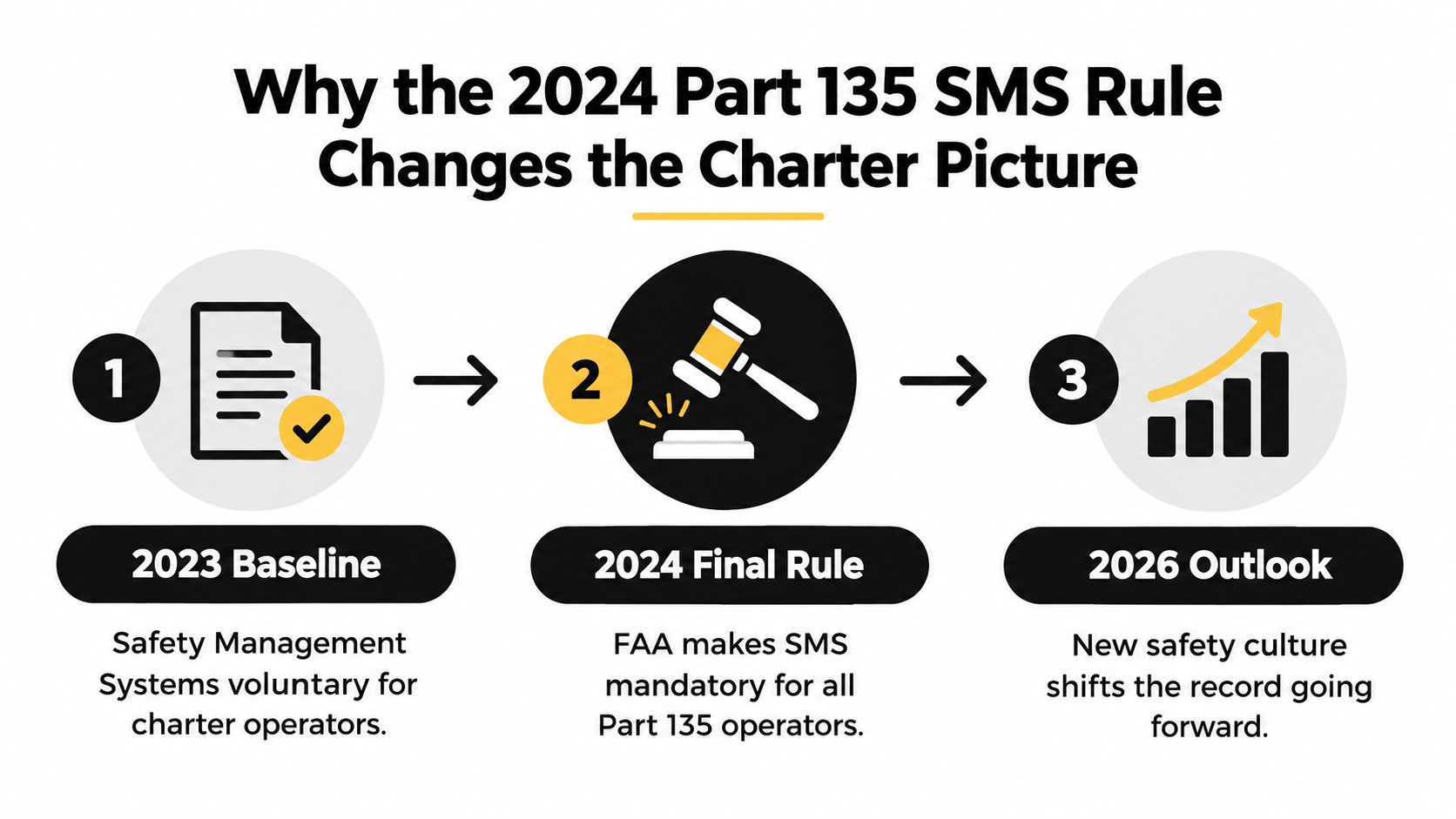
A safety record is shaped not only by past outcomes but also by the systems an operator uses to find and address risk. The FAA's 2024 final rule requiring Safety Management Systems for all Part 135 charter operators makes that distinction especially relevant to charter buyers. Rather than treating SMS as a badge, ask what it does in day-to-day operations.
A functioning Safety Management System, or SMS, gives an operator a structured way to handle hazard reporting, risk assessment, corrective action, and management accountability. In practical terms, staff need a process for raising safety concerns, evaluating what those concerns mean, deciding what changes are needed, and tracking whether those changes are carried out. The management team's role matters because reporting systems don't improve safety if people can raise concerns but nobody acts on them.
Confirm the system is active
The rule establishes a common requirement for Part 135 operators, but a buyer still needs to understand how a specific operator puts SMS into practice. Ask who receives hazard reports, how the operator evaluates risk, and how it records corrective actions. A clear answer should describe a working process, not just name a policy or certification.
Ask how management reviews safety concerns and how the operator follows up when a problem is reported. You can also ask whether employees have a straightforward way to report hazards and whether the operator can describe how it closes the loop after an issue is identified. These questions help distinguish an active management process from an aspirational statement.
SMS is more useful as evidence of an operator's safety process than as a substitute for other checks. It doesn't erase accident history, replace maintenance review, or tell you whether the aircraft assigned to your trip is appropriate for the conditions. Haute Jets' overview of FAA Safety Management Systems provides additional background on the approach. For buyers, the key is to verify that the operator can explain its reporting and response practices, not merely that it uses the term “SMS.”
How Wyvern Wingman and ARGUS Gold and Platinum Audits Fit In
Third-party ratings can help charter buyers assess an operator's procedures and oversight, but they aren't FAA operating certificates. Wyvern Wingman and ARGUS Gold or Platinum are voluntary operator-rating programs that examine pilot-training records, maintenance practices, operating procedures, safety-management processes, and operational history. A rating applies to the operator and the scope reviewed at a particular point in time (operator-rating overview).
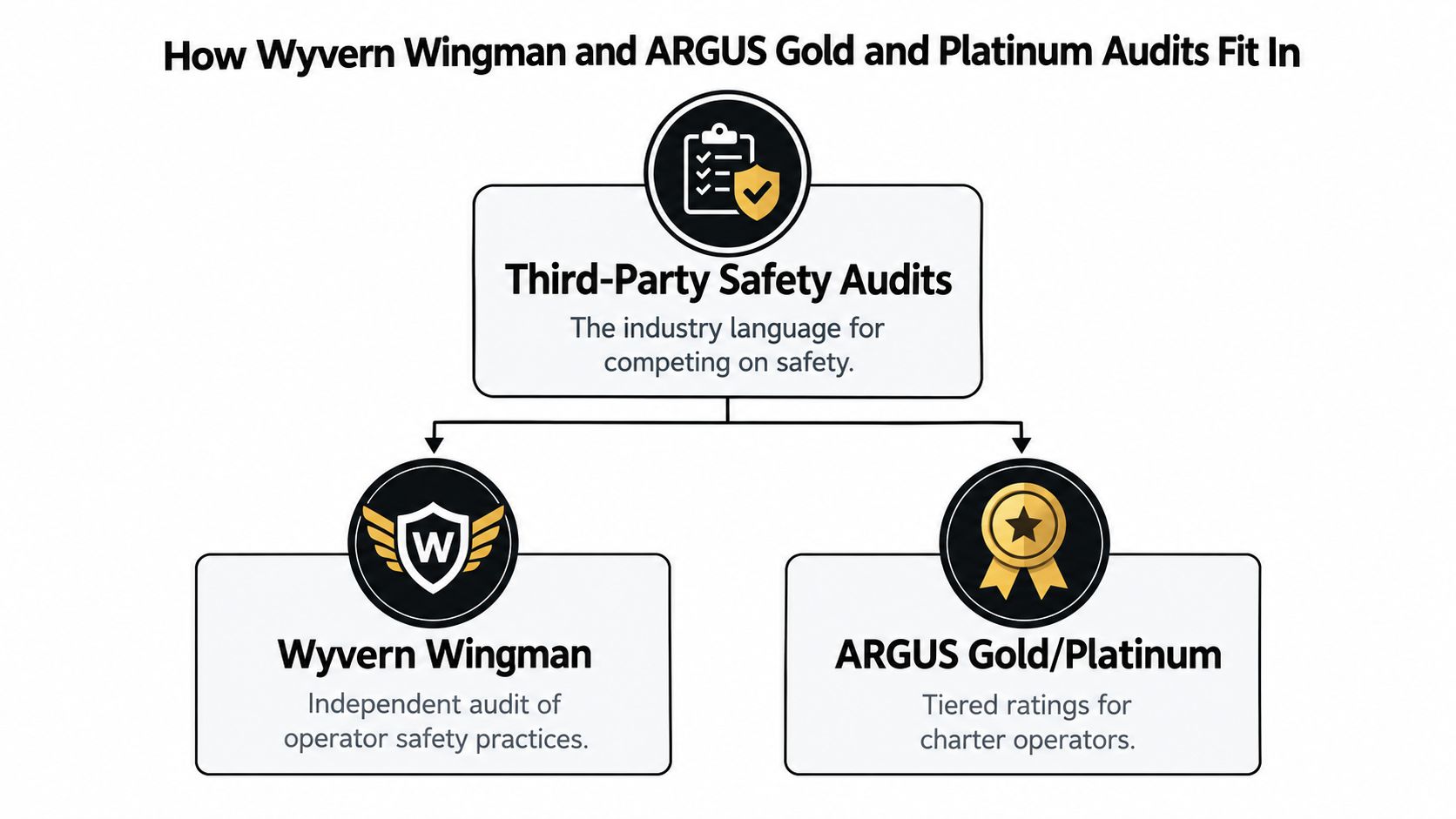
That scope limitation matters. A rating attached to a company name doesn't automatically answer whether the legal operator assigned to your trip is covered, whether the designation is current, or whether a particular aircraft falls within the reviewed operation. Ask for the exact rating and confirm the entity it applies to. “ARGUS-rated” alone doesn't identify whether the operator holds Gold or Platinum status.
Treat ratings as supporting evidence
The highest-level audit requirements described in Haute Jets Journal include a perfect safety record for at least two years, a Safety Management System and quality-assurance program, regular inspections and maintenance, simulator-based pilot training, and crew duty-time limits with adequate rest between flights. Wyvern's rating system ranges from Level 1 to Level 5, with higher levels representing more demanding safety criteria (overview of Wyvern and ARGUS audit requirements).
Those safeguards give buyers concrete subjects to discuss: how pilots train, how maintenance is managed, how the operator monitors fatigue, and how safety processes are reviewed. The rating can signal that an outside audit examined those areas, but it can't guarantee that every future flight will be free of risk.
The certificate and the audit answer different questions. The certificate establishes the regulatory framework under which the operator flies. A third-party rating adds information about the controls and records examined by the auditing program. Neither should be used to replace the other. A buyer gets a more complete view by verifying the legal operator first, then checking that any claimed rating is current and covers the operation being booked.
What the Private Jet Safety Record Does Not Tell You
“Private jets are safer than airlines” sounds like a clean comparison, but it can combine unlike operations and unlike data. Scheduled Part 121 airline flights, Part 135 charters, and Part 91 corporate operations aren't the same population. Nor are accident counts, fatal-accident rates per flight hour, and rates per departure interchangeable measures of exposure.
That last distinction affects comparisons with commercial-airline statistics. The ICAO 2023 rate of 1.87 accidents per million departures applies to scheduled commercial operations using fixed-wing aircraft above 5,700 kilograms maximum takeoff weight, not on-demand private charter. Substituting it for a Part 135 figure would compare different operating categories and different exposure measures, not establish which one is safer.
One year isn't a trend
Annual outcomes can also move sharply in business aviation because the sector has far fewer flight hours than scheduled airlines. Preliminary NBAA data reported that fatalities involving U.S.- and non-U.S.-registered business jets fell 34% from 2023 to 2024 (NBAA safety analysis resources). That's encouraging, but a change over one year doesn't by itself establish a lasting trend. A small number of events can meaningfully shift the annual result.
An average also doesn't explain what happened on an individual flight. It might not show whether risk is concentrated in a particular phase of flight, aircraft type, or operating category. That's why more detailed accident analysis is useful: it can help people ask whether runway events, approach and landing, weather, maintenance, or crew decisions deserve closer attention, rather than relying on a single undifferentiated rate.
The more useful question is specific: What's this operator's recent record, under which certificate, and what controls are in place now? Include incidents and runway events in that inquiry, not only fatal accidents. A clean fatal-accident history is relevant, but it can't reveal every operational concern a buyer should consider.
A Pre-Booking Safety Checklist for Any Charter Operator
Before confirming a charter, establish who will operate the flight and what evidence supports that operator's safety claims. A broker, aircraft brand, or polished cabin doesn't answer whether the assigned operator's certificate, crew, maintenance practices, and safety controls fit the trip.
Use this checklist to keep the review focused:
- Confirm the operating certificate. Ask whether the flight operates under Part 91, Part 135, or another applicable framework, and verify the legal operator.
- Check the rating and its scope. If the operator cites Wyvern or ARGUS, confirm the current designation and whether it covers the legal operator and aircraft assigned to your flight.
- Ask about recent events. Look beyond fatal-accident counts. Ask how the operator tracks incidents, runway excursions, and changes in its operation.
- Discuss the SMS process. Ask how crews and staff report hazards, how management assesses risk, and how the operator follows up with corrective action.
- Review crew and maintenance controls. Ask about crew experience, simulator training, duty-time management, and the maintenance records relevant to the aircraft. Haute Jets' guide to aircraft maintenance records can help frame that review.
Ask for runway-specific performance
Runway excursions deserve direct attention because they involve limited stopping margin and constrained options at low altitude. In an analysis of 28 business-jet accidents, approximately half were categorized as runway excursions, according to the Flight Safety Foundation (business-jet runway-excursion analysis). Ask the operator for performance calculations specific to the aircraft, runway, weather, and anticipated landing weight, rather than generic brochure distances.
Also ask how the operator handles contaminated runways, runway-condition reporting, stabilized approaches, and conservative crosswind or tailwind limits. Those questions focus on operational decisions that matter to the actual trip, rather than relying on a broad industry average to stand in for a specific flight.
Before you book: Verify the certificate, operator, current audit scope, crew and maintenance controls, incident history, active SMS, and runway-specific performance planning.
Haute Jets arranges on-demand private flights with operators holding Wyvern Wingman or ARGUS Gold or Platinum ratings, and provides clients with flight details before departure. If you're evaluating a charter, visit Haute Jets to discuss the operator and aircraft for your trip alongside the safety checks outlined above.