

Roughly 30–40% of private-jet flight hours involve repositioning, according to industry estimates of empty-leg activity. That's the operational reality behind the discount, not evidence that operators can provide private aviation cheaply whenever you want it. You're buying access to an aircraft movement created for someone else's itinerary.
My advice on private jet charter empty legs is straightforward: treat the offer as a conditional itinerary, not a bargain-priced substitute for a flight you absolutely must take. A lower fare is useful only if the complete cost works, the schedule fits, and you can live with the consequences if the operator withdraws the flight.
Why Private Jet Charter Empty Legs Exist
Private aircraft follow their customers, not a published timetable. After delivering passengers, an operator may need the aircraft back at its home base, at another airport for its next assignment, or at a maintenance facility. The resulting passenger-free movement is an empty leg, also called a repositioning, deadhead, or ferry flight.
The opening estimate needs careful interpretation. It measures flight hours, not an audited global count of passenger-free departures. A long repositioning sector contributes more hours than a short one, so describing the estimate loosely as about one movement in three doesn't make those measures interchangeable.
Public activity datasets don't consistently identify whether passengers were aboard. Treat the estimate as evidence of a substantial operational issue, not a precise inventory of discounted flights available to book.
Aircraft location creates the opportunity
Consider a hypothetical aircraft that has just dropped passengers in Miami and needs to be near New York for a Monday assignment. The operator has a reason to move it north whether or not another traveler books the cabin. A traveler who wants that same journey may be able to use the repositioning window.
But the aircraft isn't suddenly operating a Miami-to-New York scheduled service. Its next assignment determines the useful arrival airport and timing. The operator's obligation to that assignment comes before the convenience of a potential empty-leg customer.
That distinction matters in busy North American charter markets, where aircraft move between business centers and leisure destinations. Route imbalance, seasonal demand, aircraft location, and the timing of subsequent bookings all influence which opportunities appear.
Practical rule: Search for an aircraft movement that fits your trip. Don't assume an advertised route can be reshaped around your calendar.
Availability isn't a timetable
An aircraft can be empty without being available to you. The operator still has to accommodate its operational requirements, and the geographic overlap must make sense.
That's why a large market for repositioning doesn't translate into dependable availability on your preferred route. A traveler may see several attractive offers and still find none that solves the journey.
The useful distinction is between unused flying capacity and usable travel availability. Operators have the former because aircraft must move between assignments. Buyers get the latter only when their plans align with a particular movement.
Start with that understanding. Otherwise, every attractive listing looks like an alternative to a conventional charter, even when it's an entirely different proposition.
How an Empty Leg Flight Actually Forms
A conventional charter starts with your requirements. An empty-leg booking starts with an aircraft schedule that already exists. The Haute Jets Journal explanation of how empty legs form describes that reversal: the second traveler accepts the existing city pair, departure time, and aircraft rather than designing the mission first.
Follow the booking dependency
The sequence is simple, but each stage matters:
- A primary customer books a one-way charter. That customer's journey determines where the aircraft finishes its occupied assignment.
- The operator identifies a required repositioning sector. The aircraft needs to get home, reach its next pickup, or move for an operational reason.
- Another traveler accepts the available movement. The operator makes the otherwise unoccupied sector bookable within the aircraft's existing constraints.
The process is easier to understand when the dependency remains visible.
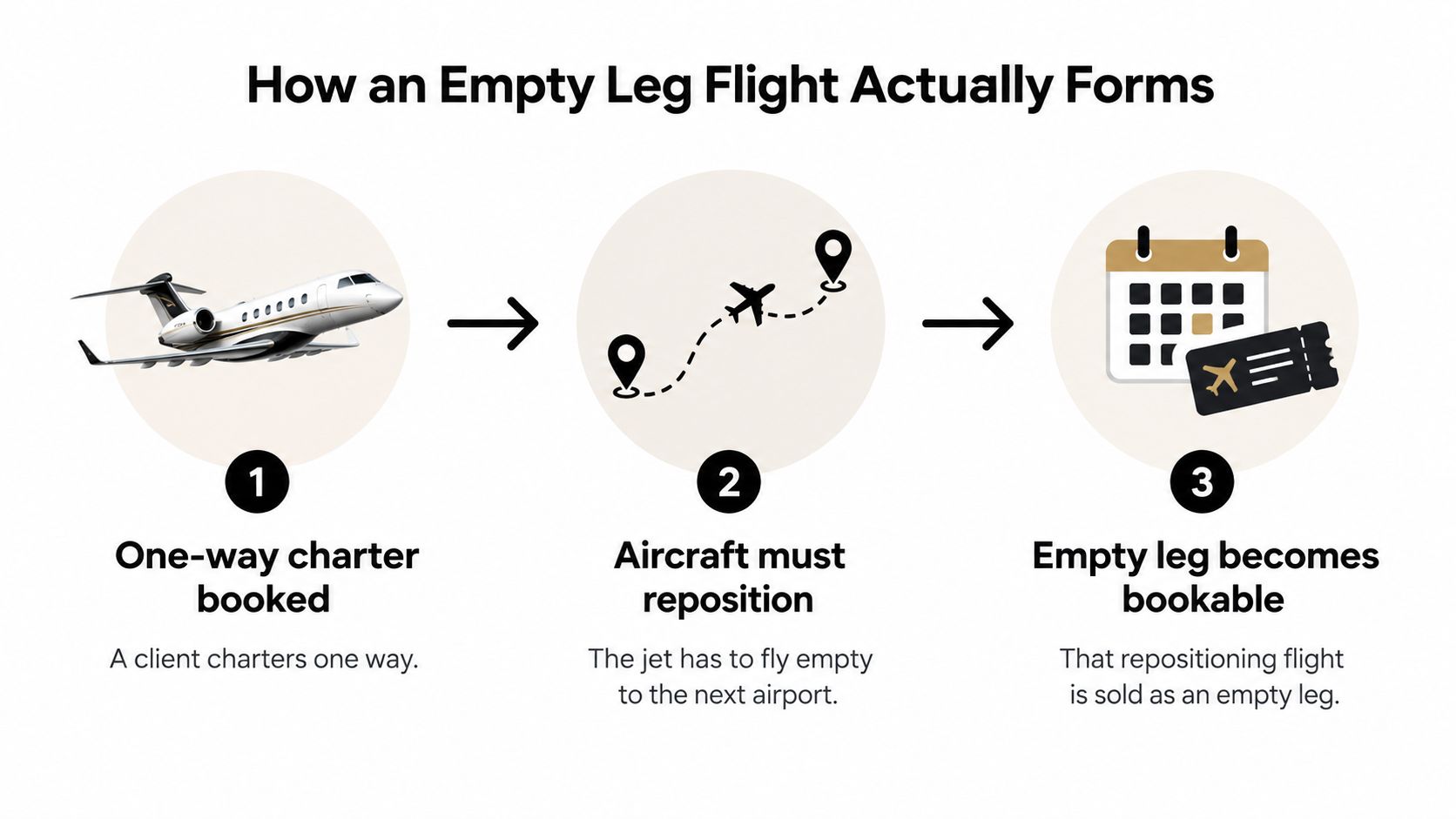
Read the arrows in both directions. The primary charter creates the repositioning requirement, which creates the offer. A change upstream can remove the requirement downstream.
Before discussing cabin preferences, ask where the aircraft is now, which sectors are ferry flights rather than your passenger journey, and which other booking supports the offer. Those questions establish whether you're considering a genuine existing movement or a trip that needs additional flying to become usable.
Separate the passenger journey from aircraft movement
The National Business Aviation Association's operating-options guidance notes that one-way repositioning is commonly billed at the same hourly rate as the occupied leg, and that charter is most cost-efficient when the aircraft is locally based and the trip fits within a day or two.
That's cost logic worth understanding before comparing offers. A locally based aircraft can remove a non-revenue sector. Conversely, a seemingly inexpensive empty leg can require extra aircraft movement before it carries you.
Ask the advisor to describe the aircraft's complete route in plain language. Your departure airport shouldn't be presented in isolation from where the aircraft begins its day or where it must go afterward.
A useful response identifies the current location, the planned pickup, your occupied sector, and any remaining repositioning. An incomplete response gives you only your desired city pair and a headline price.
Don't pay until you understand the operational dependency. You don't need another customer's private details. You do need to know what has to remain unchanged for your flight to exist.
What Empty Leg Pricing Really Includes
An empty-leg quote is a conditional itinerary, not a guaranteed bargain. Its lower price reflects the chance to sell space on a flight the operator already expects to make, while leaving you exposed if the underlying flight changes or disappears.
The operator still has costs: fuel, crew duty, maintenance-hour accrual, navigation charges, landing fees, and aircraft utilization. The cabin being empty does not make those expenses vanish. The discount reflects a commercial opportunity, not the removal of operating costs.
Read the percentage with its limitations
Air Charter Service, as cited in Haute Jets Journal's empty-leg pricing overview, estimates that empty legs account for 30–50% of private-jet charter fleet operations and says discounts can reach up to 75%. That estimate concerns fleet operations, not the share of flight hours, so don't treat the two measures as interchangeable.
Roland Berger's business-aviation analysis provides broader context on the business-aviation market, but it does not substantiate a typical empty-leg discount range or corridor-level median. Judge the offer by its written price and conditions, not by an unsupported market average.
Route, aircraft, timing, and the operator's remaining costs all affect the quote. A large advertised reduction against an expensive comparison charter may still be a poor saving compared with a suitable aircraft sourced locally.
Full One-Way Charter Versus an Empty Leg Quote
| Quote item | Standard one-way charter | Empty leg |
|---|---|---|
| Occupied flight time | Priced for the requested mission | Priced for the available repositioning opportunity |
| Ferry sectors | May include positioning to or from the trip | Confirm whether additional positioning remains |
| Crew and overnight charges | Check what the mission requires | Check what the offered price includes |
| Airport and FBO fees | Confirm charges at the selected airports | Verify the advertised airports and handling charges |
| Taxes and permits | Require itemized treatment where applicable | Don't assume they're included in the headline |
| Cancellation terms | Review customer and operator obligations | Identify remedies if the underlying opportunity is withdrawn |
| Return journey | Can be quoted alongside the outbound | Must be assessed separately |
| Final payable total | Compare the complete mission price | Compare the complete usable-trip price |
Use a private jet charter cost breakdown to compare the full trip, not an isolated hourly rate. The empty-leg market report also recommends comparing occupied time, ferry sectors, crew and overnight charges, airport fees, taxes, permits, and cancellation terms together. Request those details in writing before paying.
A discount is a comparison. Ask what the comparison flight actually includes.
Get a written total for the itinerary you can use, then request a conventional one-way quote from a suitable local aircraft on the same basis. Keep the passenger requirements, airports, and cabin needs consistent. Ask who bears the cost if the operator withdraws the empty leg, and what refund or alternative is available.
If the empty-leg total is not lower, the advertised discount has no practical value. If it is lower, decide whether the withdrawal risk and itinerary restrictions are acceptable before you commit.
When an Empty Leg Is Worth Taking
An empty leg is worth considering when you can adapt the trip to the aircraft. It's a poor choice when you need the aircraft to adapt to an immovable commitment.
The central question isn't whether the cabin is attractive. It's whether the available itinerary works without wishful thinking.

Reject a flight that misses the purpose of the trip
Departure and arrival airports are generally fixed. The Haute Jets Journal guide to empty-leg limitations gives a useful example: a traveler needing 9 a.m. cannot use an offer departing at 3 p.m. It also explains that these trips are normally one-way, so the return requires another compatible opportunity, which is unlikely, or a conventional charter.
Don't solve the outbound while leaving the journey home unresolved. Price and arrange the return before deciding whether the overall trip makes sense.
Flexible leisure travel is a better fit than an arrival tied to a ceremony or meeting. For example, Captain Cook Snorkeling Tours' guide to a Hawaiian bay adventure for snorkelers can help with destination planning, but an appealing activity shouldn't become a fixed commitment until transport arrangements support it.
Establish what happens after payment
One industry empty-leg FAQ estimates cancellations at roughly 10–15%, higher than confirmed full charters. Treat that as one provider's estimate, not a universally audited probability for your booking; the same FAQ explains that legitimate paid U.S. empty legs operate under the Part 135 commercial framework governing crew, maintenance, and operational control.
The discount isn't permission to accept weaker safety standards. The commercial compromise is schedule control.
A primary charter can change, cancel, substitute aircraft, or encounter maintenance or weather problems. Before paying, distinguish these booking stages:
- Request submitted: You've expressed interest, not secured an aircraft.
- Operator confirmation: Establish exactly what the operator has accepted and what remains conditional.
- Final operational approval: Ask which remaining operational checks or dependencies could still affect departure.
Require written answers on refunds, rebooking, and substitute aircraft. Ask whether replacement travel is included or merely offered at a new price, and when a refund would be processed.
For additional context on the flight format, review the accompanying video.
For a wedding, board meeting, sports movement, or international connection, have a viable alternative before paying. A refund may restore the fare, but it won't restore a missed event.
My recommendation is to book only when a changed departure remains tolerable or you've already accepted the cost and logistics of a backup.
The Sustainability Claim Behind Empty Legs
Filling an aircraft that was already scheduled to reposition can improve utilization. That's a narrower statement than saying an empty-leg journey is automatically sustainable.
The relevant distinction is between using existing capacity and choosing a low-emissions journey. Those aren't interchangeable claims, and a lower fare proves neither.
Define the environmental comparison
If an aircraft would fly the same sector regardless of your booking, taking the available cabin may avoid commissioning a separate charter movement. That's a reasonable starting point for a comparison.
But it doesn't establish the result for your whole journey. You may travel through a less direct airport, require additional positioning to make the offer work, or arrange a separate flight home.
The competing claims need to be considered together.
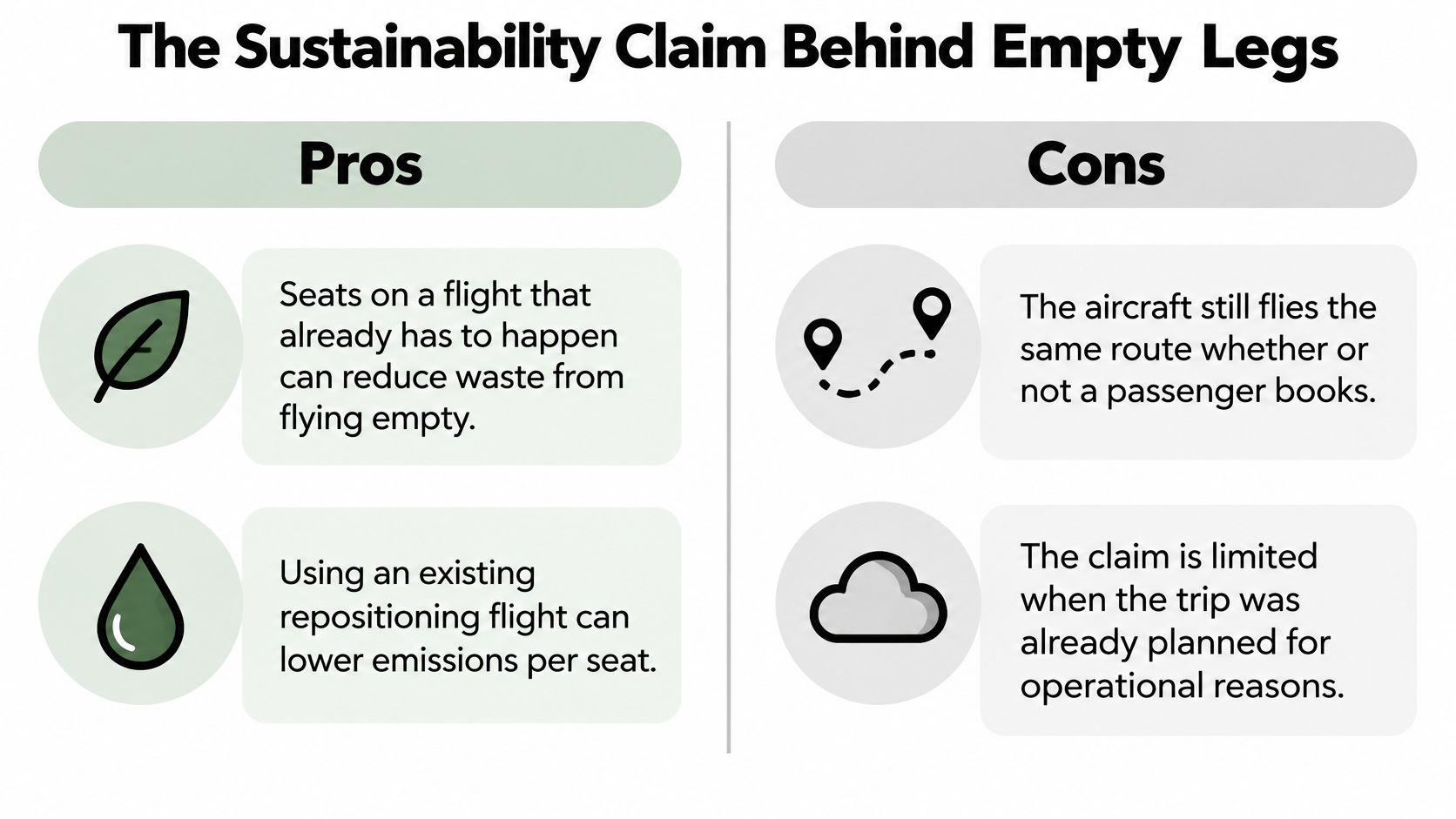
The sustainability discussion published by Fly IUS describes a 2025 analysis of 19 million private flights from 2019–2023, reporting a 46% increase in pollution and estimated 2023 direct carbon emissions of 15.6 million metric tons. The same discussion references a 2025 summary citing ICCT, which estimated 2023 global private-jet greenhouse-gas emissions at 19.5 million metric tons and identified empty repositioning as a major contributor.
Those totals describe different emissions measures. They shouldn't be merged into a single figure or used as though direct carbon emissions and greenhouse-gas estimates were identical.
Ask for the whole journey, not a favorable segment
A useful private jet carbon-footprint assessment should help define what's being counted. For a specific offer, insist on a clear boundary around the comparison.
- Aircraft movement: Does the estimate include every ferry sector needed to accommodate your booking?
- Passenger journey: Does it include the return, rather than only the attractive outbound?
- Alternative transport: Is the comparison against a normal charter, a commercial flight, or leaving the repositioning aircraft empty?
- Accounting basis: Is the claim about total aircraft emissions, allocated emissions per passenger, or incremental movement?
These questions can produce different answers without anyone changing the actual flight. Dividing emissions among occupied seats can improve a utilization measure while the aircraft still performs the same movement.
Better use of an aircraft isn't the same as a low-carbon trip.
My advice is to accept a limited, supportable claim: a compatible empty leg can use capacity that would otherwise go unoccupied. Don't accept an unqualified environmental label without a route-specific comparison.
If nobody can explain which sectors and alternatives the calculation includes, treat the sustainability claim as unsubstantiated. Make the travel decision on disclosed information, not on the assumption that unused capacity has no environmental cost.
How to Book Empty Legs Without Overpaying
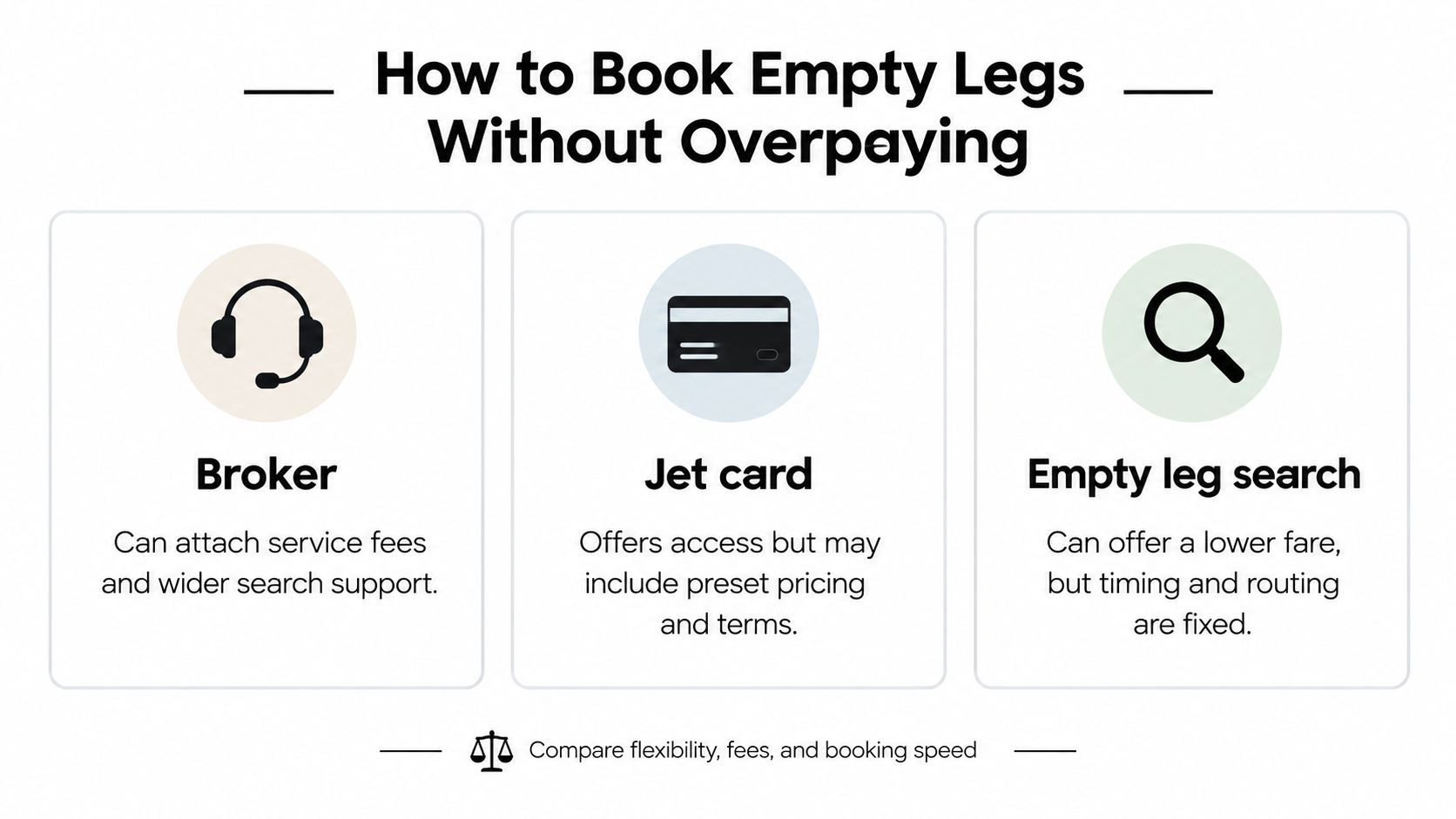
Compare sourcing methods before choosing an aircraft. A traditional broker, a jet card, and an on-demand owner-operator search can produce different pricing structures and different contractual obligations.
None of those labels tells you whether the quoted aircraft is already near your departure airport. Ask that question directly.
Compare access with the actual mission
| Sourcing method | What to examine | Decision to make |
|---|---|---|
| Traditional broker | Aircraft location, service charges, included repositioning, search scope | Does the complete offer justify the service and aircraft selection? |
| Jet card | Prepaid commitment, applicable pricing terms, positioning treatment | Do the program terms suit this specific trip? |
| On-demand sourcing | Local availability, operator, exact aircraft, per-flight terms | Can a nearby aircraft meet the mission without unnecessary ferry flying? |
| Empty-leg search | Available route, departure constraint, underlying dependency | Can you accept the itinerary already available? |
The distinction is between access arrangements and a flight you can use.
Haute Living built Haute Jets around the problem of clients paying for aircraft movements they hadn't requested. Its stated sourcing network covers more than 3,500 owner-operators across 175 countries, from turboprops to ultra-long-range aircraft, with same-day availability in most major metros, as described in its on-demand booking information.
The publisher states that repositioning can inflate traditional broker and jet-card prices by 20–40%, which is why its team searches for locally based aircraft. Treat that as the provider's stated cost rationale, not a guaranteed saving on your particular quote.
Its published model is per-flight wholesale pricing without membership fees, prepaid hours, or blackout dates. The same model applies whether you book one flight or fifty, according to the same booking information.
Confirm the aircraft, not just the category
The service allows selection by year, make, model, and cabin layout. Its Miami-based team confirms Wi-Fi, catering, pet policy, and ground transport, rather than leaving those requirements implicit in a category description.
The publisher limits its operator network to Wyvern Wingman or Argus Gold/Platinum-rated operators, describing these as its highest third-party audit standards. An audit designation should be part of the operator discussion, not a substitute for identifying who will perform your flight.
Its stated confirmation process provides a 24-hour pre-flight package containing the tail number, crew biographies, weather briefing, and passenger manifest, as set out in the booking information linked above. For an empty leg, clarify how that package interacts with any remaining operational dependency.
Send the same requirements to whichever sourcing route you use:
- Mission requirements: City pair, passenger count, baggage, and essential cabin features.
- Flexibility: Acceptable dates, airports, and departure windows.
- Commitment level: Whether arrival is discretionary or tied to an event you cannot miss.
When no suitable empty leg exists, request a locally sourced conventional charter. Don't keep widening the itinerary until the supposedly cheaper flight becomes inconvenient and expensive.
Decide Whether This Empty Leg Should Fly
The right decision doesn't depend on how impressive the listing looks. It depends on whether the offer still makes sense after you remove the advertising language.
Apply a hard acceptance screen to the actual flight in front of you. A failed condition is a reason to stop, not an invitation to explain away the problem.
Approve the offer only when the essentials work
Start with the city pair and departure window. They must fit your plans without relying on an adjustment the operator hasn't accepted in writing.
Then compare the complete payable amount with a locally sourced one-way charter. Use equivalent passenger requirements and usable airports, and include any remaining ferry charges, fees, taxes, and permits.
Finally, read the remedy for operator withdrawal. A contract that promises a refund is different from one that provides replacement transport, and neither should be confused with an informal assurance that the advisor will try to help.
| Decision test | Proceed when | Decline when |
|---|---|---|
| Itinerary | The available airports and timing genuinely work | You need an unconfirmed change |
| Complete cost | The usable trip beats the local alternative | Only the advertised discount looks attractive |
| Contractual remedy | You understand the refund or replacement obligation | Responsibility remains unclear |
| Critical arrival | A viable backup exists | Failure would leave you without acceptable transport |
For a wedding, corporate meeting, sports movement, or international connection, identify the fallback before transferring money. Check whether you can book it when needed, not merely whether another service exists in theory.
Make the next request specific
A useful inquiry states what can move and what cannot. Send the city pair, flexible dates, passenger count, and whether a fixed schedule is mandatory.
Ask the Miami-based team for a live empty-leg option and a locally sourced conventional alternative on the same complete-cost basis. That comparison gives you a defensible decision instead of a reaction to a headline percentage.
If the empty leg passes the screen, accept the restrictions deliberately. If it fails, choose on-demand charter on a nearby aircraft, paid per flight, without taking on a jet card to solve this journey.
The cheapest acceptable flight is the one that meets the trip's requirements, not the one with the largest advertised reduction.
Be particularly disciplined when somebody else depends on your arrival. A corporate travel manager, wedding planner, or production coordinator needs a workable transport plan, not just a favorable booking price.
An empty leg can be a sensible purchase. It should never become an excuse to gamble with an arrival whose importance you already know.
Haute Jets offers empty-leg searches and locally sourced on-demand charter without a membership or prepaid-hours commitment. Visit Haute Jets with your city pair, flexible dates, passenger count, and arrival deadline, then request complete quotes for both options before committing.