

Most advice on private jet charter LA starts in the wrong place. It tells you to pick the closest airport, compare hourly rates, and book the lowest number. That sequence produces slow, expensive trips. A nearby field with no confirmed parking can force your aircraft to reposition after drop off. A cheap hourly rate on an aircraft based two states away can bury you in positioning time. A quote that excludes handling, crew overnight, or taxes is not a quote you can compare to anything.
Judge the trip the other way around. Start with your door, your destination door, and the all in total that connects them. Then work backward to the airport code, the exact aircraft, and the operator who will fly it. On regular Los Angeles work, that single change in order eliminates most surprise charges and most wasted ground time. This guide, published on Haute Jets Journal, applies that all in test to every airport, route, and line item below.
Los Angeles Charter Airports and Which One Fits
The lowest hourly rate may not produce the lowest trip cost. Compare each airport by the full quote and the ground time from the aircraft to your door. A longer drive can erase a cheaper flight, while a closer field can add cost if the aircraft must reposition or parking is unavailable.
Los Angeles charter airports at a glance
| Airport | Best fit | Access and ground notes | Drive to Beverly Hills |
|---|---|---|---|
| Van Nuys (VNY) | Default hub for most Los Angeles charters | Two private terminals; no scheduled airline traffic | Traffic dependent Valley drive |
| Santa Monica (SMO) | Westside, Santa Monica and Malibu clients | Shorter runway and noise rules limit jet size | About 10 to 20 min |
| Burbank (BUR) | Valley clients and studio productions | Shares field with airline traffic; confirm FBO handling | Traffic dependent Valley drive |
| LAX | Large cabin and international departures | Ramp space limited at peaks; arrival restrictions may apply | Traffic dependent Westside drive |
| Ontario (ONT) | Overflow and repositioning alternate | Useful when Los Angeles ramps are full | About 60 to 75 min |
| John Wayne (SNA) | Orange County clients | Confirm jet ramp access and operating rules before quoting | Longer Orange County drive |
Drive times are estimates, not promises. Traffic can make a nearby airport slower in practice, so compare the transfer to your actual destination rather than relying on distance alone.
Why Van Nuys anchors the market
Van Nuys Airport (VNY) opened as Metropolitan Airport on December 17, 1928. According to Los Angeles World Airports history of Van Nuys operations and activity, the airport recorded 334,068 operations in 2024, with general aviation at 89.5% and charter at 10.4% of activity. Its 8,001 foot primary runway and lack of scheduled airline traffic make access and ground handling simpler for many business-jet trips.
Signature Aviation's East and West private aviation terminals are common access points for Los Angeles charters. Confirm handling arrangements, ground transport, and crew rest directly with the FBO before booking. For details on chartering a private jet from Van Nuys and how quotes are structured, compare the quoted airport and services with your itinerary.
Where the other fields win
LAX fits large-cabin and international departures, but limited ramp space can restrict arrivals during peak periods. Its instrument landing systems support operations in reduced visibility, though that does not remove the need to confirm airport access and timing. Santa Monica (SMO) can shorten the ground transfer for Westside and Malibu passengers, but its shorter runway and noise rules limit the jets that can use it.
Burbank (BUR) often suits Valley clients and studio trips. Since it shares the field with airline traffic, confirm FBO handling and expected ground time. Ontario (ONT) can work as an overflow alternate when Los Angeles ramps fill, but the drive to Beverly Hills is longer. John Wayne (SNA) is convenient for Orange County clients; verify that the specific jet can use the ramp and meets operating rules.
Practical rule: Ask for each quote by airport code, not simply “Los Angeles.” The same aircraft and route can produce different totals at VNY, BUR, LAX, SNA, and ONT.
Positioning, landing, handling, parking, and ground transport vary by field. An aircraft already based at a farther airport, with parking confirmed, may cost less overall than one that must reposition, drop off, and leave. Give the charter planner your preferred airport, passenger count, baggage volume, customs requirements, and maximum acceptable transfer time. Then compare the complete trip cost alongside the time from the airport to your door.
What Charter Really Costs and the Hidden Fees
A lower hourly rate can produce a higher total. The deciding figure is the all-in cost of getting the right aircraft to your departure airport, completing the trip, and covering any required repositioning or overnight expenses. Compare complete itineraries, not isolated hourly rates.
Indicative hourly charter rates by aircraft class
| Aircraft class | Example aircraft | Indicative hourly rate | Typical Los Angeles trip |
|---|---|---|---|
| Light jet | Phenom 300 | $2,500 to $5,000 | Los Angeles to Las Vegas and short Southern California hops |
| Midsize jet | Challenger 350, Citation Latitude | $4,000 to $8,000 | Los Angeles to Aspen, Scottsdale or Cabo San Lucas |
| Heavy or ultra long range | Large cabin long range jets | $8,000 to $15,000+ | Los Angeles to New York or London |
These rates exclude taxes and extra fees. The 2026 Forbes guide to private jet hourly rates and added trip costs gives indicative ranges of $2,500 to $5,000 per hour for light jets, $4,000 to $8,000 for midsize jets, and $8,000 to $15,000 plus for heavy or ultra long range aircraft. Taxes, landing fees, crew expenses, and repositioning can raise the final bill.
Worked totals, before extras
Check the arithmetic before comparing quotes. A one-hour Las Vegas flight in a light jet starts in the low thousands before extras. A midsize jet on a 2.5-hour Aspen flight comes to about $10,000 to $20,000 before extras at the listed hourly rates. For a heavy jet on a five and a half hour New York trip, flight time alone puts the total around $44,000 to $82,500 before extras.
Those figures cover flight hours only. They do not include Aspen parking in February, a crew overnight in New York, or a positioning leg to bring the aircraft to Van Nuys. A quote with the lowest hourly rate can therefore have the highest total when the aircraft is not based nearby or required trip costs are left out.
The line items to get in writing
Use the same checklist for every quote. If a charge does not apply, ask the seller to state that in writing.
- Positioning leg: Where is the aircraft based, and does the quote include its flight to Los Angeles or return after drop-off?
- Minimum billable hours: Does the trip have a daily or segment minimum, even if the flight itself is short?
- Landing and parking: What will each airport charge, including overnight or event-period parking?
- Fuel, handling and de-icing: Are fuel and FBO handling included? Who pays if winter weather requires de-icing?
- Catering, crew overnights and ground transport: Which costs are included, capped, or passed through at cost?
- Taxes and fees: Does the quoted total include government taxes and broker or carrier fees?
Federal broker rules under Part 295 require disclosure, when requested, of the transportation's total cost, including broker or carrier fees and government taxes. Request that figure in writing rather than relying on a verbal assurance that the quote is all in.
Compare any positioning charge with competing quotes for the same aircraft specification and departure airport. There is no universal percentage: the cost depends on where the specific aircraft is based relative to your departure field. Two quotes for the same model can differ because one aircraft is already at VNY while the other must fly in empty.
Airport choice is a cost decision
Choose the departure field by aircraft weight, parking availability, customs needs, the client's destination, and the drive from the ramp. For a Malibu client, Santa Monica may cut ground time compared with Ontario. Ontario could still be the better choice if the aircraft is already there and available, while a Santa Monica departure requires repositioning. Compare the full trip to the client's door, not just the hourly rate or airport fee.
The cheapest airport on paper may cost more door to door once ground transport and an empty repositioning leg are included.
Close each comparison by requiring the departure airport, the aircraft tail number, the operator, and any repositioning leg in writing. Without those details, quotes are not comparable. The airport that looks cheapest on the first page may add both a longer drive and a positioning charge to the final bill.
Common Los Angeles Routes and the Aircraft for Each
The aircraft below aren't recommendations in isolation. They're consequences of distance, passengers, bags, runway, and weather margin on each route.
Common Los Angeles routes, flight times and fitting aircraft
| Route | Approximate flight time | Aircraft class that fits | Planning note |
|---|---|---|---|
| Los Angeles to Las Vegas | About 1 hour | Light jet | Common short trip; per flight pricing matches the aircraft to the route |
| Los Angeles to Aspen | Regional midsize block | Midsize jet | Check runway performance and winter weather alternates |
| Los Angeles to Cabo San Lucas | Regional international block | Light or midsize jet | Passport and customs handling for international arrival |
| Los Angeles to New York (Teterboro) | About 5 to 5.5 hours | Midsize with range margin, or heavy jet | Winds and crew duty limits can add time |
| Los Angeles to Honolulu | About 5 to 5.5 hours | Midsize long range or heavy jet | Over water routing; plan fuel and alternates |
| Los Angeles to London | Transatlantic long haul block | Heavy or ultra long range jet | Long range cabin needed; a fuel stop is possible |
The parked aircraft view below shows the starting point for most of these decisions, a specific tail on a specific ramp, not a generic category.

Three trips, three different answers
A client flying to a same day Las Vegas meeting needs a light jet. The one hour block keeps hourly cost contained, turnaround is simple, and a larger cabin buys nothing except a higher bill. Oversizing this trip is the most common waste on the route.
A group of eight heading to Aspen in winter needs a midsize jet, and not because of the seat count alone. You need runway and weather margin for alternates, plus baggage volume that light jets handle poorly when ski gear enters the manifest. Cutting to the smallest aircraft that technically seats eight leaves no room when conditions deteriorate.
A transatlantic plan to London needs a long range cabin, sometimes with a fuel stop depending on the specific aircraft, winds, and payload. Cabin layout for rest matters here in a way it never does on the Las Vegas hop, and crew duty planning becomes part of the quote conversation early, not after booking.
The short video below walks through how those route factors change the aircraft shortlist in practice.
This is how on demand charter is supposed to work. Based on Haute Jets Journal's explanation of matching a specific aircraft to a passenger's route, an on demand charter matches a specific aircraft to your route rather than selling a generic seat or fixed category, with New York to Miami and Los Angeles to Las Vegas used as example routes. Start your request with route, passenger count, and bag volume, then ask for the aircraft that fits.
Planning rule: Size the aircraft to the trip with margin for headwinds, diversions, and luggage, not to the lowest hourly rate you can find on a rate page.
Last-Minute Availability During Peak Dates and Empty Legs
Peak weeks in Los Angeles can limit aircraft parking and handling, not just raise charter prices. When ramp space is tight, the airport with the lowest quoted rate may not deliver the lowest all-in cost or the quickest trip to your door. An aircraft may need to reposition after arrival, adding movements to the bill and making your departure depend on its return.
For the 2026 Milken Institute conference, Business Travel Authority's Milken conference Los Angeles logistics report reports estimates of 380 to 480 daily IFR business jet operations, compared with an off-peak baseline of 220 to 280, and ramp utilization of 95 to 100%. Treat these as the report's estimates, not a guarantee of conditions on a particular date. In a crowded period, overnight parking may be unavailable. Ask the operator whether the aircraft can remain at your chosen airport, or whether repositioning and a return movement could add cost or affect timing.
Do not assume the same coordination or slot requirements apply at every Los Angeles-area field. Ask the airport and operator directly whether slots, prior coordination, parking, or handling confirmation apply to your date and aircraft. Get any confirmed arrangements and related charges reflected in the quote.
World Cup 2026 makes this concrete
For the 2026 FIFA World Cup, Signature Aviation's western host cities guide placing Van Nuys about 22.5 miles from SoFi Stadium puts Van Nuys approximately 22.5 miles from SoFi Stadium and identifies East and West private terminals. The guide also notes that LAX ramp space is limited, with possible restrictions on simultaneous arrivals. Those details make the trade-off practical: compare the quoted airport with the ground time to your actual destination, and ask whether parking and handling are confirmed. A field farther from the stadium can still produce a faster, less expensive door-to-door trip if it avoids extra aircraft movements or a long wait.
Where empty legs actually help
An empty leg is a one-way flight on an aircraft repositioning for another paid charter, often offered at a discount. Skyaccess's explanation of Part 135 rules applying to empty leg repositioning sectors explains that these repositioning sectors operate under FAA Part 135 rules. The discount reflects flexibility in using an existing flight, not a different safety framework.
The schedule is the trade-off. The aircraft's planned repositioning largely determines the departure field, date, and timing, so an empty leg suits travelers who can adjust their plans. If you have a fixed meeting or return, a regular charter may be the more dependable choice. Review empty leg flights from Los Angeles and how their fixed schedules work before building your itinerary around one.
During busy weeks, compare airports by the complete trip: charter charges, possible repositioning, confirmed parking and handling, and ground time to the client's door. Stay flexible on the field when you can, and ask both the broker and operator what is confirmed. A lower hourly quote at VNY is no saving if parking is unavailable or the aircraft must reposition; another airport only wins when its total cost and ground transfer work better.
How to Choose the Exact Aircraft and Verify the Operator
Treat this as a diligence sequence, not a shopping exercise. Each step removes a category of surprise that shows up later as a fee, a delay, or a safety question you can't answer.
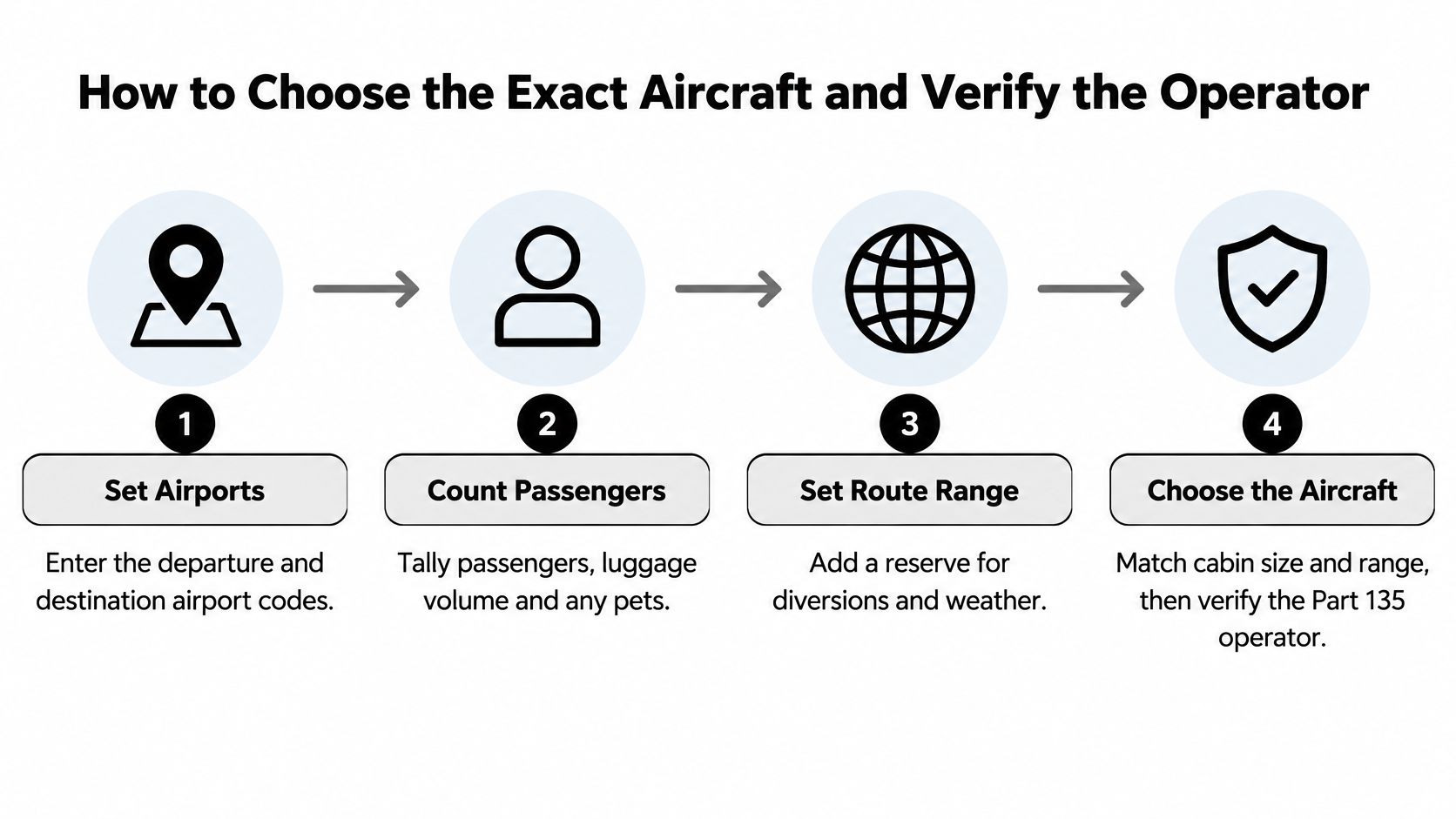
The process flow below summarizes the first four decisions before operator checks begin.
The eight step check
- Set airports by code. Name the departure and destination fields first. The common slip is quoting Los Angeles generically, which lets each seller price a different airport.
- Count passengers, luggage, and pets. Bag volume, not headcount, is what usually breaks a light jet plan. Declare pets now, not at the ramp.
- Set range with reserve. Add margin for diversions and weather. An aircraft that can just reach the destination on a good day is the wrong aircraft.
- Name the exact aircraft. Move from class to a specific year, make, model, and cabin layout, with WiFi and seating confirmed. Category only bookings invite substitutions.
- Identify who flies you. Get the operator name, the Part 135 certificate holder, and the tail number. The seller may not be the certificate holder, and that distinction matters. Background on the framework is in this guide to FAA Part 135 operators and certificate holders.
- Check the third party rating directly. Look for Wyvern Wingman or Argus Gold or Platinum, and verify it with the rating provider before accepting it. Don't rely on a logo in a proposal.
- Ask about safety management and flight data monitoring. This is the most informative question on the list, and most clients never ask it.
- Compare two quotes on one specification. Same airports, same aircraft standard, same inclusions. Otherwise you're comparing brochures.
On step 7, NBAA's description of flight data monitoring and operational quality assurance describes Flight Data Monitoring, also called Flight Operational Quality Assurance, as proactive analysis of routine data from onboard recorders to identify hazards and recurring triggered events. That analysis can surface unstable approaches, excessive descent rates, runway excursions, or repeated exceedances before they become accidents, letting safety managers change procedures, training, or dispatch practices. An operator who systematically turns individual flight events into fleet level preventive action tells you more than aircraft age or cabin finish ever will.
Applied as a sourcing model, those steps look like this. Haute Jets sources from owner operators holding Wyvern or Argus ratings, lets travelers select the exact year, make, model, and cabin, and confirms WiFi, catering, pet policy, and ground transport for the booking. Treat any broker statement about sourcing or included services, from any seller, as a claim to confirm in writing on the quote itself.
A third party rating screens the operator. It doesn't replace asking who the certificate holder is, which tail you're on, and whether flight data is monitored.
Confirm the Quote and Book Your Los Angeles Flight
The lowest hourly rate can produce the costliest trip if the airport adds a long drive to your destination. Confirm the aircraft, schedule, and ground transfer together, then judge the booking by the all-in cost and time to your door.
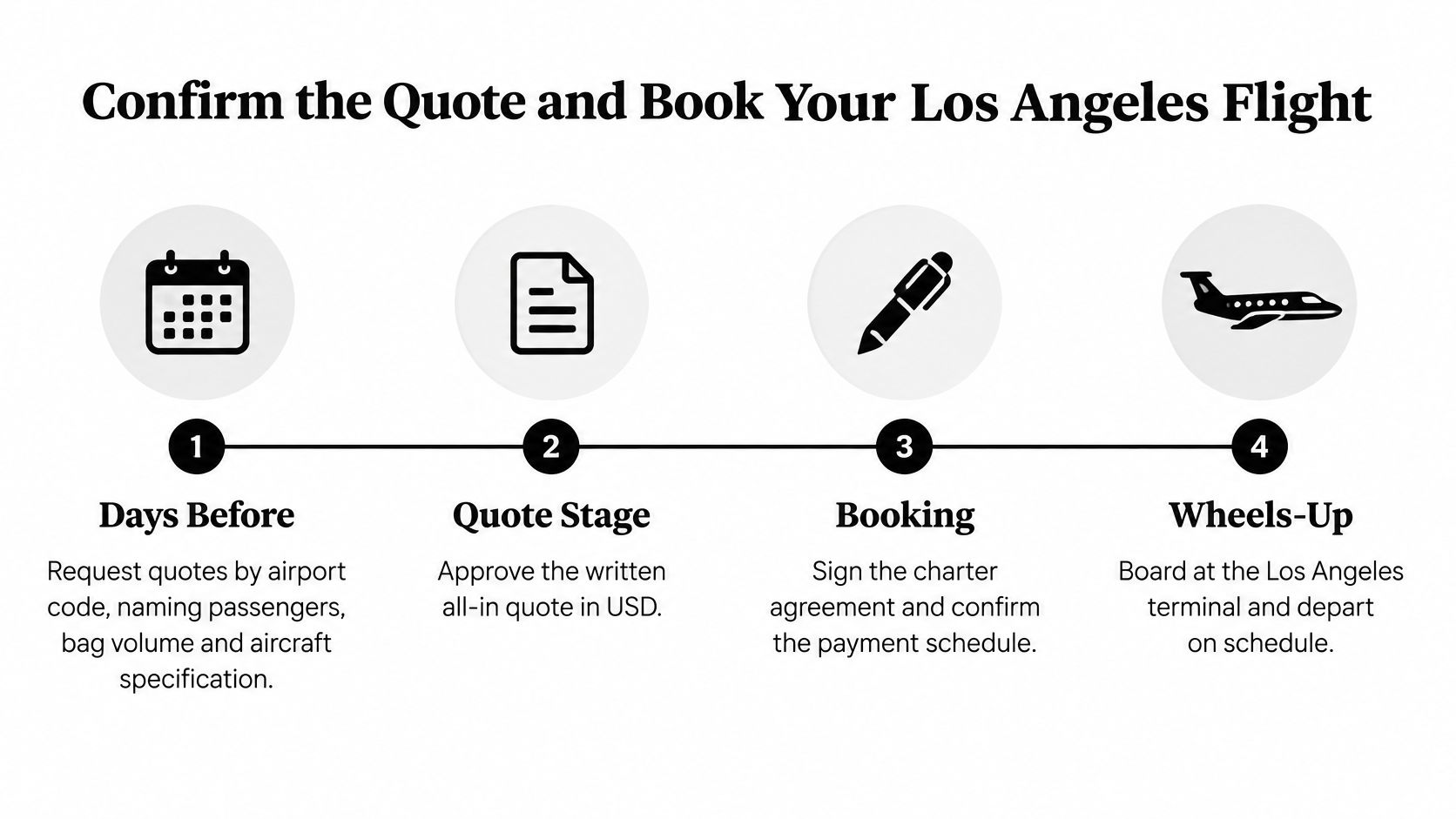
Use this sequence to move from request to departure.
Days before departure
Request quotes using airport codes, passenger count, baggage volume, and the aircraft specification you selected. Include your maximum ground-transfer time and any customs requirements. Sellers price the details provided, so missing information can lead to a change fee or an aircraft that does not fit.
Approve a written all-in total that names the operator and tail number and states whether repositioning is included. Check the charter agreement and payment schedule against that quote before signing. If the total changes, ask for a revised written quote, not a verbal adjustment.
The final 24 hours and departure day
About 24 hours before departure, expect a preflight package with the tail number, crew biographies, weather briefing, and passenger manifest. Check names against identification, confirm the correct FBO for ground transport, and verify that catering and pet arrangements match what you approved. Fixing a mismatch before leaving for the airport is simpler than sorting it out at the FBO.
Event-period operations may add dispatch constraints. For World Cup flights, confirm the applicable filing timeline and any event-period dispatch windows directly with the operator or dispatcher. The FAA World Cup 2026 operating plan for business aviation flight plan filing windows provides event-specific guidance, but your dispatcher should confirm the requirements for your flight. If a ground delay program applies, the aircraft must depart within 5 minutes of its assigned Expect Departure Clearance Time (EDCT) or request a new clearance. Allow enough time for passengers to reach the aircraft, and ask the dispatcher what happens if the assigned window is missed.
At booking, verify the pricing model as well. Per-flight charging with no membership, no jet card, and no prepaid hours lets you assess each trip on its own all-in total, without a deposit or hours commitment affecting the comparison.
Before paying a deposit, check these four items:
- Airport confirmed: Departure and arrival airports are identified by code, with parking and handling confirmed.
- All-in quote in writing: Repositioning, minimums, fees, and taxes are stated.
- Operator and tail verified: Confirm the certificate holder, tail number, and rating.
- Preflight package received: Review crew details, weather, and manifest before leaving for the airport.
If any item is missing, the booking is not fully confirmed, whatever the email subject line says.
Send Haute Jets your Los Angeles airport codes, route, passenger count, and baggage volume to request per-flight pricing for the aircraft and trip. Compare the written all-in total, operator, and tail number before deciding. Request a quote from Haute Jets.