

You've got two tabs open, two hourly rates for what looks like the same jet, and a trip next week that can't slip. One private jet charter calculator gives you a tidy number in seconds. Then a real quote lands in your inbox, noticeably higher, with line items you never saw in the estimate.
That's not necessarily a markup problem. It's usually a math problem. The calculator priced the flight you typed in. The quote priced the trip the aircraft has to fly, including getting to you, waiting for you, and getting home.
The skill isn't finding the lowest hourly rate. It's reconciling the estimate against the quote, line by line, so you can see what's aircraft, what's logistics, and what's still provisional.
How Charter Calculators Build a Total Trip Cost
Start with the temptation most first-time charter clients face. You compare two light jets by hourly rate, pick the cheaper one, multiply by the hours in the air, and call that your budget.
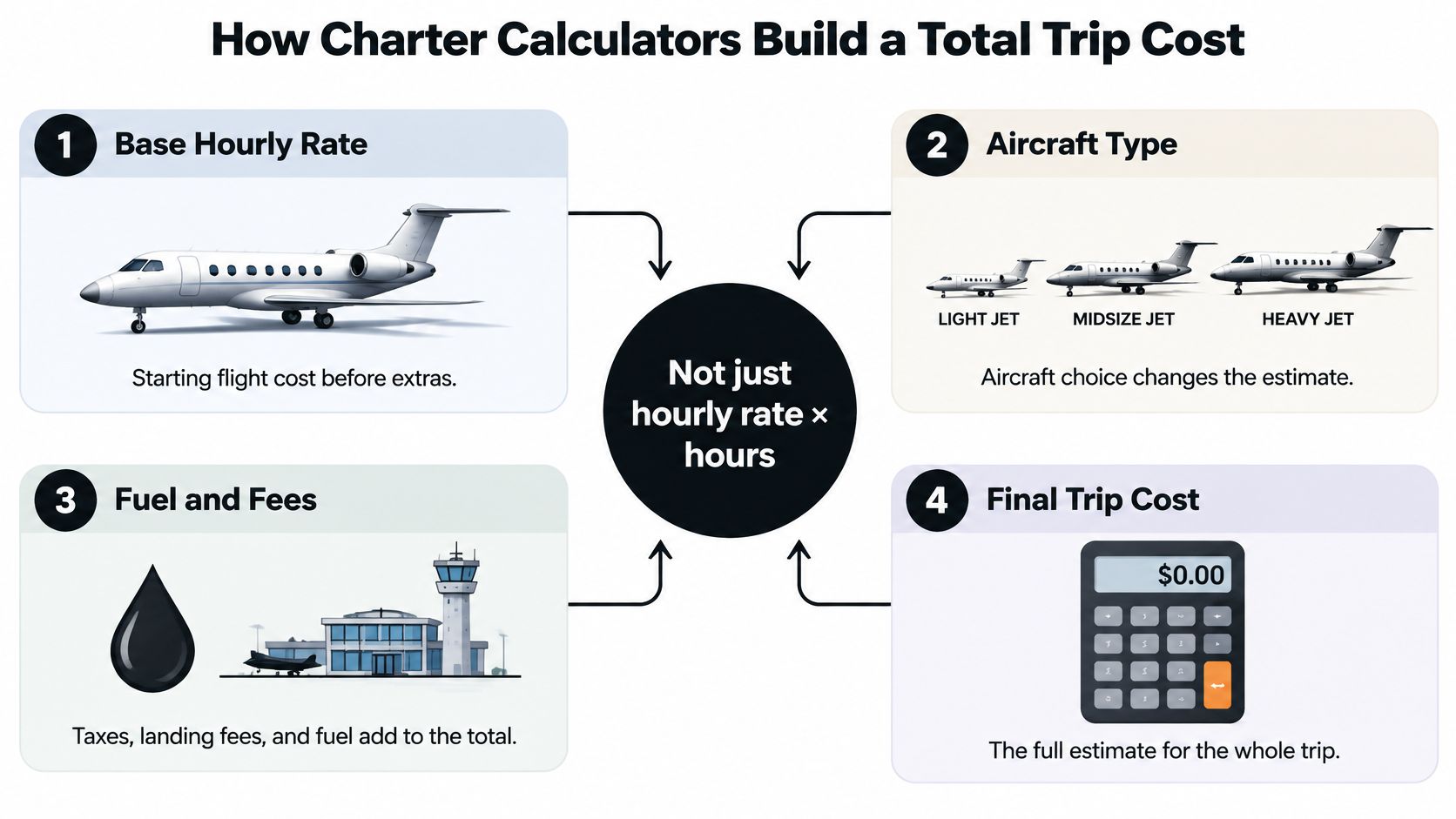
A credible calculator doesn't work that way. It's a total-trip-cost model, not a simple hourly-rate multiplier, and the National Business Aviation Association identifies the hourly aircraft charge as only one component alongside one-way charges, fuel surcharges, wait time, crew expenses, catering, ground transportation, overflight fees, landing and handling charges, customs, security fees, and federal excise taxes in its NBAA aircraft charter consumer guide.
What goes into the stack
Think of the estimate as layers. The first layer is occupied flight time, the hours you're aboard. The second is aircraft movement around your trip, because an aircraft may need to fly empty before or after your segment to be in position.
The third layer is trip-specific charges that have nothing to do with cruise speed. Those include:
- Fuel and surcharges: Tied to the specific aircraft's burn and your routing, not a flat average.
- Crew costs: Transportation, lodging, and meals when the itinerary keeps the crew away overnight.
- Airport charges: Landing, handling, parking, and FBO fees that vary sharply by field.
- Requested services: Catering and ground transport, which are choices, not defaults.
- Taxes and regulatory fees: Applied on top of the operating subtotal.
Practical rule: If a calculator shows you one number with no visible components, you don't have an estimate yet. You have a headline.
Why itemization is the whole point
The NBAA framework recommends asking operators to state both the hourly rate and every additional cost that could be charged. A good calculator follows that same logic. It should produce an estimated all-in price and tell you which variables can change before confirmation.
That transparency is what lets you compare options fairly. A slightly higher hourly rate from an aircraft already sitting at your departure airport can produce a lower trip total than a cheaper rate attached to an aircraft that has to travel to reach you. You can't see that trade-off until the calculator separates occupied time from repositioning time.
Entering the Inputs That Move Your Estimate
Enter inputs in the order a planner would, and don't trust the output until each one reflects the actual trip. A useful calculator should collect departure and arrival airports, aircraft type, flight duration, passenger count, routing, one-way or round-trip status, expected positioning, crew requirements, and airport-specific fees.
Start with airports, not cities
Type specific airports, not metro areas. The field you choose affects runway suitability, handling charges, and whether your preferred aircraft category can operate there at your passenger and baggage load.
Confirm the city pair works before you care about price. A technically credible workflow validates the route, runway constraints, and load first, then calculates block hours. If the aircraft can't perform the mission from that field, the estimate is fiction regardless of how precise it looks.
Then set the trip shape
The one-way or round-trip decision changes the math more than many expect. A round trip returning the same day keeps the aircraft with you. A one-way may leave the aircraft needing to return empty, and someone pays for that movement.
Multi-day plans add another layer. If you stay three nights, ask whether it's cheaper for the aircraft to wait with crew lodging and parking, or to leave and return. The calculator needs your actual dates and overnight pattern to model that accurately.
- Passenger count: Enter real headcount plus heavy baggage, because load can force a larger category or a fuel stop.
- Aircraft type: Pick a category that fits range and cabin needs, then test one size up and down.
- Routing: Add intermediate stops rather than estimating a straight line and hoping.
- Crew requirements: Flag long duty days or international legs that may need augmented crew.
- Airport fees: Note event dates or premium fields where handling and parking spike.
The passenger count trap
More passengers don't make the aircraft proportionally cheaper to operate. The jet, crew, fuel, and positioning legs stay largely fixed whether four people board or six. That's why cost per passenger can look flattering while the total barely moves. Enter passenger count to size the aircraft correctly, not to justify the trip on a per-seat basis.
Aircraft Category Ranges and What They Mean
Category is the biggest single lever inside the hourly assumption. Step up one class and you haven't just bought more legroom. You've changed fuel burn, crew costs, landing weight, and every hourly line that follows.
One pricing overview places light jets at $3,500 to $5,500 per flight hour, midsize jets at $5,500 to $7,500 per hour, and heavy jets at $9,500 to $13,000 per hour, with an overall range across most aircraft of about $2,300 to $17,000 per hour and VIP airliners reaching roughly $18,000 to $23,000 per hour in the Haute Jets average private jet cost overview. A broad domestic working estimate of $3,000 to $8,000 per hour is offered in that same overview, but the trip total still depends on class, route, and positioning.
Working Hourly Ranges by Aircraft Category
| Aircraft category | Hourly range per flight hour | What it changes in the estimate |
|---|---|---|
| Light jet | $3,500 to $5,500 | Lowest baseline for short routes, smaller cabin and baggage capacity |
| Midsize jet | $5,500 to $7,500 | More range and cabin space, higher fuel and crew cost per hour |
| Heavy jet | $9,500 to $13,000 | Long-range capability, largest hourly baseline before fees |
| VIP airliner | $18,000 to $23,000 | Airliner-scale cabin, priced well above conventional categories |
When stepping up is worth it
Pay for the larger cabin when the mission demands it. That means nonstop range the smaller category can't cover, a passenger load that won't fit safely, or a stand-up cabin your group needs for a long leg.
Don't pay for it out of habit on a short hop. On a brief regional route, a light jet that handles the distance comfortably will usually produce a cleaner total than a midsize burning more fuel for space nobody uses. Run your route through the aircraft selection process so the category matches range, runway, and load before you compare prices.
One caution from experience. A faster, larger aircraft occasionally finishes a leg in fewer block hours, which narrows the hourly gap. That's why you compare trip totals at the same routing, not isolated hourly badges.
Empty Legs and Repositioning in Your Estimate
The cheapest empty leg on a listings page doesn't always produce the cheapest trip. Sometimes it doesn't produce your trip at all.
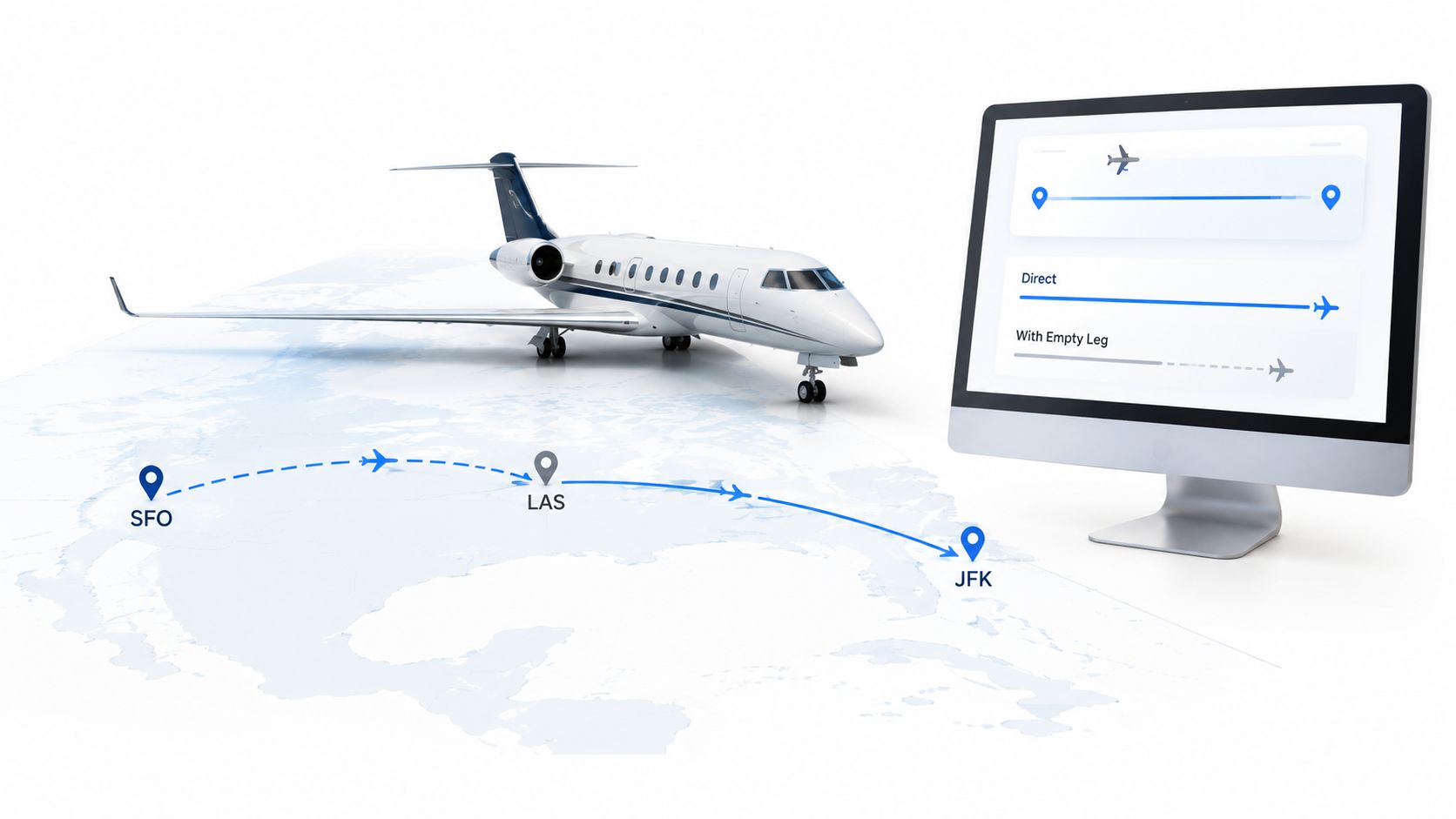
Here's the flight path view most calculators start from, before positioning is layered in.
Distance isn't billable time
The most common calculator failure is treating route distance as the billable itinerary. Audit three geometries instead. Compare great-circle distance, scheduled block time, and total aircraft movement, including the inbound positioning leg and the return to base.
NBAA guidance identifies approximately 10% deadhead or ferry hours as a business-aircraft planning rule of thumb, but actual exposure can be materially higher when the aircraft isn't based near your departure airport, as noted in the NBAA rules of thumb for business aircraft ownership and operating options. Published estimates also indicate that positioning alone may add 20 to 30%, while combined additions can raise domestic trip costs by roughly 25 to 40%, according to Hogani Jets guidance on what's included in a charter price.
Run two scenarios side by side:
- Local aircraft: Prices only your passenger itinerary plus normal fees and taxes.
- Repositioned aircraft: Prices every empty leg needed to reach you and return home.
The gap between those two numbers is your logistics cost. Once you see it, the hourly rate debate often becomes secondary. Proximity can matter more than cabin category.
The video below walks through how that positioning logic plays out in a booking flow.
Where empty legs actually help
An empty leg works when an aircraft is already moving empty in the direction you need, on a date you can accept. The discount exists because that movement was happening anyway. If your route, timing, or airport doesn't match, forcing the fit can add ground transfers and schedule risk that erase the saving. The empty leg flight guide covers how to judge that match before you build plans around it.
Reading Your Estimate and Checking It Against the Quote
Treat the calculator result as a preliminary estimate, not a binding quote. It uses your itinerary and aircraft inputs, including departure and arrival locations, aircraft type, distance, and estimated flight time, and it may incorporate fuel and standard crew costs, but the figure can change once real-time factors are confirmed, as explained in the Haute Jets private jet cost calculator guide.
Separate what's known from what's provisional
Some elements are stable the moment you enter them. Your airports, routing, passenger count, and chosen category won't move unless you change the trip. Those are your knowns.
Other elements are placeholders until an operator confirms them. Availability, airport or FBO charges, crew positioning, de-icing, and event-related fees can all shift. A strong calculator shows a high and low range for weather, airport, and schedule changes instead of one number with false precision.
Don't budget to the decimal on a calculator output. Budget to the range, and hold the firm number for the itemized quote.
Reconcile before you approve
When the quote arrives, do the arithmetic. The displayed total should equal block-hour charges plus every listed surcharge, tax, and pass-through fee. U.S. domestic private air transportation generally includes a 7.5% Federal Excise Tax, subject to applicable rules and exemptions. If that tax, positioning, or overnight charges aren't visible as lines, ask where they're sitting.
Ask four direct questions:
- What's itemized: Is repositioning shown separately or buried in the hourly rate?
- What's excluded: Are de-icing, catering, and ground transport in or out?
- What's assumed: Which aircraft, based where, and as of what time?
- What triggers a change: Weather, schedule moves, or airport swaps?
The private jet charter quote breakdown gives you the structure to compare that document against your calculator estimate without guessing.
Comparing Calculator Estimates With Other Booking Options
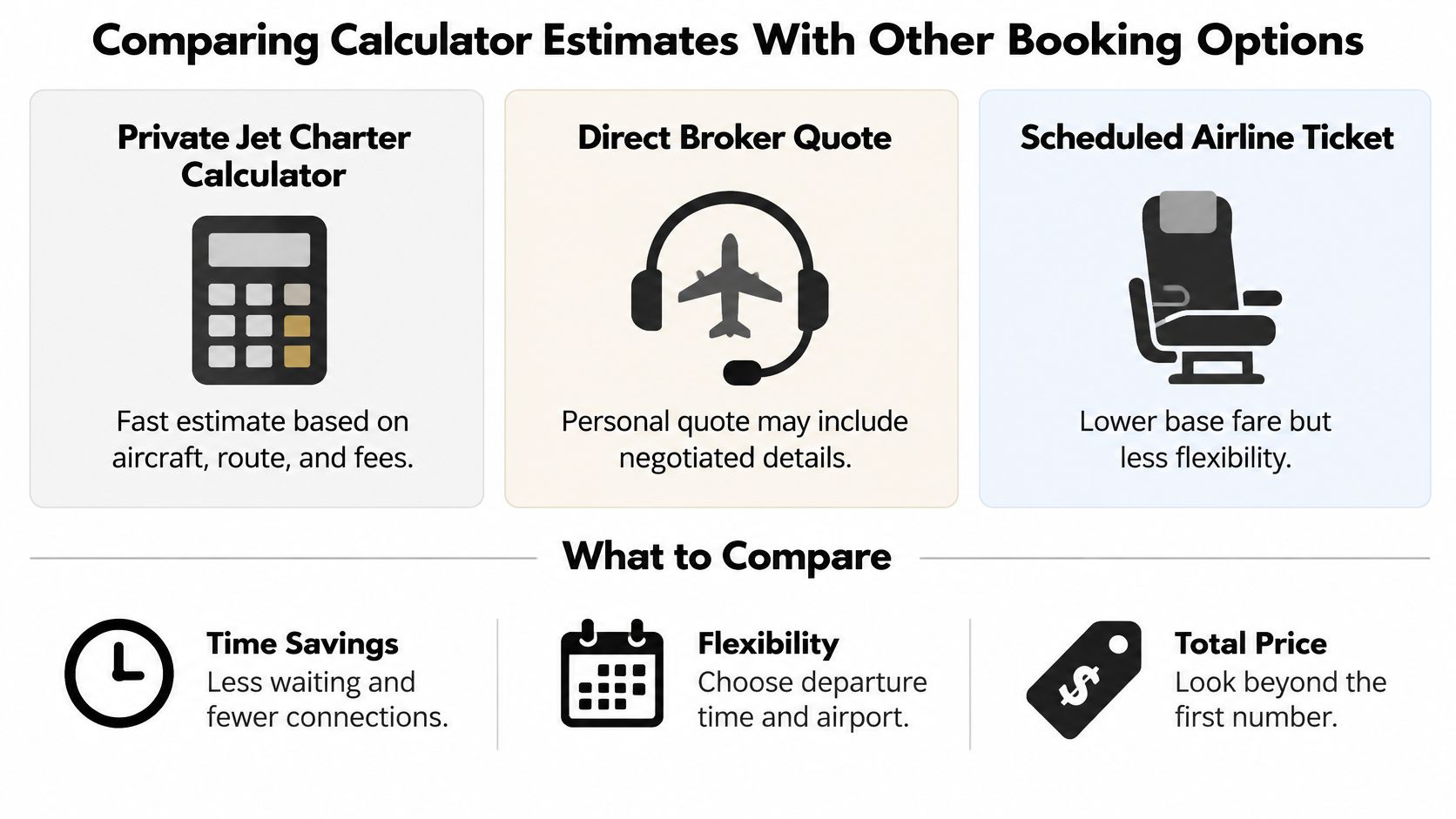
A calculator estimate, a broker quote, and a jet card price can all describe the same trip at three different totals. The comparison only works if you force each one onto the same basis, a complete trip estimate rather than an advertised hourly figure, as recommended in the Haute Jets guide to how much it costs to fly private.
Criteria that actually separate options
Judge each option on what's included. Does it show an itemized total? Does it price repositioning openly or absorb it into a fixed rate you'll pay whether the aircraft travels or not? Can you choose the specific aircraft, or only a category?
Jet cards trade flexibility for prepaid simplicity, and that fixed hourly structure can suit repeat flyers on predictable routes. On-demand charter prices each trip on its own logistics, which rewards routes where a suitable aircraft is already nearby. Neither is automatically cheaper. The route decides.
Haute Jets sources aircraft from more than 3,500 owner-operators across 175 countries, looks for aircraft near the departure city to reduce repositioning, and lets clients select the specific year, make, model, and cabin layout. It charters only from Wyvern Wingman or Argus Gold or Platinum rated operators and charges per flight with no memberships or jet cards. That's one concrete model to test your calculator estimate against, using the same itemization checks you'd apply anywhere.
The same discipline applies outside aviation. Anyone who's booked private charters with Sunset Sail USA knows a headline vessel rate and the final cost of fuel, crew, and timing aren't the same conversation. The asset changes. The cost stack logic doesn't.
For route-level sanity checks, concrete examples help. A published example gives a midsize-jet Miami to New York round trip at approximately $39,000, which is why route-specific pricing can differ materially from multiplying an hourly rate by airborne time.
Booking Your Haute Jets Charter From Estimate to Confirmation
You have a reconciled estimate and a category that fits. The booking step is mostly about submitting a complete request the first time, so the quote you get back doesn't need three rounds of clarification.
Assemble the request before you send it
Gather the inputs you'd enter into any serious calculator. That means departure and arrival airports, dates and preferred times, one-way or round-trip status, passenger count, baggage that affects load, and aircraft preferences down to year, make, and model if you have them.
Add the services that change the final invoice. Note catering expectations, ground transport, pet policies, and Wi-Fi needs now, not after the quote. Each one is a line item or an aircraft filter, and surfacing them early keeps the confirmed price close to the quoted price.
For context while you compare the returning quote, published route examples list light jets carrying about 6 to 7 passengers at $5,000 to $7,000 per hour with a Miami to New York example at $12,000 to $18,000, and heavy jets at $9,000 to $12,000 per hour with New York to London at approximately $63,000 to $85,000, in the Haute Jets empty leg flight cost pricing table. Those are estimates, not offers, and they move with availability, dates, fuel costs, and operator fees.
What confirmation should look like
Once you accept a quote, expect full flight details 24 hours before departure, including tail number, crew bios, weather briefing, and passenger manifest. That packet is your final reconciliation point. The aircraft, crew, and itinerary on those pages should match what the quote priced.
FAA economic guidance illustrates why definitions matter to the end, reporting an example average total cost of $1,265 per block hour versus $995 variable cost per block hour in its FAA guidance on aircraft operating costs. Two honest numbers can describe the same aircraft on different cost bases. Your job is to know which basis your quote uses.
Send the prepared itinerary, compare the itemized total against your calculator scenarios, and confirm the aircraft that wins on total trip cost, not hourly rate.
Bring Haute Jets your airports, dates, passenger count, and the aircraft you want, and you'll get an itemized quote sourced from owner-operators near your departure city, with repositioning shown instead of buried. Compare that total against your calculator scenarios, check that every surcharge and tax reconciles, then visit Haute Jets to request your quote and turn the estimate into a confirmed flight.