
You've got three quotes open, all for the same route, all labeled differently, and a departure in two days. One promises a midsize jet, another names a specific aircraft, and the cheapest requires a drive to a farther airport. That's where most charter decisions go wrong, not on price, but on fit.
This guide, published on Haute Jets Journal, treats the Aircraft Selection Process as a route specific and tail specific problem. Don't start with a cabin category. Start with safety, then airport access, then the exact airframe you'll board.
Start with Safety and Certification Screening
A quote can name the right aircraft model and still leave the key question unanswered: is this specific aircraft authorized and maintained for the flight you are booking? Verify the operator and the individual airframe before weighing price or cabin features.
Aircraft selection is fundamentally a safety and compliance decision. The FAA's certification process establishes standards for an aircraft design and evaluates compliance through engineering analysis, testing, and inspections. The Congressional Research Service analysis of FAA aircraft certification explains the framework. For a charter buyer, the practical check is whether the aircraft's certification and records support the proposed operation.
Run This Screen First
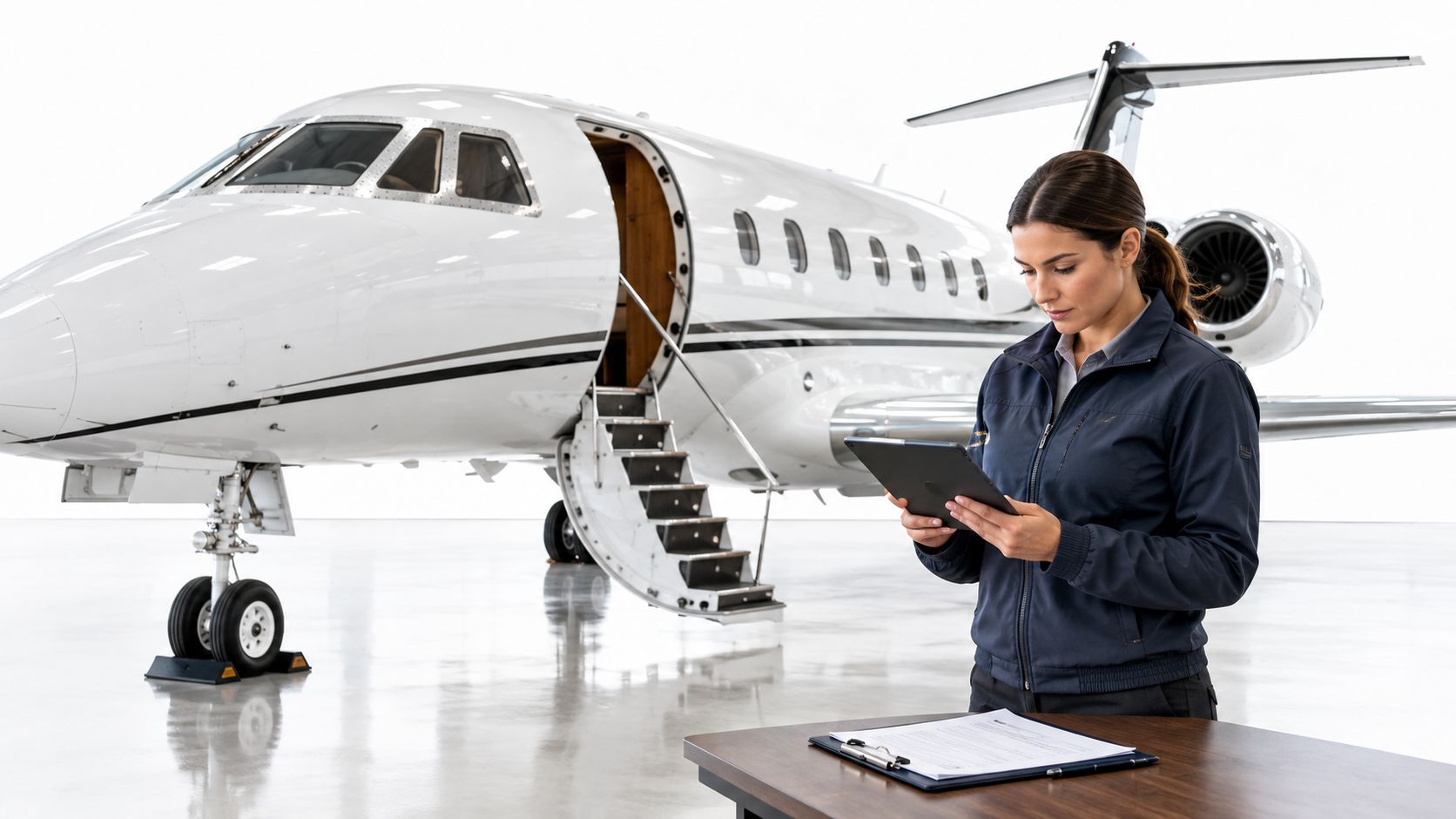
Before comparing interiors, ask the operator for documents that answer these questions:
- Aircraft certification fits the flight: Check that the aircraft has an airworthiness certificate and that its approved configuration and operating limitations fit the proposed trip. Ask the operator to clarify any limitation that affects the route or planned use.
- The operator has authority for the charter: Request confirmation that the operator holds an applicable Part 135 certificate and ask to review the relevant operations specifications. These identify the operations the FAA has authorized. The guide to FAA Part 135 operators and what their authority covers explains what that authority means.
- The specific aircraft has current records: Ask for its maintenance and inspection status, then confirm that the records cover the exact tail number quoted. A model's certification does not prove that an individual aircraft is current or available for your flight.
Keep the paperwork tied to the tail you will board. If the operator proposes a substitute, repeat the checks for that aircraft before accepting the change.
If the operator cannot explain its authority, the aircraft's certification, and its maintenance status in plain language, reject the quote. Once these checks pass, compare aircraft against the route and the details of the individual airframe, then consider cabin and cost.
Match Range and Airport Access to Your Route
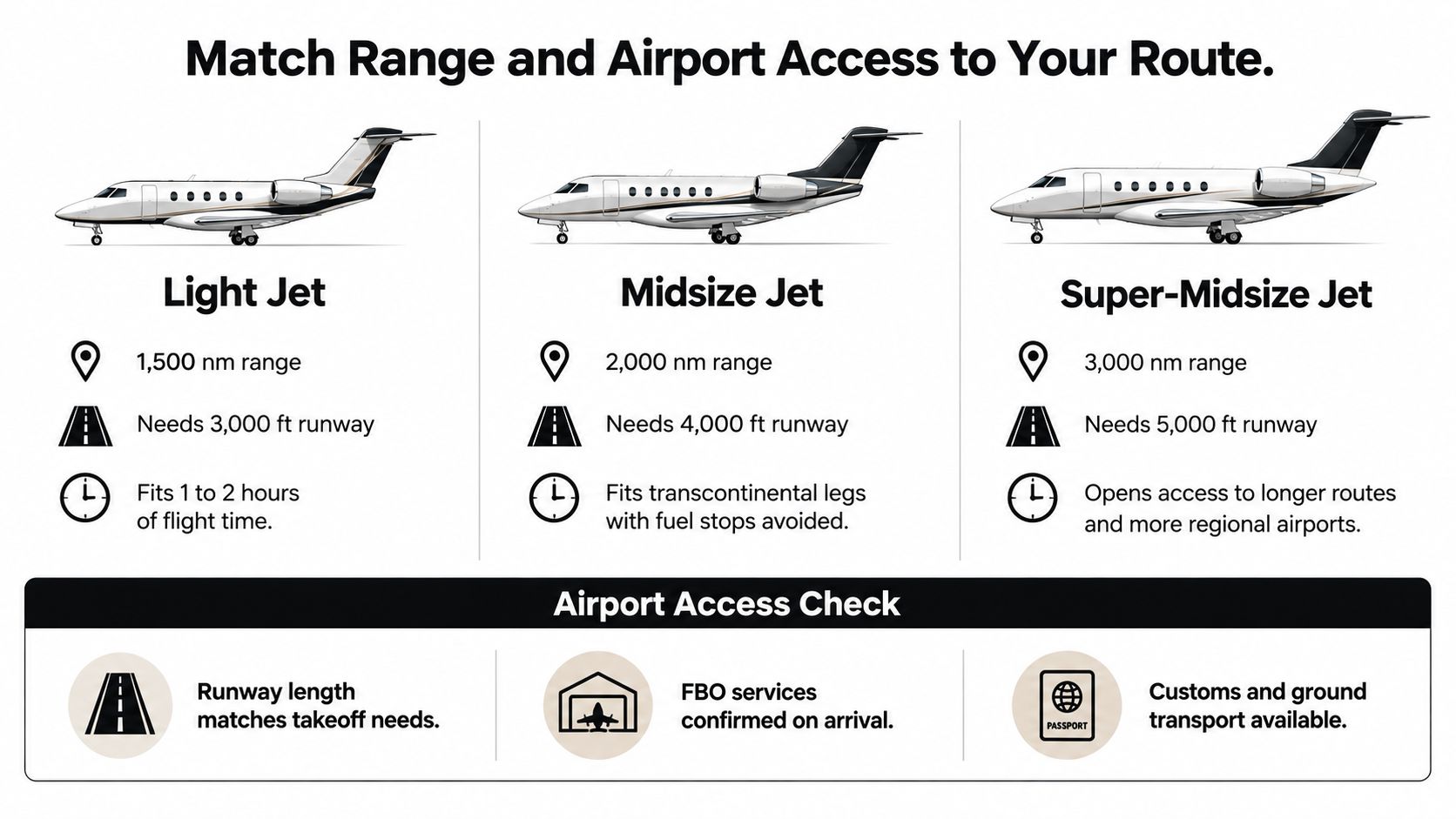
The longest range jet isn't automatically the safest pick. It's often the wrong one if it can't use the airport closest to your home, office, or final destination without a payload penalty or a long repositioning leg.
Range charts assume conditions you may not get. Your real constraints are runway length and elevation, temperature on departure day, obstacle clearance, and how much fuel the aircraft can carry while still lifting your passengers and bags. A heavy jet that needs a larger airport an hour away can lose its speed advantage before you leave the ground.
Infrastructure, not demand, is now the pinch point. McKinsey analysis of business aviation infrastructure pressure reports that US business jet departures increased by 417,000 between 2019 and 2025, and leisure destination airfields accounted for 326,000 of those additional departures, or 78%. In other words, the places you most want to fly for holidays are where ramp space, hangars, crews, and arrival slots get tight first.
Check Both Airports, Not Just the Distance
Work through these items for departure and arrival, and check how private jet flight distance interacts with real routing before you lock a category:
- Runway and performance: Can this exact aircraft depart at your planned load on a hot day or from a high elevation field without offloading bags or fuel?
- Operating limits: Are there curfews, noise restrictions, slot requirements, or parking limits that could force a drop and go or a different airport?
- Ground capability: Does the field offer deicing when you need it, customs for an international arrival, fueling, and an FBO that can turn the aircraft on your schedule?
- Alternates: What's the practical alternate if weather closes your first choice, and how far is the drive from there?
Take a short hop such as Miami to the Bahamas. A turboprop or light jet that uses a close in field, boards quickly, and avoids repositioning can beat a larger jet door to door, even if it cruises slower. The larger aircraft wins on a brochure. The smaller one wins on total trip time and reliability.
Rank options by route specific access reliability and total trip cost, not cabin class alone. Ask for performance at your two airports, with your passenger load, on your dates. If the answer is generic, you don't have a real quote yet.
Size the Cabin to Your Passenger Count
Count people first, then bags, then how you'll sit for the length of the leg. Seat count on a listing doesn't tell you whether those seats face each other, recline for rest, or leave room for the luggage you're bringing.
Start with a hard passenger count, including children, a nanny, security, or an extra crew member if the trip requires one. Then list luggage by type, not by vague volume. Golf bags, skis, instruments, and production cases consume space differently than soft duffels, and they don't compress to fit a baggage hold.
A Practical Sizing Method
- Write the load down: Passengers, large items, and anything that must ride in the cabin rather than the hold.
- Pick the seating job: Club seating for conversation, a conference grouping for work, or a quieter layout with separation for rest on a longer leg.
- Check the lavatory and interior condition: Two jets in the same category can differ materially here, and it matters on anything beyond a short hop.
Use this table as a starting filter, then verify the exact cabin.
| Aircraft Class | Best Fit Mission | Passenger Consideration |
|---|---|---|
| Turboprop | Short regional hops and smaller airfields | Efficient for small groups where airport access matters more than speed |
| Light Jet | Short to medium legs with small parties | Works when baggage is modest and seating needs are simple |
| Midsize Jet | Longer domestic legs and larger groups | More cabin and baggage flexibility for work or family travel |
| Super Midsize Jet | Coast to coast style missions | Better suited when passengers want to work, rest, and move around |
| Heavy Jet | Long range and larger party travel | Fits missions where cabin zones, rest, and luggage volume are priorities |
Consider a four person family flying to Aspen in winter. On seat count alone, several classes work. Once you add ski gear, winter clothing, and the baggage that comes with a week on the mountain, luggage volume decides the aircraft. If the hold can't take the load, you're shipping gear, splitting bags, or upgrading at the last minute.
Don't accept a category answer to a physical question. Ask for the seating configuration, baggage capacity, lavatory layout, and interior condition for the aircraft being quoted. If the cabin layout doesn't match how your group travels, it's the wrong aircraft regardless of range.
Compare Wi-Fi Catering and Pet Policies
A traveler flying to Turks and Caicos with a large dog learned the order of operations the hard way in a typical booking scenario. The aircraft was right for the route, the price worked, and then the pet question surfaced late. The operator had restrictions that should've been settled before anyone discussed catering.
Don't repeat that sequence. Amenities aren't standardized across aircraft in the same class, and pet acceptance isn't a detail to confirm after you've chosen a tail.
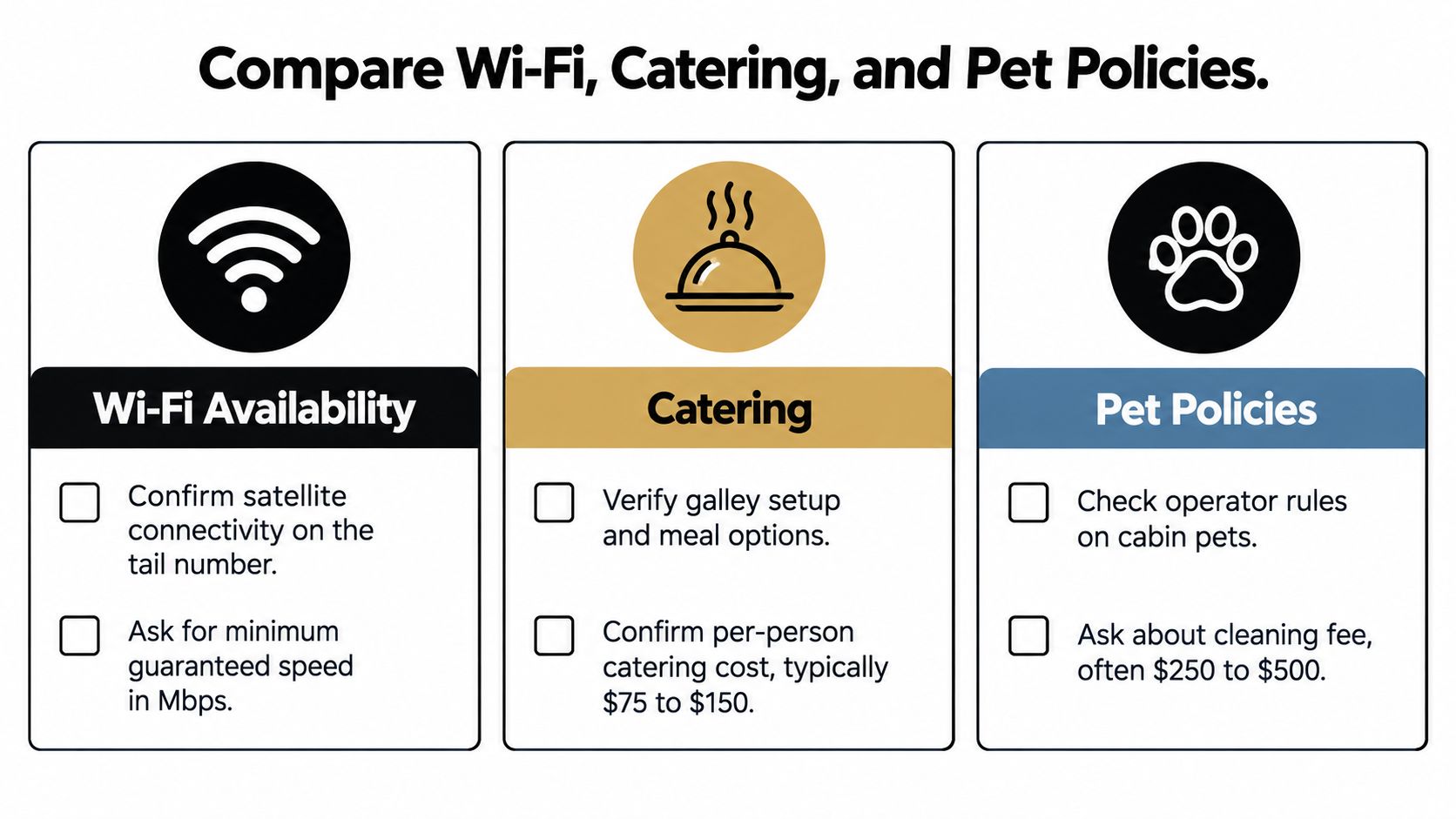
For Wi-Fi, ask what is installed on that aircraft and whether it will support the work you plan to do. Messaging on a short leg is a different requirement than video calls and large file transfers on a long one. For catering, confirm the galley setup, what can realistically be served, any ordering deadlines, and whether catering is included in the quoted price or billed separately.
Ground transport belongs in the same conversation. If a car needs to meet you on arrival or collect passengers from multiple addresses, settle that while you're comparing aircraft, not the night before departure.
Settle Pets Before You Accept a Quote
Review what to prepare when flying with pets on a private jet and confirm these points in writing:
- Operator acceptance: Does this operator accept your animal in the cabin, and are there size, breed, or carrier requirements?
- Destination documentation: What health records or entry paperwork does the destination require?
- Cleaning and cabin rules: How is the interior cleaned between flights, and are there fees or seating restrictions?
Practical rule: If Wi-Fi, catering, or pet acceptance would change your decision, it belongs in the quote, not in a follow up email.
That approach follows Haute Jets Journal guidance on evaluating position, billable time, baggage, Wi-Fi, pets, and cabin layout, which stresses asking whether the aircraft is locally positioned and what the quoted price includes. Get the answers in writing for the specific aircraft. Verbal assurances about a category won't help you at boarding.
Verify the Exact Tail Number and Base
A model can be perfect for your route while the specific aircraft assigned to you is a poor fit. That's why the Aircraft Selection Process doesn't end when you pick a make and model. It ends when you've verified the individual airframe.
Each aircraft has its own maintenance condition, installed equipment, interior state, and schedule. It also sits somewhere specific right now. If that somewhere is far from your departure airport, you're paying to ferry it into position, and you're exposed if that positioning leg runs late.
Questions That Reveal Repositioning Risk
Ask these before you accept any quote:
- Which tail number is assigned: If no tail is assigned yet, ask when it will be and what could cause a substitution.
- Where is it based today: Is it near your departure airport or arriving on an existing schedule that puts it there naturally?
- What's its maintenance status: Is scheduled maintenance coming due that could shift availability around your dates?
- Is the crew legal for your itinerary: Duty limits and positioning can affect departure times, especially on multi leg or early morning trips.
The Gulfstream G650 example makes this concrete. Haute Jets Journal guidance on chartering a Gulfstream G650 states that the tail number, current location, maintenance status, crew legality, and availability must be checked before accepting a quote, because those factors determine whether a trip operates efficiently or requires repositioning.
Ask which G650s are based near your departure airport. That single question separates genuine local availability from an aircraft that looks available in a system but must be ferried in at your expense. Request the tail number and current base, and compare that answer across quotes.
You help the process by sharing complete information up front. Provide your route, dates, passenger count, baggage profile, and special requirements at the first request. With that mission defined, an operator or broker can curate aircraft that actually fit instead of sending category placeholders you'll reject later.
Don't treat a tail swap as a minor change. If the aircraft changes, recheck cabin layout, Wi-Fi, pet policy, and base location. A different tail is a different trip.
Exact Aircraft Selection Versus Category Booking
The right booking depends on the route and the individual aircraft, not just its cabin class. Category booking lets the operator assign an aircraft within a class, such as a light, midsize, or heavy jet. Exact selection means choosing a specific aircraft and confirming its details before you commit.
The trade-off is predictability. A category can work for a flexible trip, while exact selection gives you more control over what arrives.
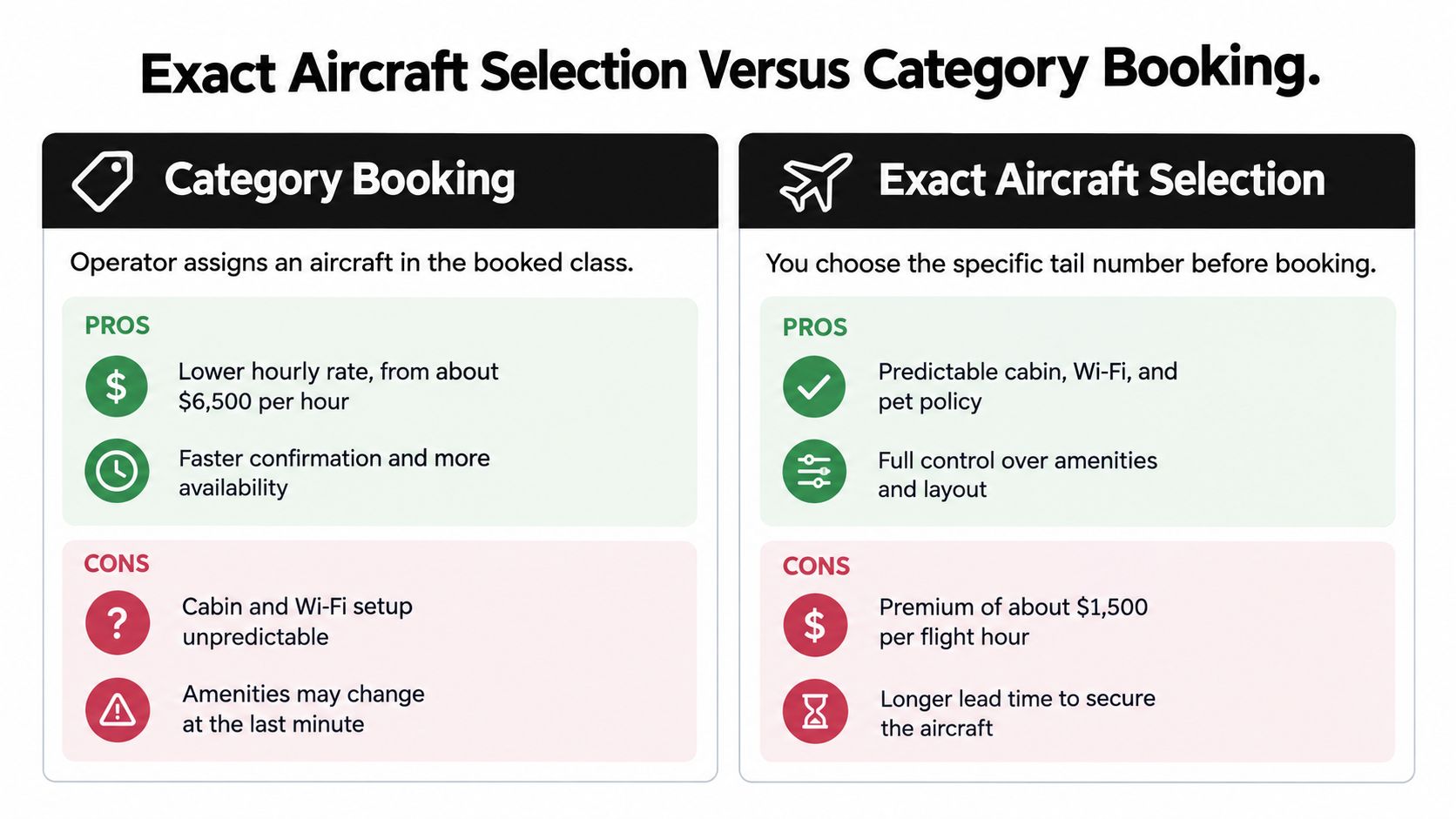
Compare both options against the needs of your trip:
- Cabin predictability: Category booking may leave seating, interior condition, and lavatory layout open. With exact selection, review the layout before confirming.
- Control over tail and base: A category quote may not identify where the aircraft is coming from. An exact tail lets you ask about its base and assess possible repositioning.
- Amenity certainty: Wi-Fi, catering capability, and pet acceptance can vary between aircraft. Confirm these details for the specific aircraft you will board.
- Pricing transparency: Ask whether the quote includes positioning and whether substitutions are permitted. For an exact selection, check that the price applies to the aircraft identified.
The category label tells you little about the fit. Haute Jets Journal advice on requesting year, make, model, and cabin layout notes that aircraft in the same category can differ in seating, luggage capacity, Wi-Fi, lavatory configuration, and interior condition. Request the year, make, model, and cabin layout, then verify that the aircraft can serve your route and passenger needs.
Haute Jets can confirm the proposed aircraft's year, make, model, and cabin layout, along with details such as Wi-Fi, catering, pet policies, and ground transport. Ask for the exact aircraft details in writing, and clarify whether a substitution would require your approval.
Category booking is reasonable when your schedule is flexible, your requirements are straightforward, and you are comfortable with variation in the cabin. Choose exact selection when a particular layout, amenity, or aircraft is required. You are paying for a clearer match between the aircraft and your trip, not just for a category name.
Request Your First Exact Aircraft Quote
The right quote should fit your route, passengers, and requirements, not just a cabin category. Screen operators for certification and eligibility first. Then check airport access against your actual load, match cabin space to passengers and baggage, confirm amenities and pet policies, and verify the assigned aircraft and its base.
This order catches costly mismatches early. Cabin photos and price cannot tell you whether the aircraft can use your airports or meet your requirements.
What to Send in Your Request
Send the full trip picture in one request:
- Airports and flexibility: Departure and destination airports, preferred alternates, dates, and schedule flexibility.
- People and load: Passenger count, baggage types, and large items that could affect hold or cabin space.
- Required features: Wi-Fi needs, pet details, catering, ground transport, and seating or rest requirements.
Ask for the assigned aircraft's make, model, year, tail number when available, and cabin configuration. Confirm its base and whether it is already positioned for your trip. Request the billable flight time and a clear breakdown of the quoted price. Positioning, catering, deicing, and ground transport may sit outside the quote, so settle those details before comparing options.
After certification, airport access, cabin, and amenity checks, verify the exact tail and its base against your route and load. That final fit check can expose a mismatch before you book.
Ask the operator to confirm the aircraft details and any changes to the assignment before departure. If the tail changes, check the cabin, Wi-Fi, and pet arrangements again. Include any confirmation terms in the quote rather than assuming a particular notice schedule or set of documents.
Start your quote at hautejets.com with these details. Haute Jets does not require memberships or jet cards. A complete request gives you specific aircraft options to compare, rather than category estimates.
Send Haute Jets your route, dates, passenger count, baggage, and required features. Review the exact aircraft's year, make, model, cabin layout, Wi-Fi, catering, and pet policies before booking. A tail-specific Aircraft Selection Process helps you catch positioning issues and substitutions before they become trip problems. Start your request at Haute Jets.