

You're landing in New York for a meeting, a game, or a weekend that can't afford a bad airport choice. The aircraft is easy. The key decision is where it should land, who can get you off the tarmac fastest, and what happens if your first choice gets blocked.
A private jet charter to New York rewards planning more than most markets because the city isn't a single-airport destination. It's a dense aviation system where arrival point, runway access, ground transfer, and timing all interact. On Haute Jets Journal, the practical question isn't “Can I get there?” It's “Which airport gets me there cleanly, and what's my backup if it doesn't?”

If you're comparing arrival points, aircraft, and total trip friction, the first thing to read is private flights to New York. It helps frame New York as a routing problem, not a vanity purchase.
Why Booking a Private Jet to New York Is Different
A client calls wanting to land near Manhattan for a same-day board dinner. Another wants to reach northern New Jersey, avoid commercial terminals, and still leave room for a last-minute schedule change. Those trips may sound similar on paper, but the booking logic is completely different.
New York behaves like a multi-airport network
New York is one of the world's most aviation-intensive metro markets, with approximately 5,000 commercial, business, helicopter, and general-aviation aircraft moving through its airspace on a typical day, according to the FAA's New York airspace overview (FAA New York airspace). That density matters because the region's airports don't function as interchangeable pins on a map. They work as a network with different access rules, traffic patterns, and operational constraints.
Teterboro is the clearest example. It doesn't handle scheduled airline service, which is exactly why charter customers rely on it for business aviation. If you're heading to Midtown, northern New Jersey, or a meeting with tight ground timing, that matters more than choosing the airport with the shortest straight-line distance.
Practical rule: choose the fastest door-to-door itinerary, not the nearest airport label.
That mindset is what turns a good charter quote into a useful one. A shorter flight that dumps you into worse ground traffic can lose to a slightly farther airport with cleaner access and fewer delays. That's especially true in New York, where airport selection is part of dispatch strategy, not just convenience.

The rest of the booking process follows from that one choice. Once the arrival point is right, the aircraft choice becomes clearer, the quote becomes easier to compare, and the ground plan stops feeling improvised.
Choosing the Right New York Area Airport for Your Trip
In New York, airport choice shapes the whole trip. It affects how freely your aircraft can operate, how cleanly customs or arrival procedures can be handled, and whether ground transport is waiting on the right side of the city when you land. I treat the airport list as a dispatch tool, not a ranking.
Teterboro, JFK, Newark and the alternates
Teterboro is the default private-aviation choice for Manhattan access because it is built for general aviation and sits close enough to keep the ground transfer manageable. It is also where private aviation traffic concentrates, so it is usually the first airport I check for executive itineraries. For a practical airport breakdown, this Teterboro charter guide is the right starting point.
JFK and Newark can work, but they are not clean substitutes. LaGuardia and JFK are slot-controlled, and Newark was placed under temporary FAA slot controls in June 2025 through at least October 2026. At LaGuardia, only three hourly slots between 6 a.m. and 10 p.m. are reserved for unscheduled operations such as general aviation and charters, down from six in prior years (LaGuardia unscheduled operations slot analysis). A close-in airport can be the hardest one to use when your timing is fixed.
What I compare before I quote
| Airport | Best for | Watch out |
|---|---|---|
| Teterboro | Manhattan, northern New Jersey, fast executive access | Private-aviation demand can tighten availability |
| JFK | International links, customs-sensitive itineraries | Slot control and commercial congestion |
| Newark | Western side of the metro area, some corporate access | Temporary slot controls and system delay risk |
| LaGuardia | Certain city-side access patterns | Very limited unscheduled ops access |
| Westchester County | Northern suburbs and Connecticut | Longer Manhattan transfer |
| Republic | Long Island | Less direct for Manhattan |
| Stewart | Hudson Valley alternatives | Not ideal for central city trips |
A good dispatch plan includes a primary airport and a backup airport. That backup matters because switching airports can change the quote, the positioning, and the car transfer. It can also keep the schedule intact when the preferred field is unavailable.
Best practice: send your operator two viable airports at the start, one primary, one fallback.
The strongest charter proposals acknowledge the ground reality. If your event is near Midtown, Teterboro usually wins. If you are headed to Long Island, another field may be a better fit. If the airport is constrained, the slightly farther option can still produce the faster door-to-door trip.
Event traffic changes the answer
New York becomes especially tight around major events. The 2026 FIFA World Cup spans 104 matches across 16 cities over six weeks, and New York-area airports are already constrained gateways, with Teterboro sitting roughly 10 to 15 minutes from MetLife Stadium (World Cup 2026 charter planning). In that window, airport flexibility becomes part of the itinerary design.
The right habit is simple. Book with a primary airport, prepare a backup, and ask whether changing the airport changes aircraft positioning, ground transport, or customs handling. If it does, you want that known before the agreement is signed.
Matching Aircraft to Route Distance and Party Size
A charter that looks impressive on paper can be the wrong aircraft for the mission. Short New York trips punish overbuying, while long-haul itineraries punish underestimating range, reserves, or baggage. I start with route distance, then passenger count, then runway fit and luggage.
Short regional trips call for restraint
For New York to Miami, Haute Jets Journal places the route at approximately 2.5 to 3 hours, with Teterboro often used on the New York side and Opa-locka on the Miami side (New York to Miami route guide). That is a different booking from a transatlantic leg. A long-range cabin can be unnecessary weight on a trip where the ground transfer, the departure airport, and the aircraft size all need to work together.
Light jets can fit modest passenger counts when the bags are manageable. Midsize aircraft usually make more sense once the cabin needs to feel quieter and the group wants a little more room to work or rest. Super-midsize options are often the practical middle ground for corporate travelers who want nonstop comfort without paying for a heavy jet they do not need.
Transatlantic missions need range margin
New York to London changes the aircraft conversation. Haute Jets Journal puts that route at about 3,459 nautical miles, which rules out light and midsize jets for nonstop service (New York to London aircraft guide). Gulfstream lists the G550 at 6,750 nautical miles of range, which gives the trip useful operating margin. The Challenger 605 is listed at approximately 4,000 nautical miles, so it sits much closer to the edge once winds, reserves, and payload are part of the plan.
Ultra-long-range aircraft such as the Gulfstream G650ER, G700, Bombardier Global 6500, Global 7500, and Dassault Falcon 8X deserve attention when passengers, baggage, reserves, and weather all have to be absorbed without stress. That is not about excess. It is about keeping the trip within the aircraft's real operating envelope.
Range is only part of the booking. Payload, baggage volume, and cabin layout can turn a technically possible trip into a poor fit.
Use the cabin that fits the mission
Three executives heading to a meeting do not need a jet sized for sixteen seats just because the cabin sounds bigger. A larger team should not be squeezed into a cabin that feels tight by the second hour. The right aircraft matches the route, the people, and the bags.
For a quick reference on passenger planning, this aircraft capacity guide is useful before you request quotes. It keeps the conversation focused on the class of jet that fits the trip.
Understanding Charter Pricing and Common Surcharges
A low quote can hide the actual cost of a New York charter. The number only matters if it includes fuel, taxes, airport fees, and any extras that appear once the itinerary is set. Compare quotes line by line, or you are comparing different trips.
What a real New York to Miami quote looks like
Haute Jets Journal gives a clear example using a Citation Excel from Teterboro to Opa-locka. The itinerary runs 2.5 hours, the base rate is $4,000 per hour, and the flight subtotal comes to $10,000. A 12% fuel surcharge adds $1,200, the 7.5% federal excise tax adds $840, landing and handling fees total $800, and segment fees add $36 for four passengers across two flight segments, bringing the one-way total to $12,876 (charter pricing breakdown).
Split among four passengers, that example works out to $3,219 per passenger. It also shows why the hourly rate alone is only a starting point. The aircraft may be quoted one way, while the trip costs more once fees and taxes are folded in.
Bands help, but totals matter more
For route planning, the same Haute Jets Journal coverage lists one-way New York to Miami pricing of about $10,000 to $16,000 for a light jet, $18,000 to $28,000 for a midsize jet, and $25,000 to $40,000 for a super-midsize aircraft (New York to Miami guide). Those bands are useful for setting expectations, but the final price still turns on the travel date, aircraft availability, catering upgrades, special handling, and fuel charges. In practice, domestic charter totals often end up around 1.4 to 1.6 times the headline hourly rate once the common extras are included.
A clean quote should say whether repositioning is included, whether a transfer from a secondary airport is included, and whether peak-day premiums are already built in. In New York, those details matter around major events and tight arrival windows.
Ask for the all-in number, not the teaser rate. If the aircraft has to be ferried in, that cost belongs in the conversation.
The best way to read a charter offer is to separate the aircraft cost from the logistics cost. A slightly higher proposal can be better value if the jet is already positioned near your departure airport. A cheaper quote that assumes a different airport or omits transfer costs is not a like-for-like comparison.
Booking Timeline, FBO Flow, and Ground Transport
A New York charter runs smoothly only when the logistics are set before wheels up. The quote, the confirmation, the private terminal, and the car at the destination all have to line up. If one piece is vague, the whole day gets harder.
What has to be confirmed before departure
Same-day availability in New York can work, but only if the operator already has the right aircraft, crew, and airport access in place. A 24-hour confirmation window gives you time to settle the tail number, crew details, weather picture, and passenger manifest before anyone heads to the terminal.
Airport choice still shapes the ground plan. Teterboro is especially useful because it is roughly 12 miles from Manhattan, which keeps the transfer direct enough for most itineraries (Teterboro airport guide). Rush hour can still slow the car ride, but the field itself is built for private aviation rather than commercial traffic.
The day-of sequence should stay simple
- Confirm the aircraft and departure airport.
- Verify the FBO and arrival time.
- Check the manifest, baggage notes, and any pet details.
- Have ground transport arranged before landing.
- For international arrivals, confirm customs handling ahead of time.
- Keep a backup ready if weather or airport traffic changes the plan.
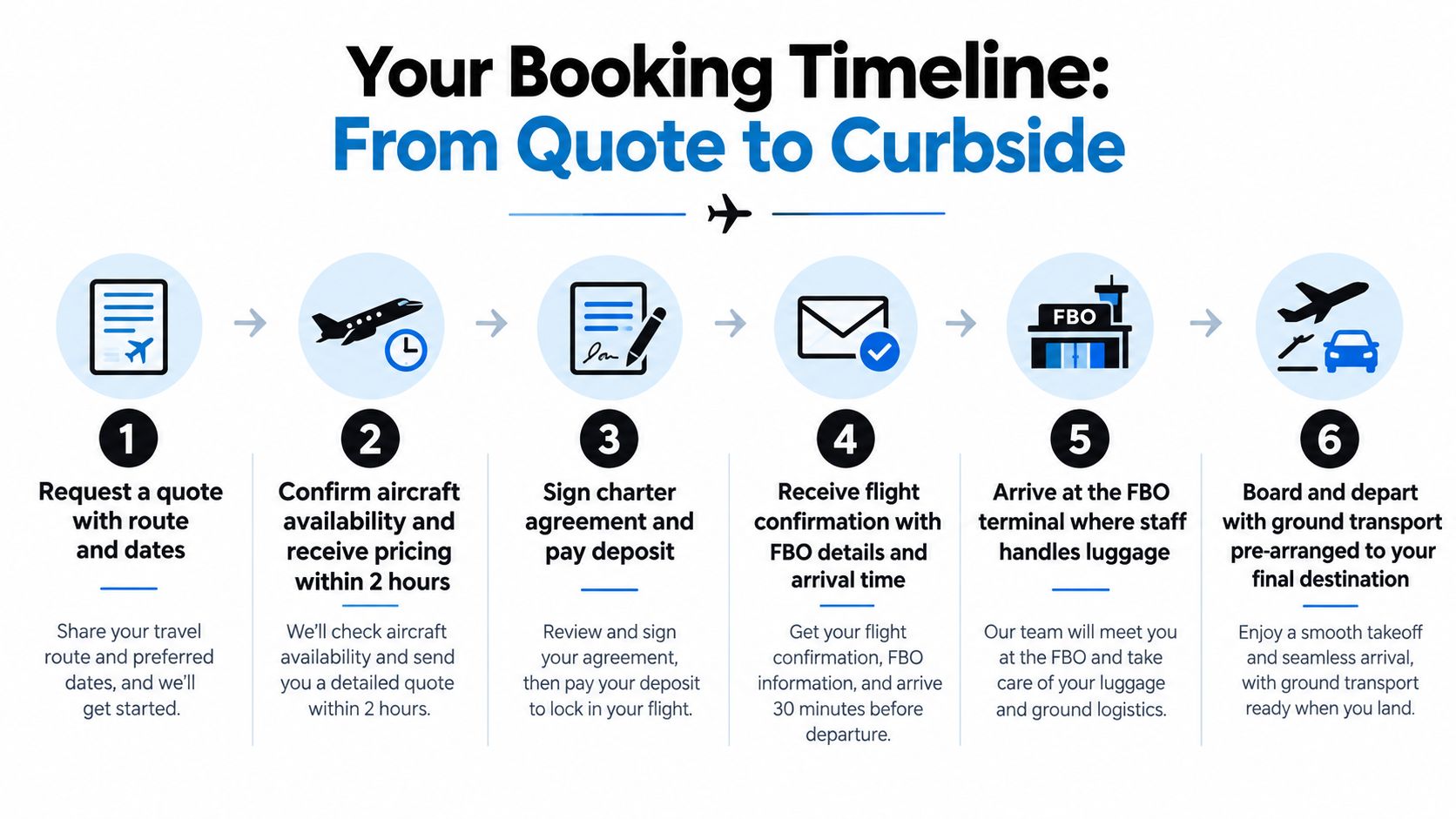
The terminal part should move fast. Bags are handled quickly, the handoff stays short, and the car should already be staged. If the trip ends at a hotel, office, or stadium, the goal is to cut handoffs, not create new ones.
Event periods need a wider buffer
Major-event windows change the equation. Demand rises, airport slots tighten, and departure timing becomes less forgiving. That is true around the biggest sports weekends in New York as well, where late planning can push you into less convenient airport or aircraft options. A private flight still works, but the itinerary needs more lead time and more flexibility on the field you use.
A written contingency plan matters most when the airport gets crowded. If the preferred field cannot take you, the operator should already know the alternate airport, the transfer plan, and whether the quote changes. That is how you keep a private flight from turning into a private delay.
How Haute Jets Delivers Better Value Without Memberships
The biggest value trap in New York charter is paying for the wrong aircraft in the wrong place. A lot of the price inflation comes from repositioning, not the flight itself. That's where local sourcing matters more than glossy sales language.
Haute Jets sources from 3,500+ owner-operators across 175 countries, prioritizes aircraft based near the departure city, and works only with Wyvern Wingman or ARGUS Gold/Platinum operators. It also lets you choose the exact year, make, model, and cabin layout, which is useful when you care about Wi-Fi, catering, pets, or ground transport being set correctly before departure. The pricing model is pay-per-flight, with no memberships or jet cards.
Good charter value starts with the right aircraft already in the right place.
That's particularly important in New York, where airport access, crew duty, and ground traffic can all tighten at the same time. When the aircraft is already positioned near your departure field, you reduce the chance that a hidden ferry leg distorts the quote. You also get a cleaner comparison between operators because the same trip is being priced on the same assumptions.
If you're booking a private jet charter to New York and you already know your primary and backup airports, the next move is straightforward. Request a quote, confirm the aircraft class, and make the ground plan part of the charter, not an afterthought.
If you're planning New York travel that can't afford guesswork, Haute Jets can source the aircraft, airport pairing, and cabin setup around your exact itinerary. Visit Haute Jets to request an on-demand quote with your primary and backup airports ready, so the trip starts with the right dispatch plan, not a scramble.