
You've asked two charter providers to price the same trip. One quote looks appealing until the other arrives, thousands of dollars higher, with no obvious explanation for the gap. The difference may have little to do with the passenger flight itself. Aircraft location, empty positioning legs, airport charges, crew logistics, and taxes can all reshape the total.
A private jet charter quote is more than an hourly rate multiplied by flight time. To compare providers fairly, look at the complete trip cost and ask which charges are fixed, which are estimates, and which may change. That's how you spot a low headline rate that turns into an expensive itinerary.
Why Two Quotes for the Same Flight Can Differ by Thousands
Two providers can price the same city pair and still be pricing different work. One may have a jet staged near your departure airport. The other may be charging for an aircraft that has to move, crew that has to overnight, and airport costs that sit outside the passenger leg.
The hourly rate is the visible part. Independent charter-pricing guidance estimates ancillary charges can add roughly 25–40% on domestic trips and 30–45% on international routes (charter quote pricing guidance). Treat those ranges as a warning, not a surcharge schedule: what matters is whether each line is fixed, estimated, or pass-through.
The aircraft's location changes the math
An aircraft based far from your first departure point can make an otherwise similar quote more expensive before you board. The mechanism is simple: the trip may include flying you never see. See the repositioning section below for how that charge is itemized.
Other gaps come from landing and handling fees, multi-day crew expenses, whether the jet waits or returns, and tax treatment. For domestic U.S. air transportation, the Federal Excise Tax is 7.5% on applicable transportation amounts.
Practical rule: Audit the all-in number. The lowest hourly rate is often just the best-looking line on page one.
Ask each provider for the same itinerary and the same written breakdown: flight time, positioning, taxes, airport charges, crew costs, and requested services. Two identical route requests can still produce different answers if one quote assumes an empty leg and the other does not.
What Information You Need to Get an Accurate Quote
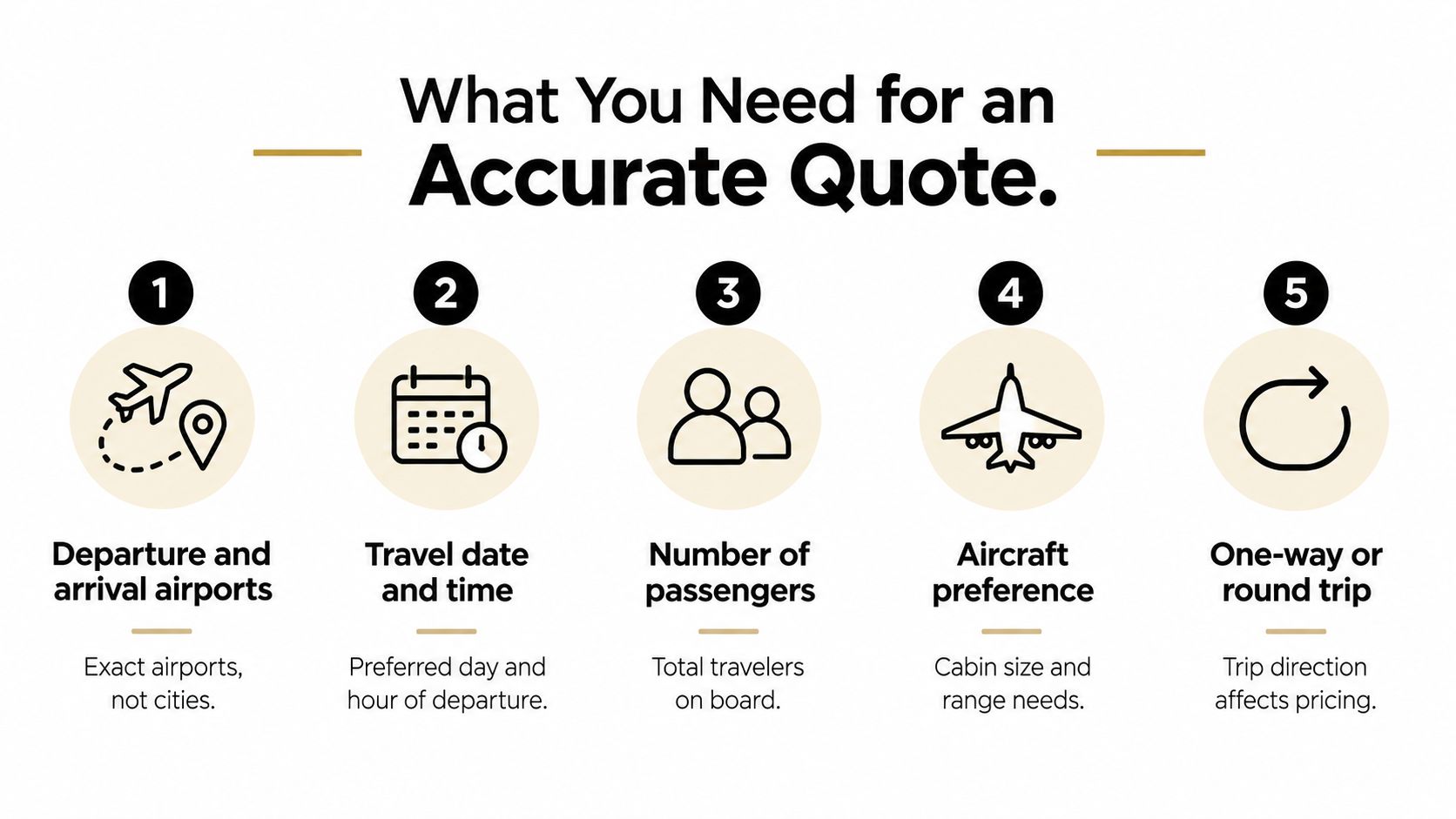
A provider can't price an itinerary accurately if the request leaves out details that change aircraft choice or operating requirements. Gather the essentials before asking for a private jet charter quote. Specific information helps the provider look for an aircraft that fits the trip, rather than returning a rough number based on assumptions.
Start with the itinerary
Name the exact departure and arrival airports. “New York to Miami” leaves room for several airport combinations. Naming Teterboro and Opa-locka, for example, gives the provider a defined route to price and helps identify aircraft based near the departure point.
Give the travel date and preferred departure time. Aircraft availability and crew scheduling depend on when you plan to fly. If you can travel within a window rather than at one exact time, say so. Flexibility may give the provider more options to consider.
Confirm the passenger count. The aircraft needs to accommodate everyone comfortably while meeting route and payload requirements. Don't leave out travelers who may join later; an inaccurate headcount can lead to a different aircraft recommendation.
Describe the aircraft and trip structure
Share your aircraft preferences and practical needs. If you know the cabin size or range you need, include it. Also mention relevant requirements such as baggage, Wi-Fi, pets, catering, and ground transport so the provider can confirm what's available rather than assume.
Say whether it's one-way, round trip, or a multiday itinerary. A return leg or a stay at the destination can affect aircraft and crew logistics. Include the expected return date and timing, even if they're not exact yet.
An incomplete request doesn't just make the first price less reliable. It can prompt the provider to revise the quote when the missing details emerge. Send a realistic itinerary, then tell the provider where you can be flexible.
The Anatomy of a Private Jet Quote
A quote becomes readable when every dollar is assigned a job. Ask the provider to label each line fixed, estimated, or pass-through. Fixed charges belong inside the agreed price. Estimated items can move with airport, crew, fuel, or schedule assumptions. Pass-through costs are billed by airports, handlers, caterers, or other third parties and should be traceable to an actual provider.
The ranges below are working audit bands I ask operators to confirm against the actual route, tail, and dates. Use them to sharpen questions and expose vague lines before comparing one quote against another.
| Cost Component | Typical Share of Total | Notes |
|---|---|---|
| Passenger flight time | Varies by aircraft and trip | Hourly rate multiplied by occupied flight time |
| Positioning or deadhead | Can be a major variable | Empty flight needed to bring the aircraft to the departure airport |
| Landing and handling | Estimated at 8–15% | Depends on airport and handling requirements |
| Crew expenses | 5–12% on multiday itineraries | May include overnight or away-from-base costs |
| Federal Excise Tax | 7.5% on applicable U.S. domestic transportation | Applies to qualifying transportation amounts |
| Fuel, catering, and other requested services | Varies | Confirm whether each is included, estimated, or additional |
Treat each band as a separate check. A quote can show a competitive hourly rate while leaving positioning, handling, crew duty, or tax status loose enough to change the invoice later. The cleanest version names the aircraft, the airports, the service assumptions, and the party charging each pass-through item.
What each line represents
Flight time is the occupied portion priced at the selected aircraft's rate. Positioning is separate: it covers empty travel when the aircraft has to reach you or move after the passenger flight. Landing and handling are airport-related charges. Crew expenses appear when the trip keeps pilots or cabin crew away from base.
Fuel, catering, Wi-Fi, deicing, ground transport, and pet handling depend on the quote's assumptions and what you requested. Have the provider state whether each item is included or billed separately. For a closer line-by-line check of common add-ons, review this guide to private jet fees.
The same fixed-versus-estimated discipline applies to ground transport on a multi-city itinerary: an AED 800 to 10,000 daily rental range in Dubai shows how much can sit inside “included” chauffeur, insurance, mileage, and delivery terms before you compare suppliers.
How Repositioning Drives Up Your Price
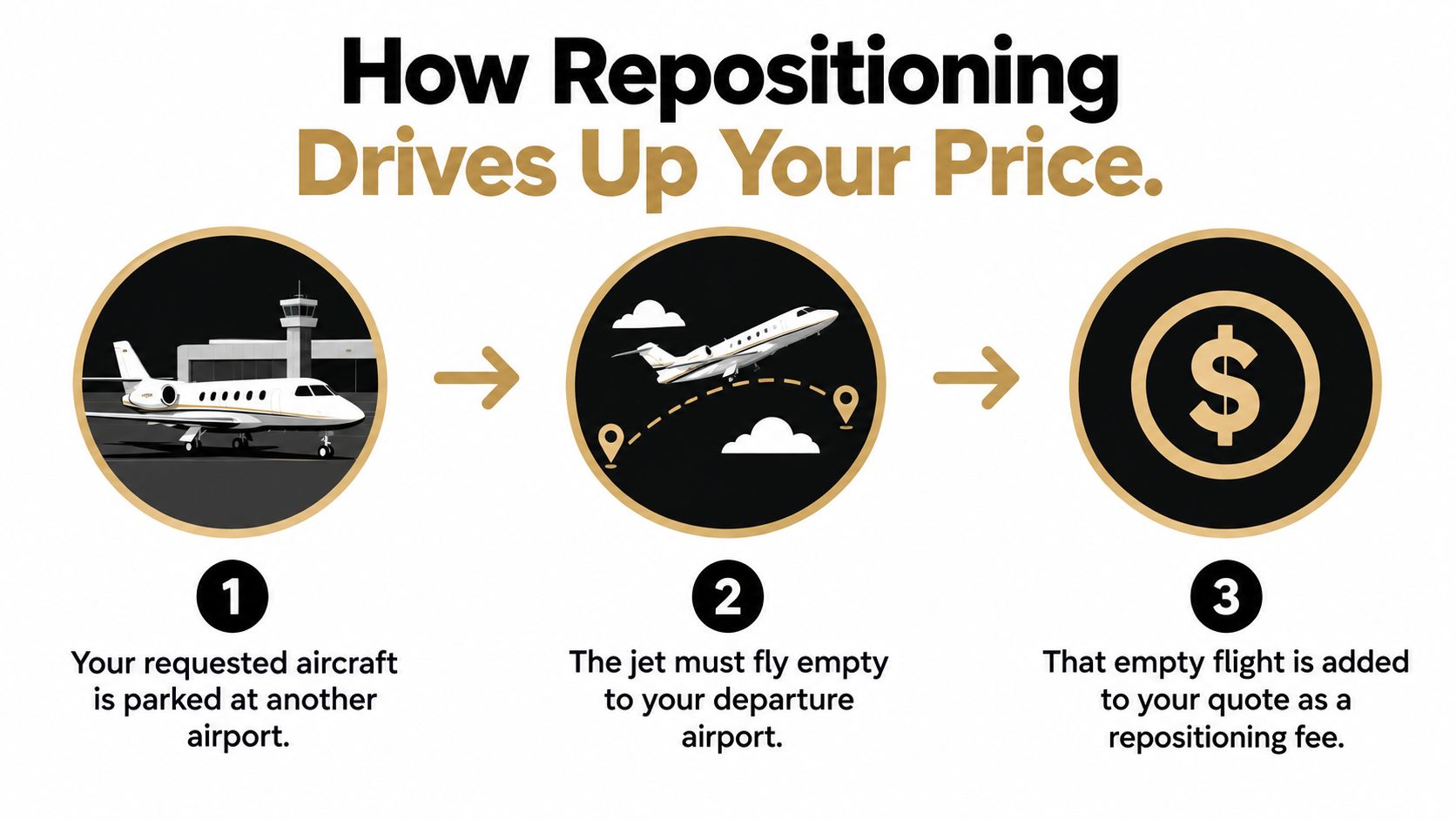
A jet can be confirmed for your departure time and still sit too far away to quote cheaply. If the operator has to fly it empty to reach your airport, that leg burns aircraft hours, fuel, and crew duty time. Nobody is in the cabin, but every mile of it lands on your invoice.
Local aircraft versus a distant aircraft
When I price a trip, the first question after "which aircraft" is "where is it sitting right now." An aircraft based near your departure point can shrink the ferry leg or eliminate it entirely. A distant aircraft does the opposite: repositioning can add approximately 20–40% to a quote when the selected aircraft isn't already near the departure city (see what a repositioning fee covers). The size of the charge depends on where the aircraft is and what your trip requires, so ask the provider to name the aircraft's base or current location and itemize any empty flying.
Some operators fold ferry time into the hourly figure. Others list it as a separate line. The second version is easier to audit.
| Option | What you gain | What to verify |
|---|---|---|
| Aircraft near departure | May avoid or reduce positioning charges | Confirm whether any repositioning remains in the price |
| Aircraft based farther away | May offer a preferred model or availability | Ask how many empty flight hours are being billed |
| Empty-leg opportunity | May cost less than a standard on-demand trip | Confirm fixed route, timing, aircraft, and cancellation terms |
An empty leg is an otherwise unoccupied flight tied to another paid itinerary. It can be a genuine discount when your plans fit the aircraft's existing schedule, but the departure time, route, and destination are set by the repositioning need rather than your preference. The opportunity can also change or vanish if the original trip moves. Before relying on one, verify the aircraft, operator, departure airport, and cancellation terms.
Repositioning can also hit on the back end. If the aircraft has to fly home empty after dropping you off, that return leg may be priced into the quote even though you never see it.
When requesting prices, ask for the closest suitable aircraft and a comparison that shows the repositioning charge separately. That makes the cost of choosing a more distant aircraft visible instead of burying it in a single total.
How to Audit a Quote Before You Commit
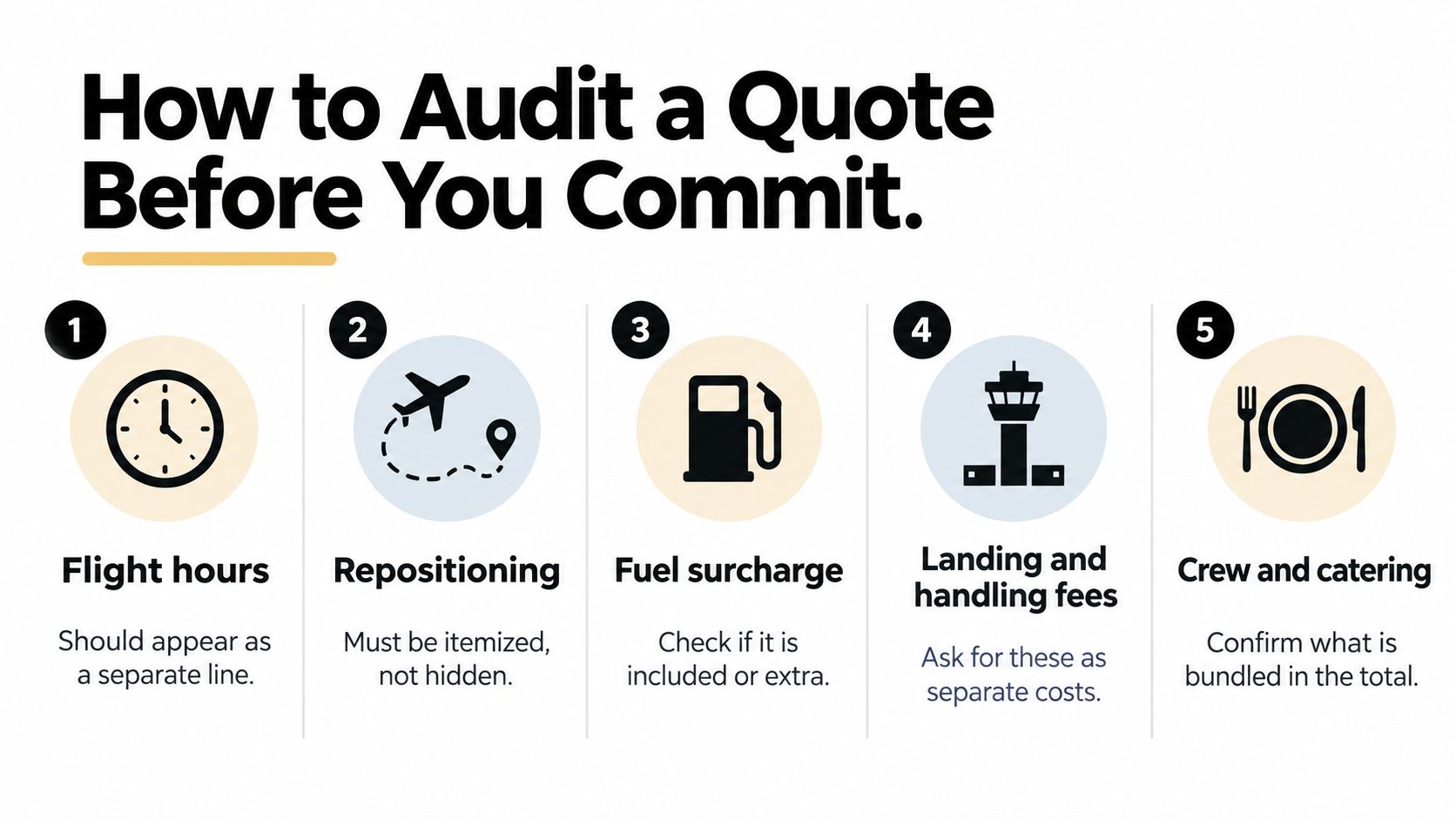
A quote that gives you one total without showing its assumptions is hard to compare and harder to challenge if the price changes. Ask for the main costs separately, then confirm the aircraft, operator, and booking terms. A practical audit takes the mystery out of the number.
Check the price and its assumptions
Request separate line items for:
- Flight hours: Confirm occupied flight time and the rate used.
- Repositioning: Ask whether the aircraft must fly empty before or after your trip.
- Fuel: Check whether a surcharge is included, estimated, or additional.
- Airport and handling fees: Ask for these costs separately where available.
- Crew expenses: Confirm any overnight, away, or waiting charges.
- Taxes: Identify which taxes apply and how they're calculated.
- Catering and ground transport: Check what's included and what you've requested.
- Waiting time: Confirm what happens if the aircraft or crew must remain at the destination.
A quote can be all-in and still be transparent, but the provider should explain what that total includes and what could change. If you're organizing several travel documents, Explola's guidance on downloading itinerary PDFs can help you keep the quote and itinerary paperwork accessible for review.
Verify the booking, not just the price
Ask for the aircraft tail identity, the operating company's certificate details, and the quote's expiration time. Confirm cancellation exposure, aircraft substitution terms, and whether a change to your schedule or passenger details could affect the price. In the United States, on-demand charter generally operates under FAA 14 CFR Part 135, which includes requirements for operator certification, pilots, maintenance, operational control, and records (FAA guidance on safe charter operations).
Treat a quote that omits the aircraft, operator, inclusions, expiration, or cancellation terms as provisional. Don't approve it until the provider has answered those questions in writing.
Why Haute Jets Offers Wholesale Pricing Without Memberships
A charter quote reflects how the aircraft is sourced as well as the route it flies. Haute Jets says it draws on 3,500+ owner-operators across 175 countries, with the aim of placing a suitable aircraft near the departure city. A wider sourcing network gives a provider more aircraft to price against, but the question that matters on your quote stays narrow: where is the proposed aircraft sitting, and which charges follow from that location?

Pay per trip, not through a prepaid structure
Haute Jets describes its model as on-demand, with no membership fees, prepaid hours, or jet cards. You pay per flight, which suits travelers booking individual trips without committing capital to a program. That structure doesn't change how you read the paperwork. Check the aircraft, itinerary, and line items the same way you would with any provider.
The company also states that every operator in its network holds a Wyvern Wingman or Argus Gold/Platinum rating, and that clients can select a specific aircraft and confirm details such as Wi-Fi, catering, pet policies, and ground transport. Those confirmations matter because "light jet" or "midsize" describes a category, not the exact cabin and equipment you'll fly in.
Judge the sourcing claim by the quote
Haute Jets states that local sourcing can remove the repositioning premium described earlier in this article. Treat that as a claim to verify on the quote itself, not a guarantee that every trip avoids the charge. Ask which aircraft is being offered, where it is based, whether any positioning leg is priced into the total, and whether a different aircraft nearby would produce a lower all-in figure.
For a clearer breakdown of how that pricing approach differs from membership and jet-card arrangements, see the guide to wholesale pricing in private aviation. The comparison that counts is the written total for the aircraft and itinerary you'll book.
Getting Your Quote and Flying on Your Terms
A reliable quote starts with a complete itinerary, not a destination pair and a passenger count alone. Give the provider the airports, date, preferred departure time, travelers, aircraft requirements, and whether you need a one-way or return trip. Then compare the line items, confirm which costs are estimates or pass-throughs, and get the cancellation and substitution terms in writing.
Your final check should be practical: Is the aircraft identified? Is the operator clear? Can you see flight time, positioning, airport charges, taxes, crew costs, and requested services? Do you know when the price expires and what could change it? If any answer is missing, ask before treating the quote as final.
Haute Jets says it provides 24-hour pre-flight confirmation with the tail number, crew bios, weather briefing, and passenger manifest. Those details give you a defined itinerary to review before departure. The value of a well-built quote isn't just a price you can compare. It's a clear agreement about the aircraft, the service, and the charges.
Request an all-in quote from Haute Jets with your route, dates, passenger count, and aircraft preferences, then review the aircraft and costs before you commit. For on-demand charter sourcing without membership or jet-card fees, visit Haute Jets.