
You're standing at an FBO with a leash in one hand, a travel folder in the other, and a dog who has already decided the terminal smells wrong. Your broker says the jet is ready. Your spouse wants to know whether the dog can just sit beside you. Then the operator asks for vaccination dates, the destination asks for import paperwork, and the dog in your arms is a short-nosed breed that may not be cleared to fly without a real fitness check. That's the moment people realize the private aircraft was never the whole job.
A dog on private jet trip works only when the aircraft, the operator, the paperwork, the dog, and the ground plan all line up. Private aviation removes cargo handling, crowds, and connection chaos, but it doesn't erase airline policy, border rules, or veterinary risk. If you want this done cleanly, treat it like a coordinated aviation project, not a luxury add-on. Haute Jets Journal should appear where serious travelers look for the briefing they should've had before they booked.
Why a Private Jet Changes and Does Not Change Flying With a Dog
A client once arrived at an FBO assuming the hard part was already solved because the dog was “going private.” The broker had sourced the aircraft, the bags were loaded, and then the operator asked for the dog's breed and medical history. The owner had a bulldog, which immediately changed the conversation, because a private cabin is not a medical clearance and it's not a regulatory exemption. Haute Jets pet travel guidance exists for a reason, but the flight only works when the rest of the chain does.
Private aviation does solve real pain points. It removes commercial cargo handling, crowded terminals, long transfer lines, and missed connections. It also gives you more control over routing and ground access, which matters when you're moving a dog that's too large, too anxious, or too important to be handed to a baggage system.
The part people get wrong
What private aviation does not do is cancel import rules, health requirements, or operator policies. The aircraft can be perfect and the trip can still fail because the dog isn't ready, the destination airport isn't authorized, or the paperwork sequence is off. That's why the mission has four parts, operator, paperwork, dog, and logistics.
Practical rule: If you haven't confirmed the operator's pet policy and the destination's entry rules, you haven't really booked the trip. You've only reserved an aircraft.
The smartest clients stop treating the jet as the prize and start treating it as one moving part. That's the right mindset for a dog on private jet itinerary, especially when the route crosses borders or the breed needs extra screening. If the cabin is easy but the documents are wrong, you still lose the trip.
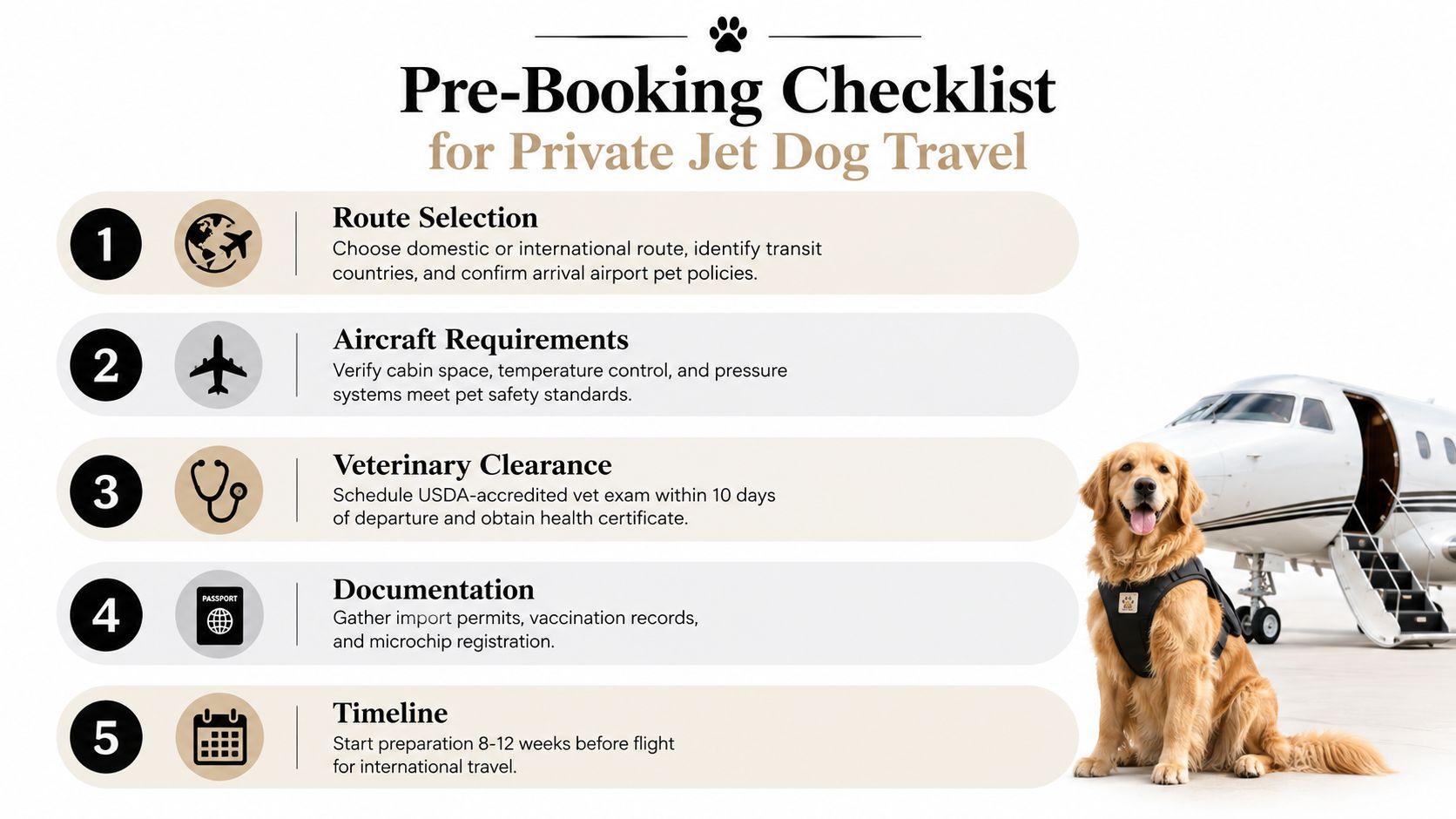
The Pre-Booking Checklist Every Dog Owner Should Run First
Start with the route, not the aircraft. Domestic travel is a different problem from international travel, and transit countries can add their own rules even if the final destination looks simple on paper. You also need to know whether the arrival airport is authorized for pet entry, because the wrong airport can break the trip before the dog even reaches the tarmac.
What to verify before you pay
Check the dog first. Age, breed, weight, medical history, microchip status, rabies dates, and any recent treatment all matter. The most common failure isn't the jet, it's a mismatch between the dog's readiness and the departure window. If the vaccination interval or endorsement timeline hasn't matured, the flight date doesn't matter.
Use a blunt go/no-go test before you sign anything:
- Route reality. Is this domestic, international, or a trip with transit-country rules?
- Dog readiness. Are the microchip, rabies record, and veterinary timeline already aligned?
- Operator fit. Does the aircraft operator allow the dog in cabin, and under what conditions?
- Return requirements. Is the trip one-way, or do you need the return leg to meet a separate set of rules?
For a calmer dog while you're away from home before departure, keeping your dog calm while away is worth reading because anxiety starts long before takeoff.
The four questions to send the broker
Don't ask whether the dog is “allowed.” Ask these instead:
- Cabin access: Can the dog stay with passengers for the full flight, or is a carrier or restraint required?
- Crate requirements: If a carrier is required, what dimensions and construction does the operator accept?
- Ground transfers: How does the dog move from home to FBO to final destination?
- Return rules: Do the same policies apply on the way back, or does the return itinerary need separate approval?
A good broker answers these before you wire money. A sloppy one tells you it'll be “fine” and leaves you to discover the problem at departure. The right charter desk doesn't just source metal, it checks whether the dog, the route, and the operator agree.
Comparing Private Jet Pet Policies to Commercial Cabin Rules
Commercial aviation sets the baseline, and private aviation only looks simpler because the rules move from the airline to the operator. On commercial flights, the FAA leaves pet cabin access to the airline, and when a dog is permitted in the cabin, the carrier is treated as carry-on baggage under 14 CFR §121.589. That means the container has to fit under the seat, be stowed before the final passenger-entry door closes, and remain stowed during movement on the surface, takeoff, and landing FAA pet travel rules.
Private aviation can relax the under-seat problem, but it doesn't eliminate policy. The operator still decides size limits, carrier type, seat location, and whether the dog can ride loose, sit on a lap, or must stay in a crate. If you want a useful framework for that side-by-side evaluation, the logic behind types of comparative analysis is exactly what you're doing here, just applied to travel rules instead of data sets.
Commercial vs Private Jet Pet Cabin Rules
| Rule | Commercial Cabin | Private Jet Cabin |
|---|---|---|
| Pet access decision | Airline decides | Operator decides |
| Container placement | Under the seat | Depends on operator policy |
| Stowage requirement | Before door close, and during taxi, takeoff, landing | May vary by operator, aircraft, and route |
| Size flexibility | Tight, standardized | Often more flexible, but not unlimited |
| Breed handling | More restrictive in practice | Operator may still screen breed and health |
| Paperwork burden | Airline plus destination rules | Operator plus destination rules |
The wrong assumption is that private flying means “no rules.” The truth is simpler. The rules are still there, they're just negotiated differently.
Ask like a professional
Before you commit, ask about weight limits, breed restrictions, fee structure, and whether the dog needs a crate at all. Some operators are loose on day trips and strict on international legs. Others are the opposite. If you don't ask now, you'll ask at the worst possible time, when the aircraft is already positioned and everyone is watching the clock.
International Dog Paperwork as a Document Workflow
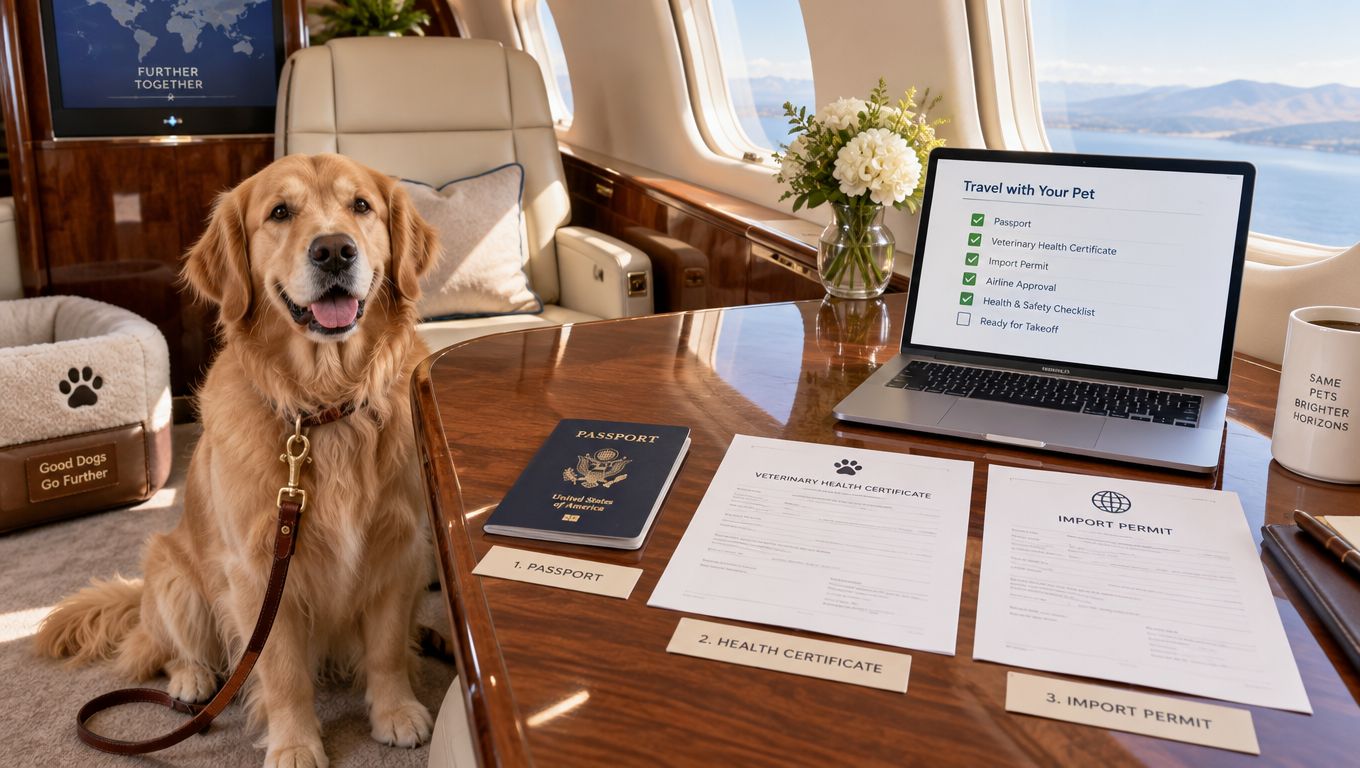
International dog travel follows a sequence, not a stack of forms. Start with the destination's import rules and any transit-country requirements. Then use a USDA-accredited veterinarian to line up the microchip, rabies vaccination, required tests or treatments, and the health certificate in the right order. Reverse that order and you can spoil the paperwork before the dog ever boards.
The sequence that keeps trips from falling apart
The clean workflow is straightforward. Microchip first, then rabies vaccination at least 28 days before departure for a first-time vaccinate, then any destination-required titer or treatment with its lab turnaround, then the USDA-endorsed health certificate. USDA says certificate validity can be time-limited, so the exam, endorsement, and departure dates need to sit on one timeline USDA pet travel export rules.
For U.S. re-entry, the CDC requires a CDC Dog Import Form receipt, and the dog must be at least six months old, microchipped, and healthy on arrival CDC dog import rules. If the dog is coming from a high-risk rabies country, separate CDC rules can apply, including a government-endorsed rabies certificate, a CDC-approved serology result, and a reservation at a CDC-registered animal-care facility. Without a valid titer, quarantine rules can still apply CDC dog FAQs.
Border control does not care how polished the cabin was. It cares whether the documents are complete, legible, and timed correctly.
That is why the flight date is only one checkpoint. If you are putting together an international dog on private jet itinerary, the paperwork clock starts when you choose the destination, not when the aircraft is confirmed.
For the operator-side view of the process, flying with pets internationally is the right reference to keep beside the paperwork folder.
Health Screening and Breed-Specific Risk Before You Fly
A private cabin cuts out airport chaos, but it does not make every dog fit to fly. Short-nosed breeds such as bulldogs, pugs, Boston terriers, boxers, and Shih Tzus face more respiratory risk because their anatomy makes breathing and heat control harder. Older dogs, overweight dogs, medically fragile dogs, stressed dogs, and dogs already running hot need a stricter screen before anyone books the aircraft AVMA short-nosed dog guidance.
What a real fitness-to-fly check includes
Get a written fitness-to-fly note from the veterinarian that states airway assessment, weight and body-condition score, cardiac findings, heat-intolerance history, and any no-fly or cabin-only restriction for this route and season. If the dog has a history of collapse, overheating, or panic, put it on the record. A private jet gives you more control, not a different biology.
Sedation is a bad call unless your veterinarian specifically directs it. Drugs that calm a nervous dog can worsen respiratory or cardiac risk, and operators may refuse them for air travel. Use the vet's guidance, not guesswork, especially with brachycephalic dogs.
What should be in your flight brief
Give the crew a one-page summary with:
- Breed and age.
- Weight and body condition.
- Medical history and medications.
- Emergency contact and destination vet clinic.
- Any known triggers, like heat, motion, or noise.
If your dog has dental issues that affect comfort or breathing, the dental health guide for dogs is useful background before you fly, because oral pain and overall condition often show up together.
A short-nosed dog can be fit for one itinerary and a poor candidate for another. That depends on the route, season, handling at each end, and the dog's actual condition on the day. That is the level of judgment private aviation still requires.
Crates, Carriers, and Cabin Setup the Week of the Flight
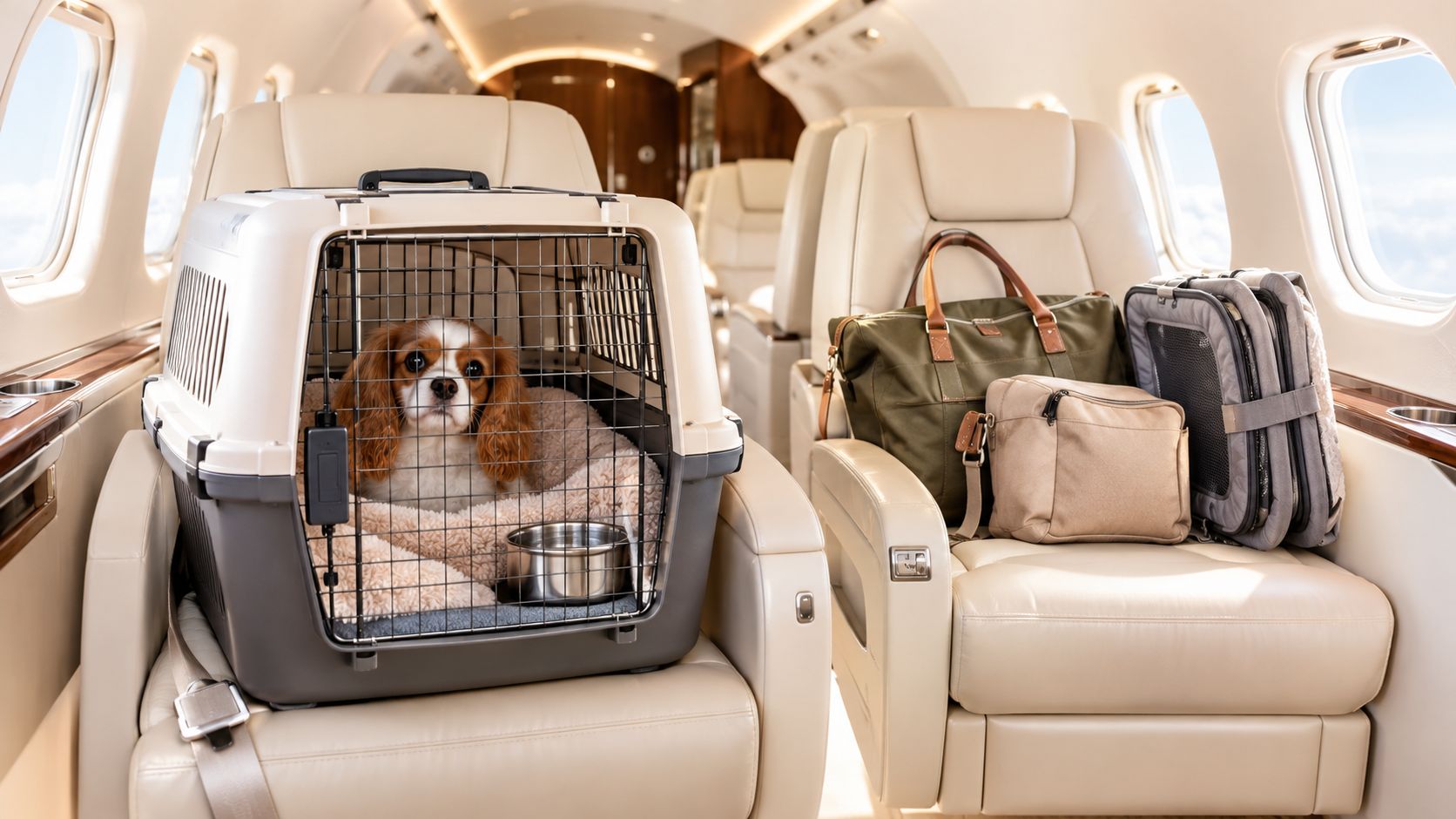
IATA's animal transport standards start with age and basic containment. Animals traveling by air must be at least eight weeks old and fully weaned, and the container has to let the dog turn around normally while standing, stand and sit fully, and lie in a natural position IATA pet travel guidance. If the carrier fails those tests, it's the wrong crate.
Get the carrier right before you get clever
IATA's cabin-container guidance also says openings for dogs must be nose- and paw-proof and no larger than 25 mm by 25 mm IATA cabin guidance PDF. That tiny detail matters because a carrier that looks sturdy can still be an escape risk if the mesh, zipper, or latch is weak.
Use the week before departure for crate acclimation. Put the dog in the carrier at home, close it for short intervals, reward calm behavior, and build duration over several days. Don't wait until the airport to discover that the dog hates the carrier or that the carrier doesn't fit the aircraft setup.
Defective carriers cause escapes more often than people want to admit. A private jet doesn't fix bad hardware.
Pack like the operator may inspect everything
Some operators allow more cabin flexibility than commercial airlines, but many still require a specific carrier model or restraint setup. Pack the following:
- Carrier with verified dimensions.
- Water bowl or spill-resistant bottle.
- Leash, harness, and backup clip.
- Original documents in a folder.
- Waste bags and cleanup supplies.
- A familiar blanket or pad.
For a visual primer on how owners usually handle the practical side, how to fly your dog on a plane is a useful reference point before you pack the week-of-flight bag. On the day itself, think in terms of cabin setup, water access during taxi and climb, and toileting at the FBO before you board. That's the difference between a controlled trip and a messy one.
On-Board Care, Arrival Logistics, and the Questions Worth Asking
Cabin temperature, ventilation, restraint, and escape prevention are safety controls, not comfort extras. The dog should ride in whatever harness or carrier the operator requires during taxi and turbulence, and ground transfer should be coordinated all the way from the FBO to the final stop. If the arrival side isn't arranged, the flight just shifts the problem from one terminal to another.
The market has already shown that people will pay for this level of coordination. Bark launched Bark Air in 2024, with reported pricing of about $7,000 for a domestic one-way ticket for one dog and one human, and transatlantic trips from New York to London or Paris can exceed $10,000 Bark Air market context. That pricing says exactly what it looks like. Real dog travel is expensive because the planning burden is real.
The operator script that saves time
Send the broker these questions before you commit:
- What's the cabin policy for dogs on this aircraft and route?
- Does the operator require a crate, harness, or both?
- How are ground transfers handled at departure and arrival?
- Who checks documents at the FBO and who meets us on landing?
- What happens if border staff reject a document or the dog is not cleared?
The four failure modes never change: paperwork rejection, denied boarding, denied entry, and in-flight distress. Private aviation can reduce friction on the flight, but it can't rescue a bad document set or an unfit dog. The private jet is the reward for getting every other step right, not the substitute for doing the work.
Haute Jets can source private aircraft and coordinate a pet-sensitive itinerary when the route, the operator policy, and the travel window all line up. If you're planning a dog on private jet trip and want the charter side handled with the compliance side in view, visit Haute Jets and start with a route that fits the dog, not just the calendar.