
A Friday afternoon in March, a Naples resident needs to be in Aspen by dinner. The first quote looks reasonable until the broker mentions that the aircraft is coming empty from Fort Lauderdale. A second quote uses a jet already positioned near Southwest Florida and costs materially less. The aircraft category is similar, but the sourcing decision changes the trip.
That's the central issue with a private jet charter to Naples, Florida. The headline hourly rate matters, but aircraft positioning, airport fit, runway performance, and seasonal availability usually matter more. A jet that has to fly in without passengers can add a substantial repositioning charge, while an aircraft already near APF, RSW, or FMY may produce a cleaner all-in price.
Naples also gives travelers a choice that many destination pages gloss over. Naples Municipal Airport, Southwest Florida International Airport, and Page Field each solve a different operational problem. The right choice isn't the airport with the most impressive terminal. It's the closest airport the selected aircraft can use safely and economically.
Why Naples Is a Charter-Heavy Gateway
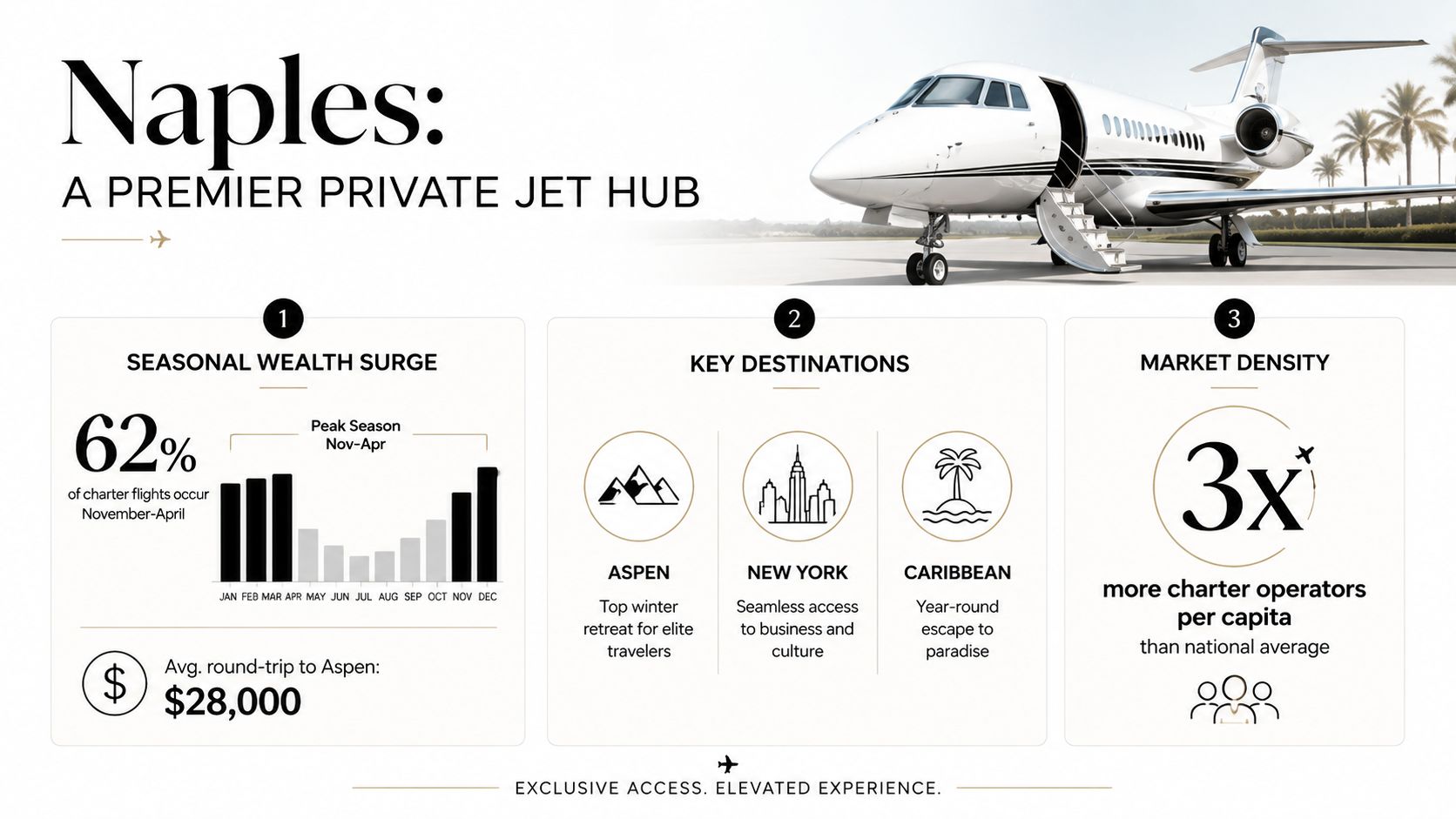
Naples isn't a casual charter market. Wealthy seasonal residents, second-home owners, executives, and high-net-worth visitors use private aviation to move between Naples, the Northeast, the Rockies, Texas, the Caribbean, and other destinations during a single stay. Many travelers don't fly in and out once. They build multi-destination weeks around homes, resorts, golf, business meetings, and boats.
Naples Municipal Airport handled 123,171 aircraft operations in fiscal year 2024, with jets representing 38% of all operations, according to the Naples Airport Authority financial report. Jet fuel accounted for 97.2% of aviation gallons sold, and the airport sold 11,750,153 gallons of aviation fuel in FY2024. Those figures explain why a city without scheduled airline service still supports a deep private-aviation ecosystem.
The first-hour decision
Most travelers face three questions as soon as they begin researching:
- Is an aircraft available near Naples?
- Will the broker charge for an empty repositioning flight?
- Can the selected aircraft use APF, or does the itinerary need RSW?
The airport's FY2025 report listed 125,926 operations, 433 based aircraft, and 1,910 aircraft clearings carrying 9,321 passengers, reinforcing that Naples demand is concentrated and substantial even without scheduled airline service. Congressional testimony also described a Naples airport with nearly 400 based aircraft, about 105,000 annual operations, and a $440 million annual economic impact, while noting that private jet activity rose by more than 40% in 2021. The congressional statement on Naples aviation provides that broader operating context.
For practical trip planning, start with the local airport, then test the aircraft. If APF works, it usually offers the most convenient arrival into Naples. If the tail has to ferry from Miami or Fort Lauderdale, compare the total against RSW before accepting the first quote. Travelers evaluating homes, villas, or seasonal residences may also find a Naples home staging guide useful when coordinating a property move around the flight.
For additional Florida routing ideas, review Haute Jets' private jet charter guide to Florida.
Choosing the Right Naples Airport and FBO
Naples Municipal Airport, APF or KAPF, is the default for most Naples charter trips. It's city-owned, public-use, and has two fixed-base operators, Naples Jet Center and Naples Aviation, according to airport information for Naples APF. The primary runway is listed at 6,600 feet, or approximately 2,011 to 2,012 meters, and the airport has no ILS. That makes temperature, wind, runway condition, fuel load, baggage, and passenger weight important parts of dispatch planning.
RSW is the practical alternative when the aircraft is too large, too heavy, or operationally inefficient for APF. Its longer runway supports a wider range of business aircraft, including large-cabin and long-range jets. The tradeoff is ground time. Travelers headed to central Naples, Pelican Bay, or Marco Island should expect a longer drive than from APF, particularly during seasonal traffic.
FMY, or Page Field, is an occasional positioning and access option. It can be useful when the aircraft is already based there, when RSW is crowded, or when the itinerary includes Fort Myers. It isn't the first choice for a traveler whose final destination is central Naples, but it can reduce repositioning expense when the aircraft is nearby.
| Airport (Code) | Runway | Primary FBOs | Drive to Naples | Aircraft Range | Typical Use |
|---|---|---|---|---|---|
| Naples Municipal Airport (APF/KAPF) | Longest listed at 6,600 feet | Naples Jet Center, Naples Aviation | Closest to Naples, including Pelican Bay and central neighborhoods | Light and midsize jets, with some larger aircraft subject to performance limits | Direct Naples access and local private aviation |
| Southwest Florida International Airport (RSW) | Longer commercial-airport runway infrastructure | Atlantic Aviation and other RSW handling options | Longer drive to Naples and Marco Island than APF | Broad cabin range, including aircraft needing greater runway flexibility | Heavy jets, long-range missions, larger groups, international planning |
| Page Field (FMY) | Regional general-aviation runway infrastructure | Local fixed-base handling options | Better for Fort Myers than Naples | Turboprops, light jets, and selected midsize jets | Aircraft positioning and Fort Myers access |
The Naples APF airport directory is a useful starting point, but don't select an airport from a directory alone. Ask the broker to validate the tail number against runway performance, expected temperature, wind, payload, and fuel requirements.
Practical rule: Choose the closest airport the aircraft can use, not the one with the flashiest lobby.
APF has customs capability through U.S. Customs and Border Protection, with inspection services listed 7 days per week from 11:00 to 18:30 in the Naples airport listing from CBP. International arrivals still require advance coordination, and RSW may be more practical for certain long-haul aircraft or schedules.
How to Request and Compare a Charter Quote
A credible quote begins with a defined mission, not a vague request for “a private jet to Naples.” Provide the departure airport, preferred departure time, passenger count, luggage, pets, return timing, and whether you need APF specifically. Tell the broker whether the itinerary is fixed or flexible. Flexibility can create access to an aircraft that's already moving through Florida.
Ask these questions before sending a deposit
- Who holds the certificate? The operating carrier, not the broker, should hold the applicable FAA Part 135 certificate.
- What's the exact tail number and aircraft year? A category label doesn't tell you the cabin layout, baggage capacity, or actual aircraft condition.
- How much crew duty time is available? A tight same-day return may require a crew swap or overnight plan.
- What repositioning is included? Require the quote to show whether the jet is already near APF, RSW, or FMY, or must fly in empty.
- What happens overnight? Ask about crew hotels, aircraft parking, and return-day positioning.
- What are the cancellation terms? The policy should be clear before payment, especially for weather-sensitive trips.
- What does the total include? Confirm catering, ground transport, FBO fees, Wi-Fi, pet handling, and any international services.
The sourcing decision should be visible in the quote. A broker with access to owner-operators across Florida may find a suitable aircraft already near the departure city. Another broker may source a jet from Teterboro or Centennial and add the ferry legs to your invoice. Both arrangements can be legal and safe, but the pricing can be very different.
Compare quotes line by line. A lower hourly rate can still produce a higher total if the aircraft has a long empty repositioning leg. A slightly higher rate may be cheaper when the jet is already positioned and the quote includes the return aircraft, crew, catering, and ground transportation.
Before wiring funds, pull the tail number on FlightAware to review its recent operating pattern. Then ask for current Wyvern or ARGUS verification and confirm that the certificate holder, aircraft, and crew arrangement match the proposal. Haute Jets' model is built around sourcing from owner-operators across 175 countries, with access to 3,500+ aircraft, so the relevant question is always where the right aircraft is located, not merely which broker answered first.
Naples Charter Pricing by Aircraft Type
Naples charter quotes are driven by two separate costs: aircraft time and aircraft positioning. A light jet can suit a short Bahamas or Atlanta trip, while a super-midsize aircraft may earn its higher price on a longer route or with a larger group. The expensive mistake is choosing unnecessary capacity, then paying again to bring that aircraft into Naples.
A current Naples charter pricing reference lists market hourly ranges of approximately $1,900 to $3,400 for turboprops and $9,500 to $14,500 for heavy jets. The same guide confirms that heavy jets perform better at RSW than APF because of runway constraints. These are hourly market ranges, not guaranteed trip totals.
Use those figures for planning, then request an all-in quote. Availability, routing, crew duty, airport choice, fuel, taxes, and positioning can change the final amount. A jet already parked near the departure city can cost materially less than one flown in empty, even when both aircraft belong to the same category.
Light jets
A Phenom 300 or Citation CJ3 usually fits 4 to 6 passengers on shorter Southeast routes, including Atlanta or the Bahamas. For Naples to Teterboro, a light jet can be efficient when baggage and weather support the mission. Naples to Aspen is a different calculation. A fuel stop may be required, and the added operating burden can make a midsize or super-midsize aircraft more practical.
Light-jet hourly rates generally sit below midsize and large-cabin pricing. That advantage can disappear if the aircraft must reposition from South Florida. Ask where the jet is coming from before judging the rate.
Midsize jets
A Citation XLS+ or Learjet 60 suits 5 to 7 passengers traveling to the Northeast or Texas. On Naples to Teterboro, midsize aircraft provide more cabin and baggage flexibility than a light jet. On Naples to Aspen, they offer a stronger balance between comfort, range, and the possibility of a fuel stop.
The $9,500 to $14,500 per hour range belongs to heavy jets, not every aircraft type. Confirm the category, tail number, and positioning legs before comparing that figure with a midsize proposal.
Super-midsize aircraft
A Citation Sovereign or Challenger 350 is a better fit for 8 to 9 passengers, coast-to-coast travel, or travelers carrying substantial baggage. Naples to Teterboro works well for a larger group. Naples to Aspen may still require a fuel stop, depending on conditions, payload, and routing.
Four passengers flying to New York with ordinary luggage rarely need a heavy jet. The larger aircraft can add cost without improving the trip enough to justify it.
Large-cabin aircraft
A Gulfstream G450 or Global 6000 belongs on transatlantic itineraries, complex multi-stop schedules, or trips involving 10 or more passengers. These aircraft may perform better at RSW when APF runway or performance limits restrict payload.
Review the private jet charter cost factors behind the quote, and compare the all-in figure rather than the advertised hourly rate.
The largest pricing swing is often the empty aircraft leg. A jet already based near APF, RSW, or FXE can avoid the cost of flying from Miami or Fort Lauderdale without passengers. Haute Jets sources from owner-operators across 175 countries and has access to 3,500+ aircraft, so its relevant pricing question is where the suitable aircraft is located. This sourcing model can reduce repositioning costs by 20% to 40%, according to the publisher's local sourcing explanation.
Safety Credentials and Operator Vetting
Part 135 certification is the legal floor for U.S. on-demand charter. It matters, but it doesn't answer every question a Naples traveler should ask. The United States has roughly 1,800 Part 135 operators, so the certificate alone doesn't distinguish one proposal from another.
Wyvern Wingman indicates that an operator has passed a recurrent safety audit covering pilot records, maintenance programs, and operational history. ARGUS Gold and Platinum ratings provide additional scrutiny, with Platinum associated with on-site operational audits and a clean accident record across the fleet. IS-BAO Stage 3 addresses international safety-management practices and often appears on larger operators.
Four questions belong in every quote review
- Who holds the Part 135 certificate? Get the legal operating carrier's name in writing.
- Which audit rating does that carrier hold? Ask whether it's Wyvern Wingman, ARGUS Gold, ARGUS Platinum, or IS-BAO Stage 3.
- What insurance limits apply? For high-value travel, ask whether coverage is at least $50 million.
- Who employs the crew? Confirm whether the pilots work for the certificate holder, an affiliated management company, or another contractor.
The answer should connect to the actual aircraft, not just the broker's network. A broker can present a highly rated operator, but you still need to know whether that operator is flying the tail number shown on your itinerary.
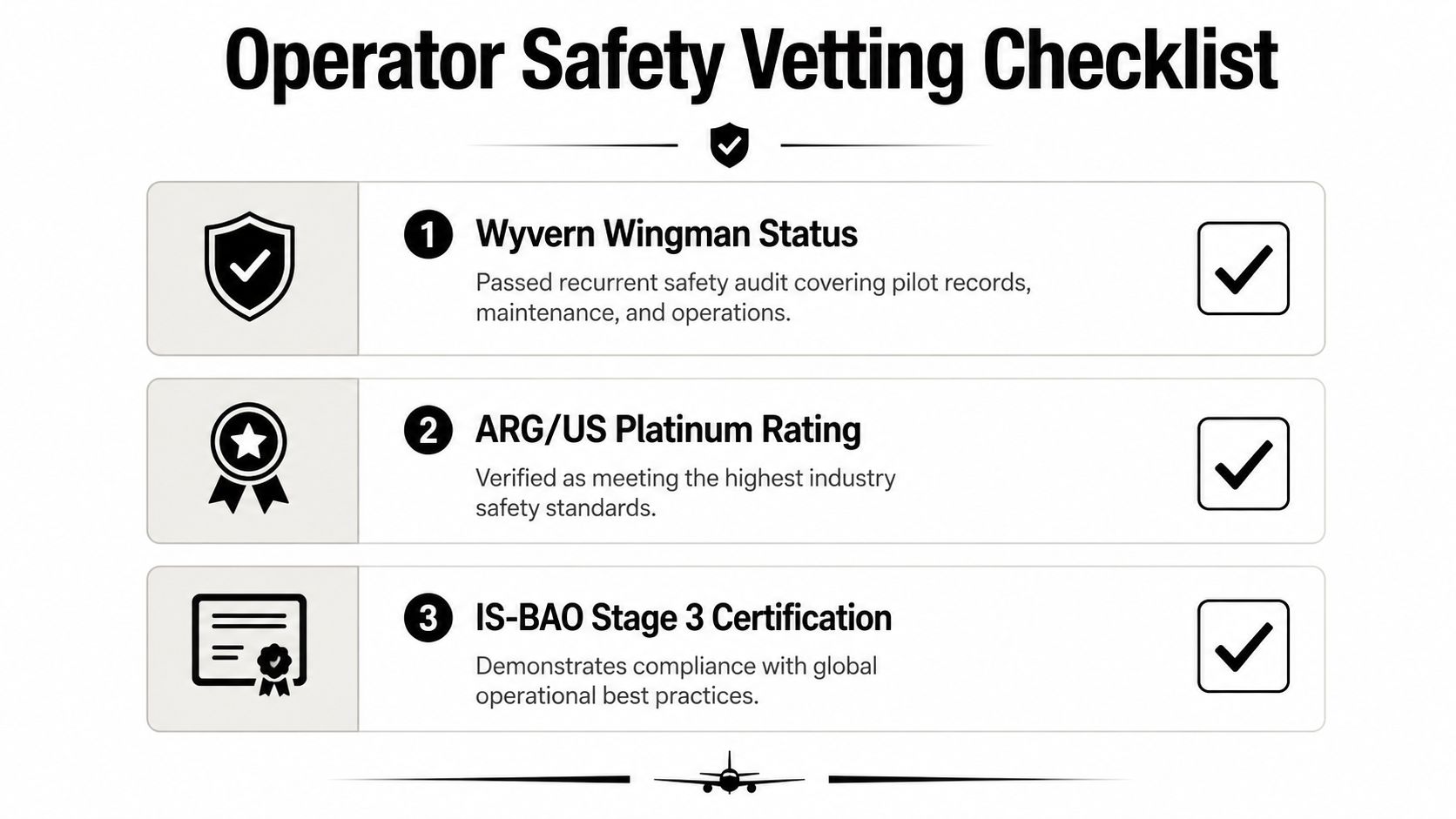
Haute Jets states that its network uses Wyvern Wingman or ARGUS Gold and Platinum-rated operators, but the traveler should still request the operating carrier, exact tail, insurance details, and crew arrangement before payment. Safety vetting isn't a decorative badge on a quote. It's the documentation that tells you who is responsible for operating your flight.
Booking Timeline and Day-of Logistics
Same-day Naples charter requests can work when a suitable aircraft and crew are already on the field. If the jet must reposition, build time into the plan for the aircraft to reach Naples, clear operational checks, and meet crew-duty requirements. The local airport is described as available around the clock for private aviation, while voluntary quiet hours run from 10 PM to 7 AM, as outlined by Naples airport charter guidance.
Build the trip in operating order
Start with the inquiry and identify the aircraft, airport, and ground destination. Once the quote is accepted, the broker should confirm the carrier, tail number, crew plan, passenger names, luggage, pets, catering, and ground transportation.
During the day before departure, request a consolidated confirmation package. It should contain the FBO address, departure time, aircraft details, crew contact information, passenger manifest, weather review, and any relevant NOTAM information. Haute Jets describes a 24-hour pre-flight confirmation process that includes the tail number, crew bios, weather briefing, and manifest.
Custom catering needs lead time. Many Naples FBOs need 8 to 12 hours for special orders, so don't wait until the morning of departure to request a particular menu, dietary preparation, or children's items. Pet travel also needs advance coordination because carrier and aircraft policies vary.
At APF, passengers typically use the FBO rather than a commercial terminal. Luggage handling, vehicle coordination, and security procedures are arranged through the operator and FBO. Private charter passengers can often arrive 15 to 20 minutes before pushback, rather than following the longer arrival routine used by commercial airlines, but the operator's show time remains the controlling instruction.
RSW requires more ground planning because the airport sits farther from Naples. The larger facility may be the correct operational choice for a heavy jet or international itinerary, but the ground transfer should be booked at the same time as the aircraft.
Weather requires a real contingency plan. Summer thunderstorms can disrupt afternoon movements, and winter fog can affect early departures. If weather removes the planned slot, a good operator should discuss a later departure, alternate airport, aircraft swap, or revised routing instead of leaving the passenger to solve the problem alone.
Putting It Together on a Sample Naples Trip
Consider a Tuesday 7:00 AM Citation Excel departure from KAPF to Teterboro for four passengers, with a return three days later. The passenger wants a quiet morning departure, enough baggage capacity for a short business trip, catering onboard, and a car waiting at Teterboro.
The first quote should compare KAPF with KRSW, not assume that one airport is automatically correct. KAPF is closer to the passenger's Naples residence and suits the aircraft category, so it becomes the working airport. RSW stays in reserve if runway performance, parking, or aircraft availability changes.
The sourcing review then asks where the Excel is sleeping the night before. In this example, the aircraft is based overnight at Page Field. That eliminates the need to ferry the aircraft from Miami or Fort Lauderdale before the passenger's departure. The savings don't come from negotiating the Excel's hourly rate. They come from removing an unnecessary empty leg.
An empty-leg option could have trimmed roughly 18% from the round-trip total if the calendar had matched. That option would have required flexibility around the aircraft's existing movement, so it wouldn't be appropriate for a fixed executive schedule unless the timing worked exactly.
What the passenger should receive
The quote should show one all-in price, the operating carrier, the exact tail number, crew plan, departure FBO, return plan, catering, and ground transport. The broker should not add a vague “fetch fee” after the passenger accepts the aircraft.
Haute Jets can coordinate aircraft sourcing, catering, and ground transport through a single point of contact, while its stated model avoids memberships and prepaid jet-card commitments. For this trip, the passenger's advisor would confirm the Citation Excel, verify the carrier's safety credentials, monitor the return-day aircraft plan, and handle a swap if the original return aircraft became unavailable.
Three decisions controlled the outcome:
- Airport choice: KAPF kept the passenger close to Naples and fit the selected aircraft.
- Aircraft location: Page Field positioning removed a costly empty ferry leg.
- Schedule flexibility: The fixed Tuesday departure favored reliability, while the flexible empty-leg option offered a lower possible total.
That's the pattern to apply to your own Naples trip. Select the mission first, compare APF against RSW, identify where the aircraft is located, and demand a complete return plan before you compare totals.
Haute Jets arranges on-demand private jet charter options to and from Naples, with aircraft sourcing based on proximity, cabin fit, operator credentials, and itinerary requirements. Visit Haute Jets to request a Naples quote that shows the aircraft, positioning plan, airport choice, and all-in cost before you commit.