

Most advice about private jet charter Tampa starts with the wrong question: “What's the hourly rate?” That number is often the least reliable part of the quote. Your final price can move sharply because the aircraft is coming from another city, the operator uses a different Tampa-area airport, or a broker adds margin without clearly separating it from operating costs.
Tampa is a substantial aviation market, not a bargain outpost. Tampa International Airport handled 23,948,889 passengers in 2024 and averaged 314 daily departures, according to its 2024 airport fact sheet. That commercial scale supports a strong private aviation ecosystem, but it also means aircraft availability, FBO choice, airport access, and positioning must be evaluated together.
The right approach is simple. Request an all-in trip quote, ask where the aircraft is based, compare Tampa-area departure points, and insist on the exact aircraft and operator before you sign. A low hourly figure means little if the aircraft has to fly empty to Tampa before collecting you.
Why Tampa Charter Quotes Vary So Wildly
Tampa isn't automatically a cheap private aviation market. A short Florida route can still produce a surprisingly large invoice because the operator prices the entire aircraft movement, not only the time you spend onboard.
Three variables create most of the confusion:
- Aircraft repositioning: If the selected aircraft isn't already near Tampa, you may pay for the ferry leg that brings it to your departure airport.
- Airport selection: The airport you choose affects FBO handling, customs coordination, parking, runway suitability, and the aircraft available nearby.
- Broker pricing structure: Some intermediaries show a clean hourly figure first and disclose positioning, fuel, international charges, or service fees later.
Independent charter guidance identifies live aircraft availability, fuel, positioning, international fees, and exact dates as factors that affect the final quote. Tampa pricing material also presents broad estimates of roughly $2,500 to $13,000 or more per flight hour, with one-way examples of approximately $5,900 to $14,500 or more, as shown in this private jet charter cost explanation. Those figures are reference points, not promises.
Why short flights can still cost near five figures
A Tampa to Miami flight illustrates the problem. A light jet may be suitable for the distance, but the operator still has aircraft minimums, departure and arrival costs, crew requirements, and possible positioning to account for. If the jet is sitting in Orlando, Fort Lauderdale, or another market, the aircraft must first reach Tampa and later continue to its next assignment.
That ferry movement can add a material surcharge. The commonly cited 20 to 40 percent positioning effect is a practical warning supplied in the Tampa charter brief, but it shouldn't be treated as an automatic charge on every itinerary. A locally available aircraft may avoid much of it, while a scarce aircraft type or fixed departure time can make positioning unavoidable.
Practical rule: Judge the quote by the total trip cost, not the displayed hourly rate.
A broker should identify the aircraft's current location, home base, estimated empty legs, daily minimums, fuel treatment, taxes, FBO charges, and cancellation terms. If those items are missing, you're comparing incomplete offers. Ask for two or three aircraft that can perform the mission, then compare the total, the aircraft age, the cabin configuration, and the operator's safety credentials.
Choosing the Right Tampa Airport for Your Departure
Airport choice should follow the mission, not habit. Tampa International Airport, Tampa Executive Airport, Peter O. Knight Airport, and St. Pete-Clearwater can serve different operating needs, but they aren't interchangeable for every aircraft or itinerary.
Tampa International, or KTPA, is the strongest choice when you need major-airport infrastructure, long-runway capability, or international coordination. The airport ranked 26th among U.S. airports in its 2024 fact sheet, and its private aviation activity is handled separately from airline traffic through Signature Flight Support and Sheltair, as documented in KTPA airport and FBO information. Sheltair operates a 24-hour full-service FBO at 4751 Jim Walter Blvd., Tampa, Florida 33607, with a 29-foot arrival canopy and 24-hour customs described on its Tampa location page.
Peter O. Knight, or TPF, sits on Davis Islands and can be attractive when the passenger's destination is central Tampa or the waterfront. Tampa Executive, or VDF, is the better operational candidate for many regional private flights because it is dedicated to general aviation and avoids the airline-terminal environment. The Florida Department of Transportation's airport profile identifies VDF as a Tampa-area general aviation facility and records 181 based aircraft in one 2023 airport profile reference. The same profile records 102 based aircraft and 55,562 operations at Peter O. Knight in 2023. Review the Florida airport profiles.pdf?sfvrsn=efa8b14e_1) for the underlying airport-system information.
St. Pete-Clearwater, or PIE, can be useful when the aircraft is already positioned on the Gulf Coast or when your destination is in Pinellas County. Don't select it solely because it sounds less congested. The practical benefit depends on the aircraft's location, the available FBO, customs requirements, and your ground transfer.
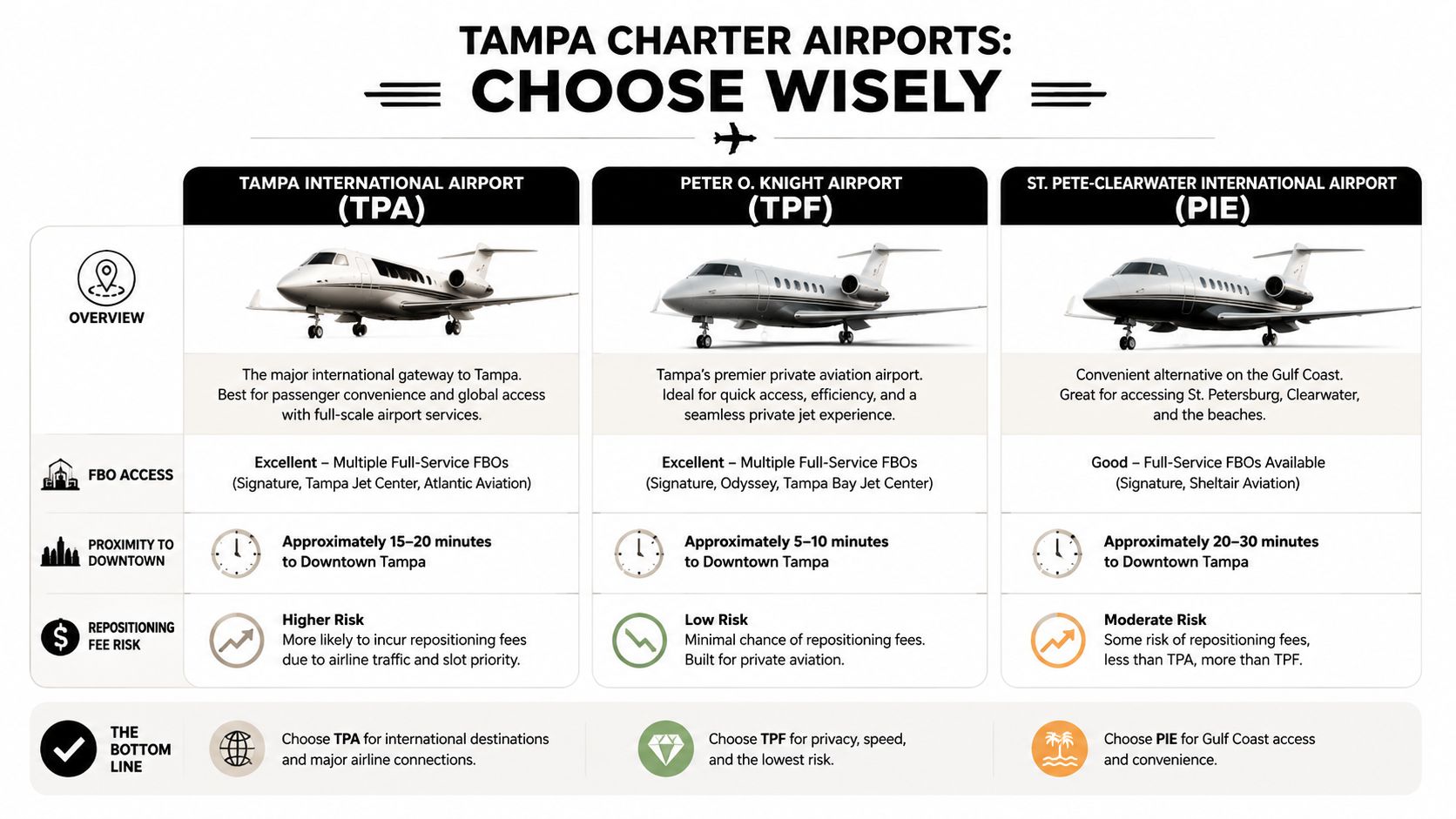
Tampa private jet departure airports compared
| Airport | Longest Runway | FBO Options | Customs | Best For |
|---|---|---|---|---|
| KTPA | 11,002 feet, according to Tampa airport destination guidance | Signature Flight Support and Sheltair | Established private and general aviation customs procedures | Long-range aircraft, international coordination, Westshore access |
| VDF | Airport suitability depends on aircraft and operating requirements | General aviation handling | Confirm for the specific international itinerary | Regional Florida missions and aircraft already based nearby |
| PIE | Confirm runway, FBO, and customs suitability for the selected aircraft | Confirm the assigned FBO before contracting | Confirm before booking an international leg | Gulf Coast destinations and aircraft positioned in Pinellas County |
For international travel, don't assume a general aviation airport can process your passengers because it accepts private aircraft. Confirm customs hours, advance notice, documentation, and arrival procedures with the operator. For KTPA, U.S. Customs and Border Protection lists private and general aviation procedures with regular office hours from 0600 to 2200 Eastern Time, seven days a week, according to CBP information included in Tampa airport guidance. You can also review Haute Jets' Tampa International private terminal information when comparing KTPA handling.
What a Tampa Charter Actually Costs in 2026
A Tampa charter quote should be read as a trip budget, not a multiplication exercise. Aircraft category, route, availability, airport fees, fuel, crew positioning, and schedule constraints all matter. The final amount can't be responsibly fixed from an hourly rate alone.
The available Tampa pricing material provides a broad market reference of approximately $2,500 to $13,000 or more per flight hour, while one-way examples for common routes range from about $5,900 to $14,500 or more. Those figures come from the Tampa private jet cost reference, and they illustrate the spread rather than guarantee a price for a particular date.
Tampa private jet charter cost ranges by aircraft and route
| Aircraft Class | Example Route | Estimated One-Way Cost |
|---|---|---|
| Light jet | Tampa to Miami | About $5,900 to $14,500 or more, depending on aircraft and itinerary |
| Midsize jet | Tampa to New York | Request a live all-in quote, because positioning and availability can change the total materially |
| Heavy jet | Tampa to Aspen | Request a live all-in quote, with aircraft range, crew logistics, and positioning confirmed in writing |
The table is intentionally conservative where verified route-specific figures aren't available. A precise dollar estimate for Tampa to New York or Tampa to Aspen would require inventing data. The professional answer is to quote the actual mission after confirming passenger count, luggage, dates, aircraft preference, and airport.
Why the hourly rate misleads
Operators may calculate charges using flight time, occupied time, daily minimums, or a combination of operating rules. A short leg can be disproportionately expensive because takeoff, landing, crew scheduling, and aircraft utilization still consume resources. A heavy jet may also be unnecessary for a domestic trip, while choosing a smaller aircraft with insufficient range can force a less efficient arrangement.
Repositioning is the most overlooked variable. If an aircraft based in another city must fly empty to Tampa, the charter can absorb that ferry movement. The supplied Tampa analysis describes this effect as potentially adding 20 to 40 percent to a quote, but the actual impact depends on the operator, schedule, aircraft location, and whether another suitable aircraft is available locally.
Local sourcing can remove that surcharge when a qualified aircraft is already near Tampa. Ask the broker to show the aircraft's current location and the planned routing before accepting the quote. Then compare the all-in figure against another aircraft that is already positioned in the region.
For a deeper explanation of the variables behind a private flight invoice, use this private jet charter cost guide. The useful question isn't “What does this jet cost per hour?” It's “What is the complete cost to move these passengers from this airport to that destination on this date?”
How to Book a Private Jet From Tampa Step by Step
A smooth booking begins with precise information. Before contacting an operator or broker, prepare the departure date, preferred departure window, passenger names, luggage volume, pets, destination airport, return requirements, and any international customs needs. If you're flying for business, identify whether the aircraft must wait, return empty, or remain available for a later segment.
The first quote should include aircraft options, not just a category. Ask for the tail number when available, the aircraft's current location, year, make, model, cabin layout, Wi-Fi status, catering options, pet policy, and the assigned operator. Cabin photos help, but they don't replace confirmation that the pictured aircraft is the one being offered.
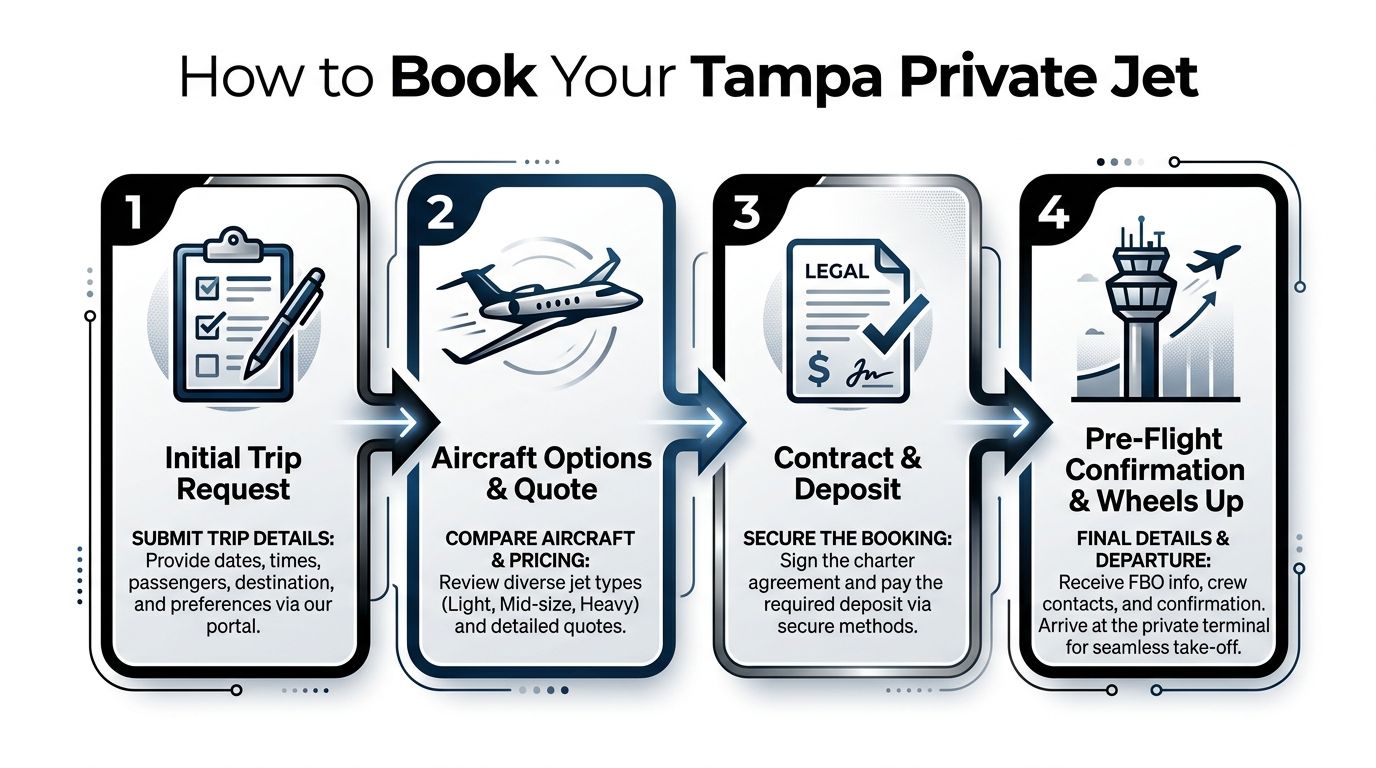
The booking sequence that protects the client
Submit the mission accurately. Give the provider the passenger count and luggage requirements. A quote based on incomplete information can change after aircraft selection.
Review aircraft and operator details. Don't settle for “light jet” or “midsize jet.” Request the exact aircraft, operator name, home base, safety audit status, and cabin specifications.
Compare all-in contracts. The agreement should identify the total price, payment schedule, cancellation terms, repositioning treatment, taxes, FBO charges, catering, ground transport, and any assumptions about waiting time.
Confirm the final package. A professional pre-flight file should arrive before departure with the tail number, crew bios, weather briefing, passenger manifest, FBO address, departure instructions, and ground transportation details.
A broker who refuses to identify the operator or aircraft before payment is creating unnecessary risk. You don't need every operational detail at the first phone call, but you do need enough information to compare offers intelligently.
Ask directly: “Where is the aircraft now, and which line items cover repositioning?”
The airport meeting point matters as much as the contract. FBOs operate separately from airline terminals, so your driver should take you to the correct private aviation facility, not the main passenger drop-off. For additional booking guidance, review Haute Jets' private jet booking process.
Avoiding Repositioning Fees and Broker Markups
Local aircraft sourcing is the clearest cost lever available to a Tampa charter client. If a suitable aircraft is already based in the Tampa region, you may avoid paying for an empty ferry leg that would otherwise bring the aircraft to you.
Traditional broker structures and jet card programs can obscure this issue because the client sees a packaged price rather than the aircraft's actual movement. The supplied Tampa analysis identifies repositioning as a possible 20 to 40 percent contributor to quote inflation. That range is not a universal tariff, but it's large enough to justify asking the question on every trip.
How to verify the aircraft is local
Request the aircraft's current location and home base in writing. Then ask whether the quoted amount includes:
- Ferry legs: Movement to Tampa before pickup and onward positioning after drop-off.
- Daily minimums: Required billable utilization even when your occupied flight is short.
- Airport charges: Landing, handling, parking, and FBO costs.
- Schedule protection: Costs created by holding the aircraft for a return or delayed departure.
- Change exposure: The price effect if your departure time moves.
Owner-operator sourcing can produce a cleaner comparison because the aircraft's operating economics are closer to the quote. That doesn't mean every owner-operator offer is automatically cheaper. Safety qualification, aircraft condition, availability, and contract terms still determine whether the offer is appropriate.
Haute Jets is one option that sources from 3,500+ aircraft across 175 countries, uses owner-operator availability, and offers on-demand booking without memberships or jet cards, according to the publisher's service information. Its stated network requirement is a Wyvern Wingman or ARGUS Gold/Platinum safety rating. Treat those details as a starting point for due diligence, then verify the specific operator and aircraft assigned to your trip.

Empty legs deserve a separate judgment. They can work well when your schedule is flexible and the aircraft's existing route matches your plans. They're a poor choice when you need a fixed departure time, a guaranteed return, or a particular cabin, because the underlying repositioning mission may change or disappear.
An empty leg is a scheduling opportunity, not a substitute for a confirmed primary aircraft.
For most occasional travelers, compare on-demand charter against a jet card rather than assuming prepaid hours create value. Membership fees, blackout rules, aircraft substitution, and repositioning treatment can matter more than a promised hourly rate.
Your Pre-Flight Checklist for Tampa Charters
Use the checklist as a final control before you authorize payment. Private aviation feels informal at the FBO, but the aircraft, operator, contract, and passenger details still require disciplined verification.
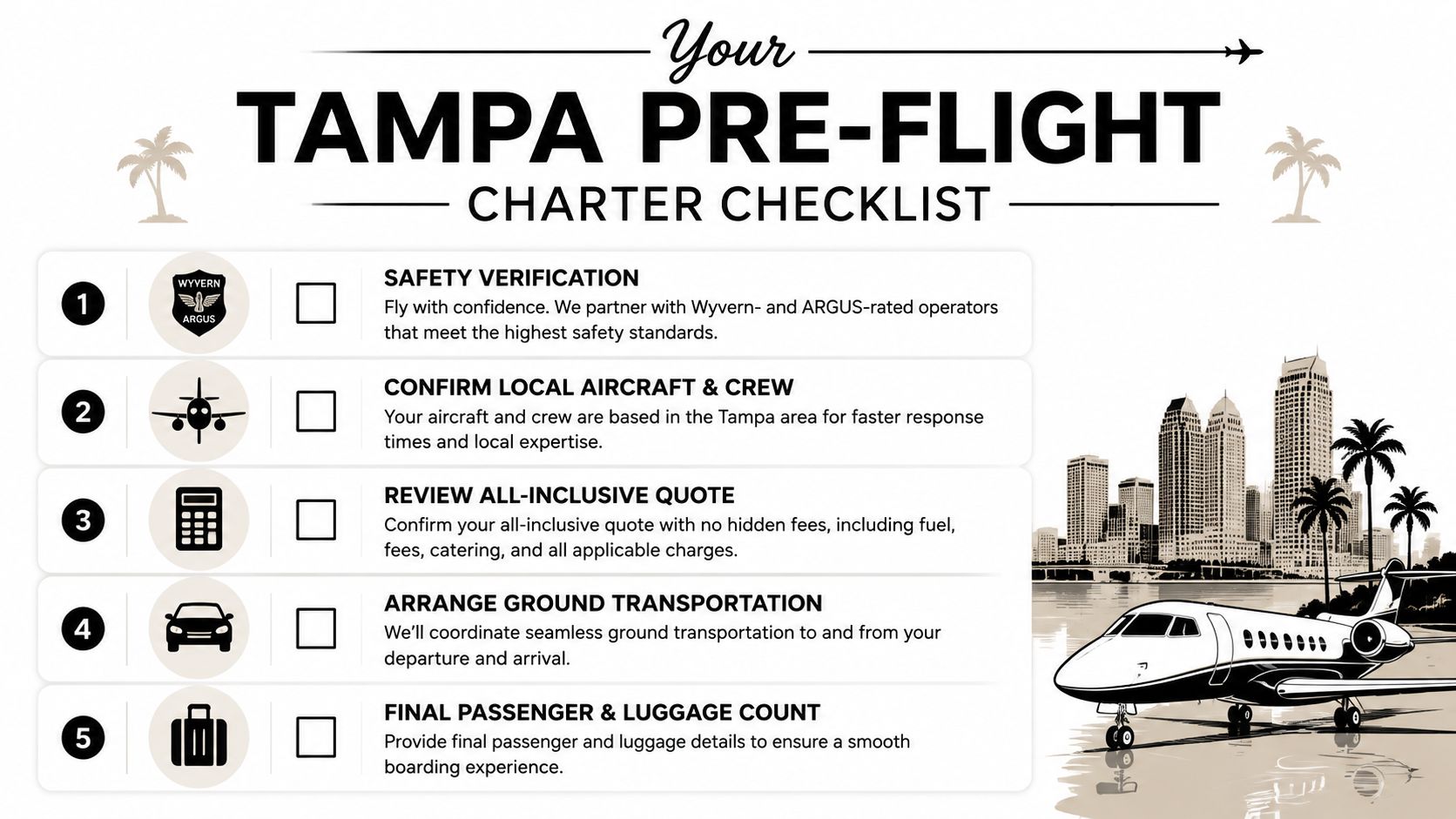
Safety and aircraft verification
Confirm that the assigned operator has a recognized independent safety audit, such as Wyvern Wingman or ARGUS Gold/Platinum, and verify that the rating applies to the operator performing your flight. Ask for the exact aircraft registration, cabin photographs, maintenance status as appropriate, passenger capacity, luggage limitations, and crew arrangement.
Don't accept a generic aircraft category if the cabin matters. Confirm the actual Wi-Fi system, catering plan, pet approval, and seating configuration before the contract becomes nonrefundable.
Airport and ground logistics
Your departure instructions should state the FBO name, address, parking process, and recommended arrival time. At KTPA, Sheltair operates a 24-hour facility with a 29-foot arrival canopy and 24-hour customs, according to its official Tampa FBO information. International passengers should still confirm customs coordination with the operator because office procedures and documentation requirements apply to the specific itinerary.
Arrange the vehicle before departure, especially for downtown Tampa, Westshore, South Tampa, or a cross-bay destination. The correct FBO reduces confusion, but it doesn't eliminate road traffic or event-related delays.
Passenger details and final confirmation
Send the final passenger and luggage count, passport details for international travel, pet information, catering preferences, and ground transportation instructions. Ask for the complete confirmation package before departure, including:
- Tail number and aircraft details
- Crew bios
- Weather briefing
- Passenger manifest
- FBO contact information
- Catering and Wi-Fi confirmation
- Pet approval
- Payment and cancellation terms
For common questions, get a written answer rather than relying on a sales call. Pet travel depends on the aircraft and operator's policy. Bitcoin payment depends on the provider and contract. Same-day availability depends on aircraft location and schedule. Tampa Executive may support general aviation missions, but international departures require confirmation of customs capability, operating hours, permits, and passenger documentation.
Final check: If the quote doesn't show the aircraft, operator, airport, positioning treatment, and complete payment terms, it isn't ready for approval.
Haute Jets can arrange on-demand private charter options from Tampa, compare locally positioned aircraft, and coordinate the aircraft, FBO, crew, catering, pets, and ground transport around one itinerary. Visit Haute Jets to request a Tampa quote that identifies the actual aircraft and separates the costs that matter.