
A lot of founders still approach the private jet rental business as if success starts with aircraft ownership. In practice, the economics often start somewhere else. The global private jet charter services market rose from $24.12 billion in 2025 to $27.38 billion in 2026, a 13.5% CAGR according to The Business Research Company's private jet charter services market report. That kind of expansion matters, but the more useful takeaway for an operator is simpler. Growth doesn't automatically reward the company with the most planes. It often rewards the company that prices cleanly, sources intelligently, and executes reliably.
That shift is why this topic belongs on Haute Jets Journal. The primary opportunity in modern charter isn't glamour. It's margin discipline, safety discipline, and distribution discipline. If you're considering entering the market, the central question isn't whether people want private flights. They do. The key question is which operating model gives you enough control over pricing and service without burying you under fixed costs.
The Soaring Opportunity in Private Aviation
A market can grow quickly and still punish weak operators. Private charter is one of those sectors. Demand has expanded, but that growth has not made the business simple or forgiving. It has raised the reward for firms that can source lift efficiently, quote accurately, and protect margin trip by trip.
That distinction matters for anyone considering a private jet rental business. New entrants often assume the upside comes from visible assets, especially aircraft ownership. In practice, the stronger opening is often in distribution and pricing. The firms that understand the spread between wholesale aircraft access and retail client pricing have a clearer path to profit than firms that start by loading the balance sheet with fixed costs.
Why founders misread the opportunity
First-time entrants often borrow assumptions from adjacent rental categories. That comparison has value, and exploring the car rental business model is useful for understanding utilization pressure, idle inventory, and rate discipline. But private aviation adds more friction at every level. Supply is fragmented, operator quality is uneven, airport constraints matter, and one bad handoff can erase a client's trust.
Clients are not paying for a jet in the abstract. They are paying for certainty. They want a suitable aircraft, a vetted operator, a clean itinerary, and a final invoice that does not drift upward with avoidable surprises.
That is why price opacity remains such a large opening.
The Strategic Opening
The strongest opportunity for a new entrant usually sits in an asset-light brokerage model, not a fleet-first buildout. The economics are easier to control. Capital stays available for sales, operator relations, customer service, and quoting systems instead of being tied up in a depreciating aircraft that still needs financing, maintenance oversight, crew coordination, insurance, and enough utilization to justify ownership.
This is also where the wholesale versus retail gap starts to matter. A broker that buys well from qualified operators and prices with discipline can build healthy margins without carrying the overhead of a traditional operator. A broker that buys poorly or quotes loosely can lose money even in a growing market.
Haute Jets is a useful case study because the model reflects how modern charter buyers behave. The company has built its offer around broad operator access, careful sourcing, and a pricing structure designed to remove common client objections, including repositioning fees on many trips. That is more than a marketing detail. It changes conversion math because clients compare the all-in number, not the hourly rate alone.
The customer base supports this model. Reports on affluent travel behavior, including the Haute Jets Wealth Report 2025, point to a buyer who values time, privacy, and consistency but still notices pricing structure. In this sector, convenience sells the trip, but cost clarity often closes it.
Founders who see that early tend to allocate capital better. They build a company that can win on sourcing quality, speed to quote, operator vetting, and service reliability. Those are the habits that create repeat business and referral momentum in private charter.
Understanding Market Demand and Client Behavior
U.S. private jet charter revenue is expected to reach $28.9 billion in 2026, spread across 2,056 businesses, according to IBISWorld's U.S. private jet charter industry analysis. For a new entrant, that matters for one reason above all. Demand is real, but margin does not belong automatically to whoever answers the phone first.
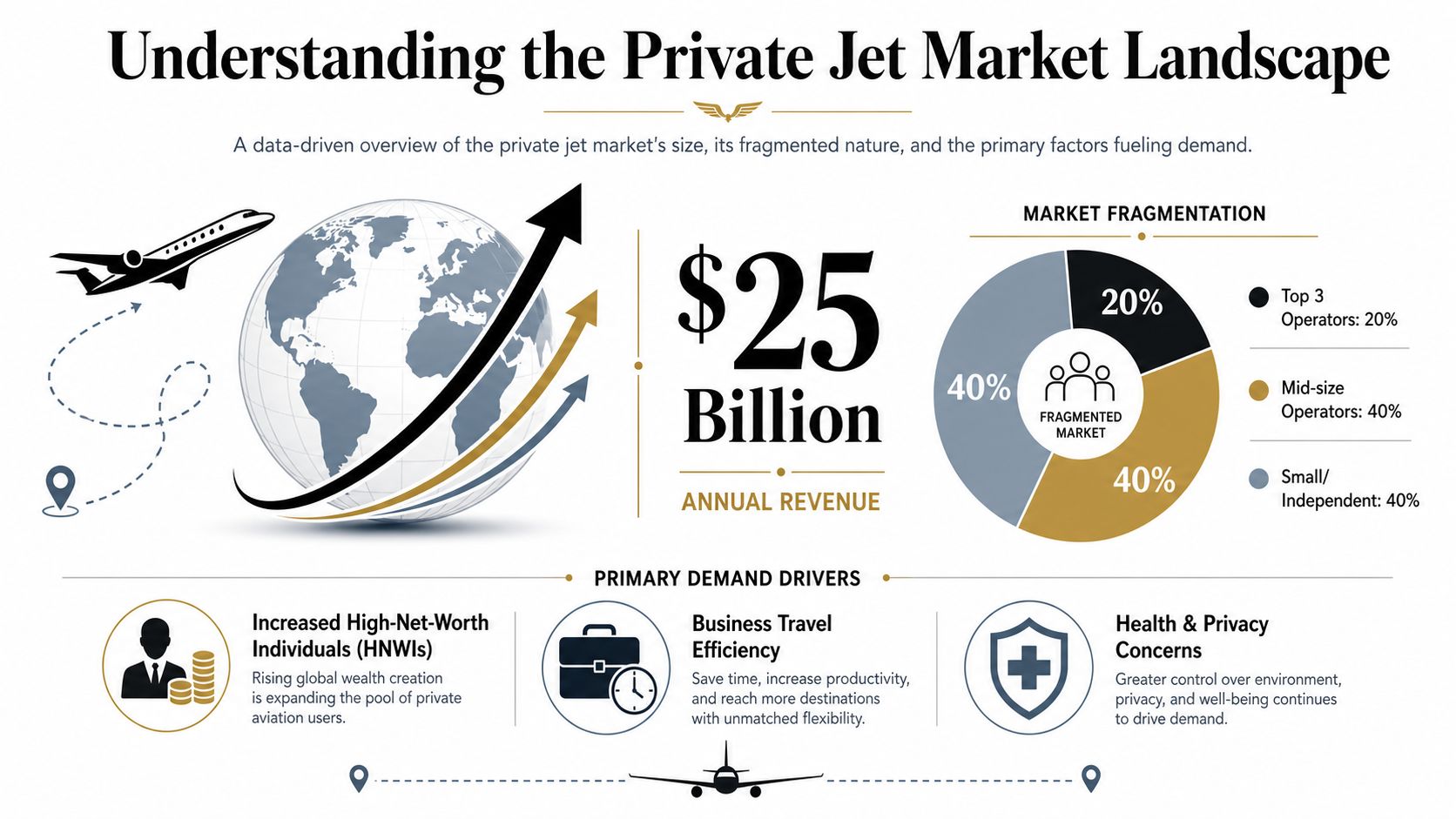
A fragmented market rewards firms that understand how clients buy, how trips are sourced, and where pricing discipline protects profit. In practice, the strongest operators and brokers do not win by sounding more luxurious. They win by quoting fast, sourcing accurately, and removing avoidable friction from the booking process.
What clients are actually paying for
Clients rarely care about aircraft types in isolation. They care about the business or personal result the trip delivers.
A CEO wants control over schedule and airport choice. A family office wants privacy, predictability, and a provider who will not create cleanup work for an assistant. Entertainment and sports clients often need late changes handled without drama. Referral partners such as wealth managers or executive assistants want a charter provider that makes them look careful and competent.
Those expectations shape buying behavior:
- Fast, accurate quoting: Speed matters, but accuracy matters more. A fast quote that gets revised twice hurts trust.
- Clear safety process: Clients want to know who is operating the flight, how that operator is vetted, and who is accountable if plans change.
- All-in price clarity: Buyers compare total trip cost, not just hourly rate.
- Execution on details: Wi-Fi reliability, baggage fit, pet handling, catering timing, and ground transport coordination often decide whether a client rebooks.
This is also where many new entrants misread demand. They assume private aviation sells on aspiration alone. Repeat charter sells on reduced uncertainty.
Demand favors access over ownership
A large share of the market comes from travelers who want private aviation benefits without the fixed burden of aircraft ownership. They do not want to deal with crew employment, maintenance planning, insurance renewals, depreciation exposure, or idle capacity.
That buyer profile supports the asset-light brokerage model discussed earlier, but only if the economics are handled properly. The core financial question is not merely whether demand exists. It is whether the company can consistently buy charter lift at wholesale rates and sell it at disciplined retail pricing without losing deals to slower competitors or vague quotes.
Founders should model that early. If the margin structure is thin, volume alone will not save the business. A practical primer on finding your break even point without an MBA is worth reviewing before you start setting quote policy, sales targets, or staffing assumptions.
The best demand signals are behavioral
The strongest charter prospects usually show the same patterns. They book irregularly but repeatedly. They value time more than fare class. They may compare providers, but they still reward clarity and responsiveness. They notice whether repositioning is folded into the quote or added later as a surprise line item.
That last point has direct commercial value. Haute Jets is a useful example because the company built part of its offer around eliminating repositioning fees on many trips. That changes how a client reads the quote. Instead of mentally recalculating the actual trip cost, the buyer sees a cleaner all-in number. In a market where several providers may have access to similar lift, that pricing structure can improve conversion even before any discussion of cabin finishes or service extras.
For a broader view of how affluent travelers weigh time, privacy, flexibility, and spending priorities, the Haute Jets Wealth Report 2025 offers useful context.
Focus beats generic coverage
New entrants often assume broader coverage means stronger market position. In charter, focus usually performs better.
A firm can specialize by client type, trip profile, or geography. Family office travel, entertainment tours, multi-leg business itineraries, high-frequency East Coast shuttle demand, and peak-season leisure routes all require different sourcing habits and service workflows. Specialists usually quote faster because they know the mission profile, the airport constraints, the operator pool, and the client's tolerance for trade-offs.
That matters because private aviation is not a pure lead-generation business. It is a judgment business. The firms that build durable demand are the ones that understand who they serve, which trips they can source well, and how to present a price that feels clear, fair, and worth accepting.
Choosing Your Business Model
Margin is set earlier than many founders expect. In private charter, the biggest strategic decision is not branding or aircraft category. It is whether your model gives you consistent access to the gap between what lift costs you wholesale and what the client will accept at retail.
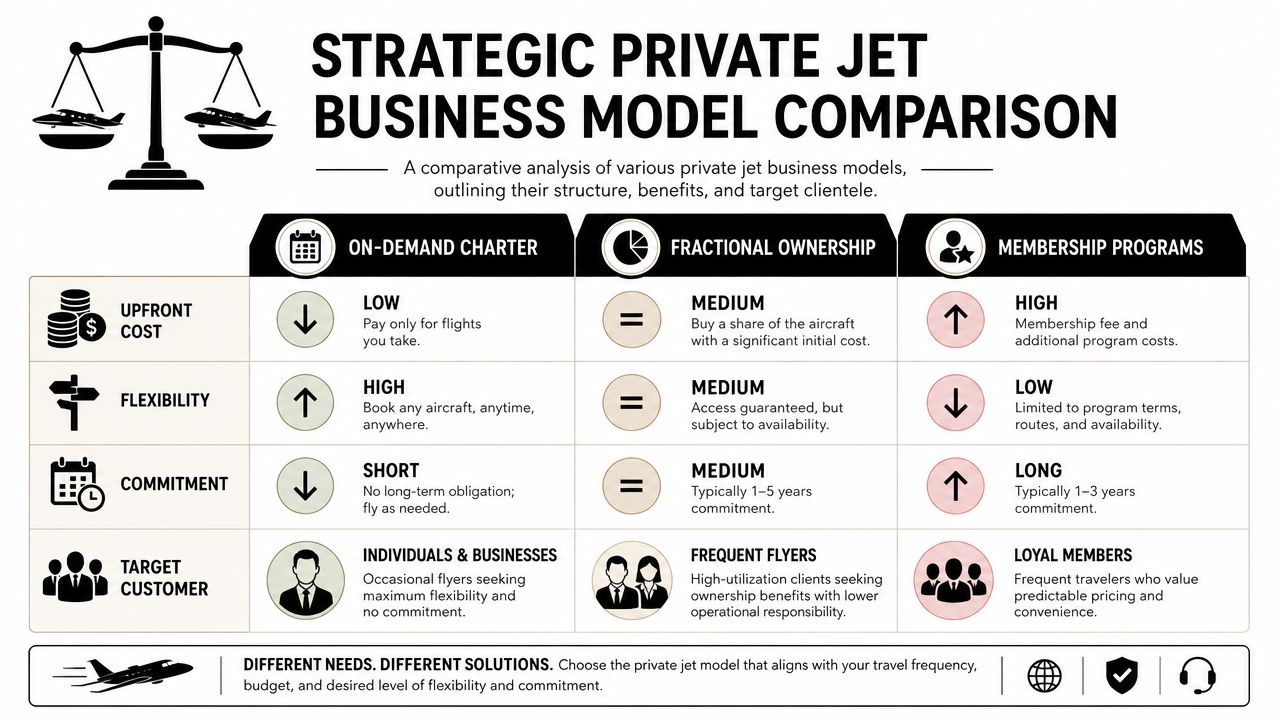
The main models in the market
Founders usually choose among four structures, and each one creates a very different cost base.
| Model | Strength | Limitation | Best fit |
|---|---|---|---|
| Part 135 operator | Control over aircraft, crew standards, and service delivery | High fixed cost, regulatory burden, and utilization pressure | Founders who already have aviation infrastructure or patient capital |
| Broker | Low asset intensity and flexible sourcing | Quality depends on operator network and internal discipline | Commercial teams that can quote accurately and manage trips well |
| Marketplace | Broad lead capture and scalable quote distribution | Weak control over service quality and post-sale execution | Tech-led firms with traffic, automation, and supplier depth |
| Fractional or jet card platform | More predictable repeat demand and customer commitment | Inventory risk, pricing complexity, and service guarantee exposure | Firms with strong balance sheets and concentrated frequent-flyer demand |
The common mistake is assuming aircraft control automatically creates the stronger business. For a new entrant, it often creates the heavier business. Those are not the same thing.
Why capital-heavy models trap inexperienced founders
Operating aircraft gives you more control over the product, but it also creates fixed obligations before revenue becomes dependable. Payroll, training, insurance, hangar agreements, maintenance scheduling, unscheduled maintenance, and compliance overhead continue whether the aircraft flies or sits.
That structure can work. It just needs enough utilization and enough pricing discipline to carry the burden.
Many founders miss the math because they focus on trip revenue instead of contribution margin. The more useful question is simple: after supplier cost or operating cost is paid, how much gross profit remains to absorb overhead? If that part is fuzzy, this guide to the break even point without an MBA is a practical refresher.
A second issue is legal structure. If you plan to operate aircraft rather than stay purely on the brokerage side, understand the operating framework before you spend money on sales or branding. A plain-English guide to what FAA Part 135 allows and requires is a good place to start.
Why the asset-light brokerage model remains attractive
Charter demand is broad because many clients want private access without full-time ownership economics. That creates room for a brokerage model that buys lift intelligently, prices it clearly, and keeps overhead under control.
The financial engine is the spread between your buy rate and your sell rate. That spread is not automatic. It depends on operator relationships, timing, trip type, airport pair, and whether the quote includes avoidable cost. Founders who understand that usually build around sourcing before they build around marketing.
This is also where many weak brokers lose deals. They pass through every repositioning charge, every last-minute inefficiency, and every supplier inconsistency, then wonder why quote conversion stays soft. A better model is to source around those friction points wherever possible and present a cleaner retail number.
What works in practice
The firms that last tend to build a brokerage operation with a few habits in place from day one:
- A real operator bench: Enough approved supply to source by route, timing, and aircraft availability, not just by whoever answers first.
- Clear qualification rules: Weak operators and loosely checked paperwork create margin risk and reputation risk at the same time.
- Fast, disciplined quoting: Speed matters, but accuracy matters more. A fast bad quote is still a bad quote.
- Trip management after the sale: Repeat business usually comes from execution, not from the first accepted quote.
- Control of avoidable cost: Repositioning, short-notice ferry exposure, and airport-specific constraints should be managed upstream, not explained away after the quote is sent.
Haute Jets is a useful example of that asset-light approach. The company operates as an on-demand brokerage, sources from a large network of owner-operators, does not require annual fees or prepaid hours, and has built part of its offer around removing repositioning fees on many trips. That matters because eliminating a visible cost line can tighten the gap between a confusing quote and an acceptable one. In brokerage, that is often where margin and conversion meet.
For most new entrants, the smart sequence is simple. Start asset-light. Prove that you can source well, price well, and manage clients well. Add complexity only after the margin structure is consistent enough to justify it.
Navigating Safety and Regulatory Requirements
Founders sometimes treat safety as a compliance box and branding as the primary commercial engine. In private aviation, that thinking doesn't last. Safety is the commercial engine because one weak operator relationship can damage your reputation faster than any sales campaign can repair it.
Start with legal eligibility
If you aren't operating aircraft yourself, you still need to understand the operating framework your suppliers live inside. In the U.S., that usually means understanding what a charter operator is authorized to do under Part 135 and how that differs from private operations.
For a plain-English explanation, the Haute Jets guide to FAA Part 135 is a practical starting point.
A broker or advisor doesn't need to become a regulator. But you do need to know what documents to request, what approvals matter, and what operational promises should never be made on assumptions.
Compliance isn't enough
Basic legality is only the floor. High-quality charter businesses go further by screening operators through recognized third-party audits. That extra layer matters because two operators can both be legal to fly charter and still present very different levels of process maturity and risk control.
Every operator in Haute Jets' network must hold a Wyvern Wingman or Argus Gold/Platinum rating, which are the two highest third-party safety audits in private aviation, according to the company's safety standards page. That policy narrows availability to rigorously vetted operators.
That principle is bigger than one brand. It illustrates a sound founder decision. Restricting your supply pool can improve your business if the restriction raises trust and reduces avoidable risk.
What to evaluate beyond the badge
A strong safety process should include more than marketing language about standards. It should answer operational questions clearly.
Use a checklist like this when vetting operators:
- Certificate status: Confirm the operator is properly authorized for the mission profile you're booking.
- Audit standing: Verify current third-party audit status and whether it aligns with your own acceptance criteria.
- Crew qualifications: Review who flies the aircraft category and how experience is documented internally.
- Operational control: Know who owns dispatch authority, weather oversight, and trip release responsibility.
- Maintenance approach: Ask how scheduled and unscheduled maintenance issues are handled before an aircraft is offered for sale.
Don't ask whether an operator is "safe." Ask how the operator proves its standards before the trip, during the trip, and when something changes.
Safety as positioning
Clients don't always ask detailed safety questions. That doesn't mean they don't care. It means they assume the broker or operator already has a rigorous process in place.
That's why safety discipline also becomes a marketing differentiator. If your standards are clear, consistent, and explainable, clients feel it in the sales process. Referral partners do too. Wealth advisors, executive assistants, concierges, and family offices want a service partner who can defend the booking decision if anyone asks later.
For a founder, the lesson is straightforward. Build your supply network slowly. Reject operators that don't meet your standard, even when they solve a short-term availability problem. A private jet rental business can recover from a lost sale. It may not recover from a preventable safety failure.
Developing a Winning Pricing Strategy
Pricing is where many charter businesses lose credibility. Not because private aviation is expensive by nature, but because the quote often arrives as a black box. The client sees one number, senses hidden variables, and starts shopping elsewhere.
A strong pricing strategy starts by making the quote intelligible.
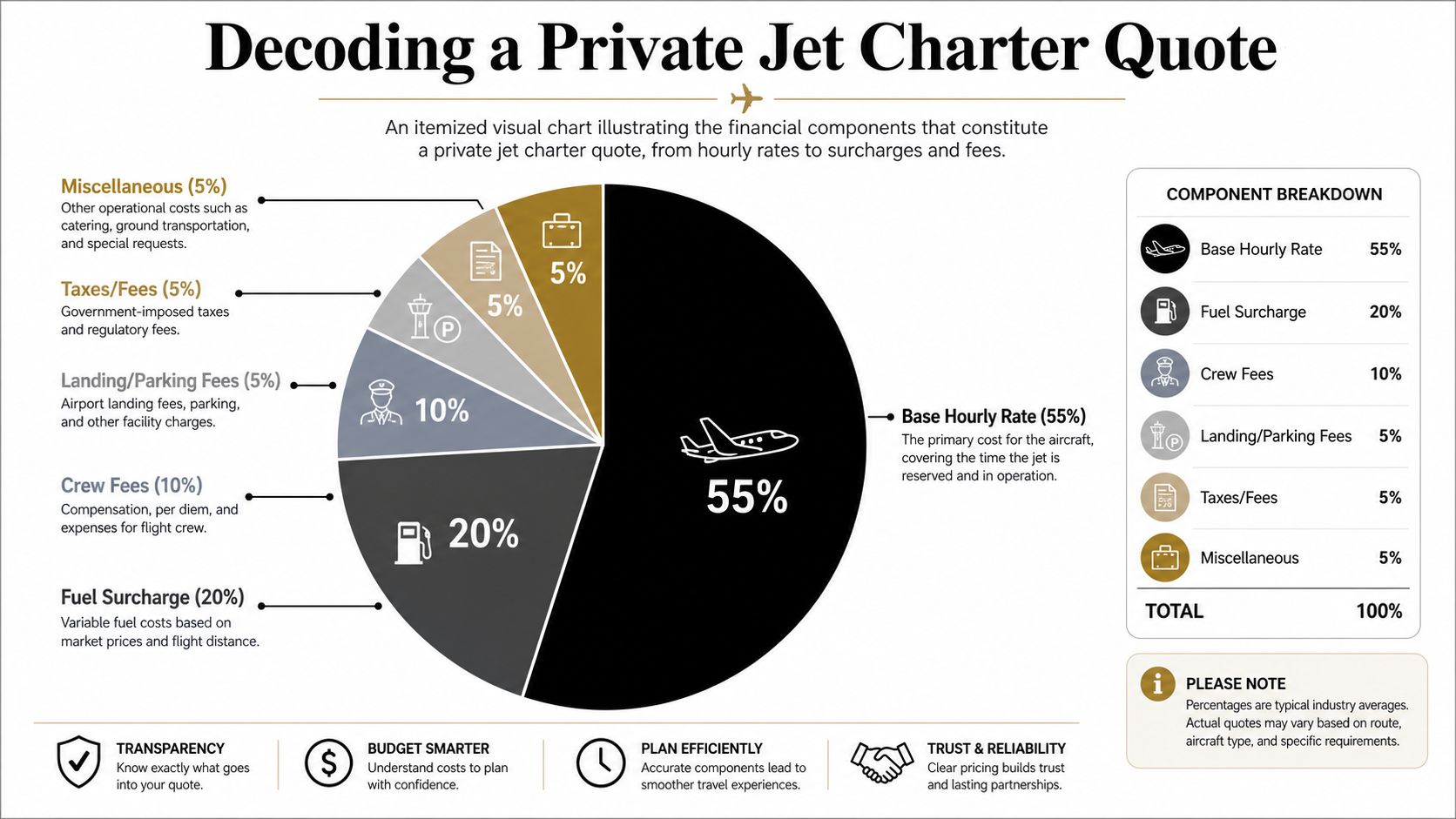
The line item most founders underestimate
The single most important concept to understand is repositioning. That's the cost created when an aircraft has to fly from where it's based to where your passenger departs.
In the 2026 private jet rental market, repositioning fees can inflate charter prices by 20% to 40%, with positioning charges ranging from $2,000 to $8,000 depending on distance, according to Paramount Business Jets' private jet rental cost guide.
That isn't a minor surcharge. It can materially change whether your quote feels competitive or bloated.
Wholesale versus retail in real terms
The wholesale-versus-retail gap becomes the core profit lesson in the private jet rental business.
Retail-style charter selling often starts with whatever aircraft is easiest for the seller to access. If that aircraft sits far from the departure airport, the client absorbs repositioning. The quote may still close, but the economics are weak for the client and fragile for the relationship.
Wholesale-oriented sourcing works differently. You search for an aircraft already near the trip origin, then build the quote from local availability first. That doesn't remove all trip costs, but it avoids a common source of price inflation.
For deeper context on how clients evaluate those line items, the Haute Jets charter pricing guide is a useful reference.
Pricing rule: If you can't explain why a quote costs what it costs, the client will assume the margin is hiding in the dark.
What a clean quote should communicate
A credible quote doesn't need to overwhelm the client with technical detail. It should clarify the major drivers and remove ambiguity.
Use this structure:
- Aircraft and routing: Identify the specific aircraft or a clearly defined option set.
- Flight time basis: Explain whether the quote reflects billable flight time only or includes positioning.
- Known trip charges: Surface the major cost components instead of burying them in a lump sum.
- Client-specific variables: Flag items such as deicing exposure, overnight crew needs, or schedule changes if relevant.
This video gives a useful visual reference for how charter pricing gets framed in the market.
How to protect margin without damaging trust
The goal isn't to become the cheapest seller in the market. Cheap pricing with sloppy sourcing usually creates operational pain later. The goal is to create defensible value.
That happens when you:
- Source close to departure.
- Present specific aircraft options.
- Explain the quote clearly.
- Hold your standards when a cheaper but weaker option appears.
A founder should think of pricing strategy as part sales, part procurement. If your sourcing discipline is weak, your pricing will always look retail. If your sourcing discipline is strong, your quote can remain premium in service while still feeling fair.
Building Your Operations and Sales Engine
The private jet rental business is won in the middle layers. Not at the logo level, and not only at the quote stage. It gets won in operator management, dispatch coordination, client follow-up, and the systems that keep all of those moving together.
Build the supply side before you scale the sales side
A lot of entrants focus first on lead generation. That's understandable, but it creates problems if your operator bench isn't deep enough to support fast, credible quoting.
Start by building a network with real working relationships. Not a spreadsheet of names. Not a loose marketplace list. Actual relationships where your team knows who responds quickly, who keeps aircraft availability current, who communicates well on day-of-trip issues, and who handles edge cases without drama.
Look for operators who are easy to do business with in the unglamorous moments. Schedule changes. catering revisions. airport swaps. weather-driven timing issues. That's where quality reveals itself.
Dispatch is the heart of the experience
Clients may think they're buying an aircraft. In reality, they experience your dispatch and coordination function far more directly.
A strong operations desk handles:
- Trip feasibility: airport suitability, aircraft fit, and timing realism
- Pre-flight coordination: manifests, crew timing, ground transport, and passenger preferences
- Live monitoring: weather updates, delay management, and communications flow
- Post-trip closeout: billing accuracy and service recovery if anything went wrong
If this function is weak, your marketing won't matter. The client remembers confusion more than brand language.
The best sales teams in charter don't overpromise. They sell what operations can deliver cleanly.
Your core tech stack
This business doesn't require a giant software budget at launch, but it does require the right categories of tools.
Most serious teams need a stack that covers:
| Function | What it needs to do |
|---|---|
| Aircraft sourcing | Surface operator options and support real-time quote assembly |
| CRM | Track preferences, repeat routes, referral relationships, and follow-up |
| Document workflow | Manage charter agreements, manifests, and client approvals |
| Payments and accounting | Keep deposits, carrier payments, taxes, and reconciliation organized |
| Communications | Centralize urgent trip changes across sales, ops, and client contacts |
Founders often ask whether they should automate heavily from the start. My view is no. Automate repeatable admin. Keep human control over sourcing, vetting, and client communication until your workflow patterns are stable.
Sales channels that actually fit this market
This isn't a volume lead business in the usual sense. Strong sales usually come from a mix of direct outreach, referral relationships, repeat-booking discipline, and selective visibility in the luxury ecosystem.
The most productive channels tend to be:
- Referral partners: wealth advisors, concierges, travel designers, family office staff
- Direct relationship selling: especially for executives, entertainment managers, and founders
- Search and content: useful when it answers specific buyer questions instead of publishing generic luxury copy
- Event-based networking: valuable if your follow-up process is disciplined
The sales mistake to avoid is acting like a commodity broker. When every quote looks interchangeable, the client shops only on price. When your team understands mission details, explains trade-offs well, and protects the client from avoidable cost inflation, you're no longer just selling lift. You're selling judgment.
That's what creates repeat business in charter.
Your Startup Checklist and Key Risks to Manage
Launching a private jet rental business takes more restraint than bravado. The founders who last usually start narrower than they wanted, document more than they expected, and reject more operator relationships than they thought they would.
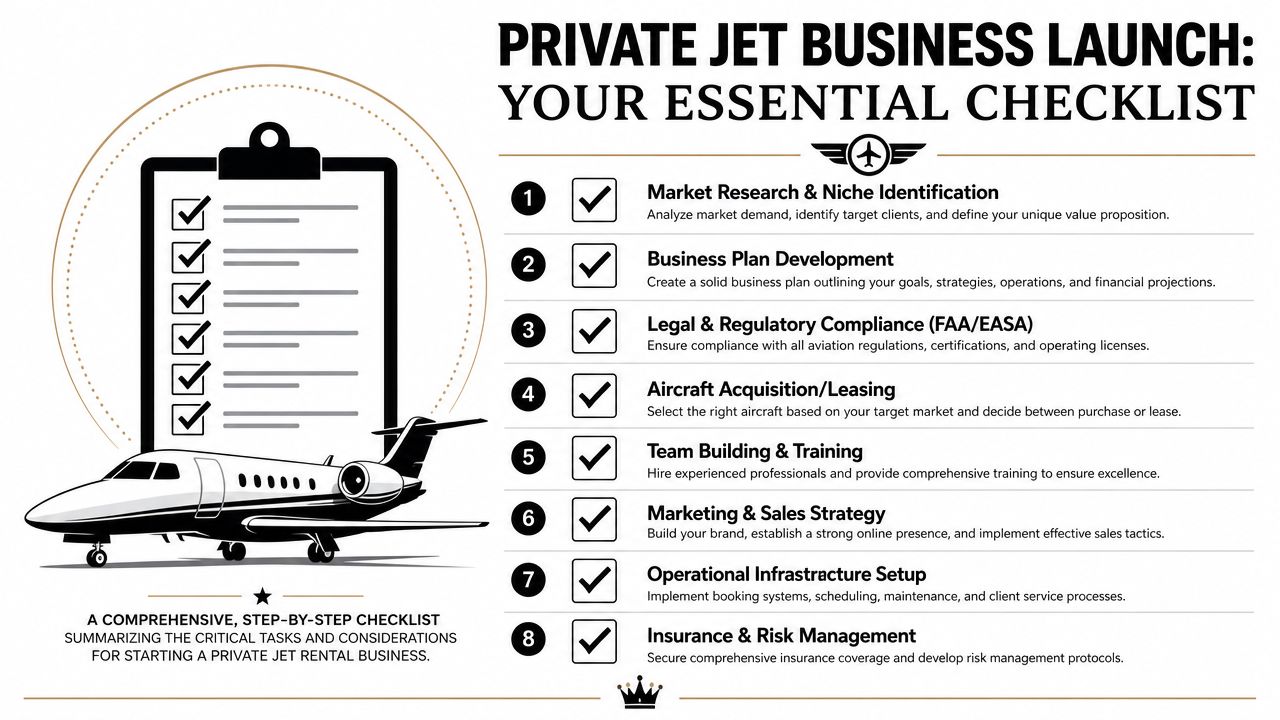
A practical startup checklist
Use this as the minimum viable launch sequence:
- Define your niche: Choose a client profile, trip pattern, or geography you can serve with real focus.
- Set your business model: Decide early whether you're brokering, operating, or building a marketplace layer.
- Write your operator standard: Document exactly which operators you will and won't use.
- Build your quote workflow: Create a repeatable process for sourcing, pricing, approval, and payment.
- Install your CRM and document stack: Don't rely on inbox memory for high-value clients.
- Create your service playbook: Standardize confirmations, trip updates, and problem escalation.
- Secure your first referral channels: Strong partnerships usually outperform broad cold marketing at launch.
- Stress-test your economics: Know your margin logic before volume starts masking weak deals.
If you're thinking about funding options or researching capital sources around rental-focused businesses more broadly, Gritt.io's rental investor directory can help outline the environment.
The risks that matter most
The obvious risk is safety, but it isn't the only one.
A founder also needs to manage pricing risk, operator reliability risk, client concentration risk, and reputation risk. One noisy service failure can damage referral momentum. One poorly explained quote can make a prospect distrust every quote after it. One weak operator can consume days of staff time on a single booking.
The private jet rental business also punishes inconsistency. If your first ten clients receive ten different service experiences, you don't have a business yet. You have activity.
Build the company you can control before you build the company you can brag about.
The upside remains substantial for founders who stay disciplined. Demand is there. The market is fragmented. Clients still value advisors who source well, communicate clearly, and protect them from hidden cost. That's enough room to build something durable, provided you respect how operational this business really is.
If you want an on-demand charter option built around local sourcing, transparent per-flight pricing, and vetted operator standards, Haute Jets is a practical place to start evaluating how a modern asset-light charter model works in the market.