
Most advice on international private jet charter is too soft and too shallow. It treats the process like a luxury shopping exercise. That's the wrong lens. Private jet rental international decisions are operational and financial decisions first. If you don't control sourcing, safety screening, permits, and paperwork, you'll pay more than you should and tolerate risk you don't need.
I've watched clients focus on cabin photos, champagne lists, and brand-name aircraft while ignoring the line item that blows up their quote: repositioning. I've also seen travelers accept “all-inclusive” pricing without asking where the aircraft is based, whether the operator is independently audited, or whether the tail they were shown is the one they'll board. That's how smart people overpay.
This piece is for travelers who want cleaner execution. If you charter internationally for business, family travel, events, or multi-stop leisure itineraries, you need a tighter framework than most booking guides provide.
When and Why to Charter a Private Jet Internationally
Private aviation isn't just about comfort. It's about control.
That matters more on international trips than on domestic ones. Border crossings, permit lead times, customs coordination, schedule changes, and airport access create friction fast. Commercial travel locks you into airline schedules and crowded hubs. International charter lets you build the trip around your calendar, your privacy requirements, and your actual destination.
The market is moving in that direction for a reason. The global private jet charter services market reached approximately $16.38 billion in 2025 and is projected to reach $25.79 billion by 2031, reflecting a shift toward flexible, on-demand access instead of fractional ownership or full aircraft acquisition, according to this 2026 charter services market projection.
The trips that justify charter fast
International charter makes the most sense when the airline system creates drag you can't afford.
- Multi-city business travel: You can visit several markets on one itinerary without surrendering a day to connections.
- Remote or secondary destinations: You can route closer to the final destination instead of building the trip around a major commercial gateway.
- Family and security-sensitive travel: You keep your group together, move through private terminals, and avoid unnecessary exposure.
- Time-specific leisure travel: Yachts, villas, events, and island transfers rarely line up neatly with commercial schedules.
If your destination is part of a broader itinerary, even leisure planning benefits from sharper routing. For example, if you're coordinating Caribbean travel and need a practical reference point for island access, your options for Exuma flights can help clarify how scheduled service and private routing differ.
International charter isn't a luxury upgrade from first class. It's a way to remove weak links from a complicated trip.
What serious clients should care about
I'd rank the priorities this way.
| Priority | Why it matters |
|---|---|
| Aircraft position | It directly affects whether your quote is efficient or padded |
| Operator quality | Safety standards and operating discipline matter more than cabin marketing |
| Permit handling | International trips fail on paperwork more often than on aircraft availability |
| Schedule flexibility | Real value comes when plans change and the trip still works |
Clients who understand this tend to make better decisions. They ask where the aircraft starts. They ask who operates it. They ask whether the trip can still work if one meeting moves or one passenger changes. That's the right mindset.
Decoding International Charter Costs and Savings
Most charter quotes are designed to look simple. They aren't simple.
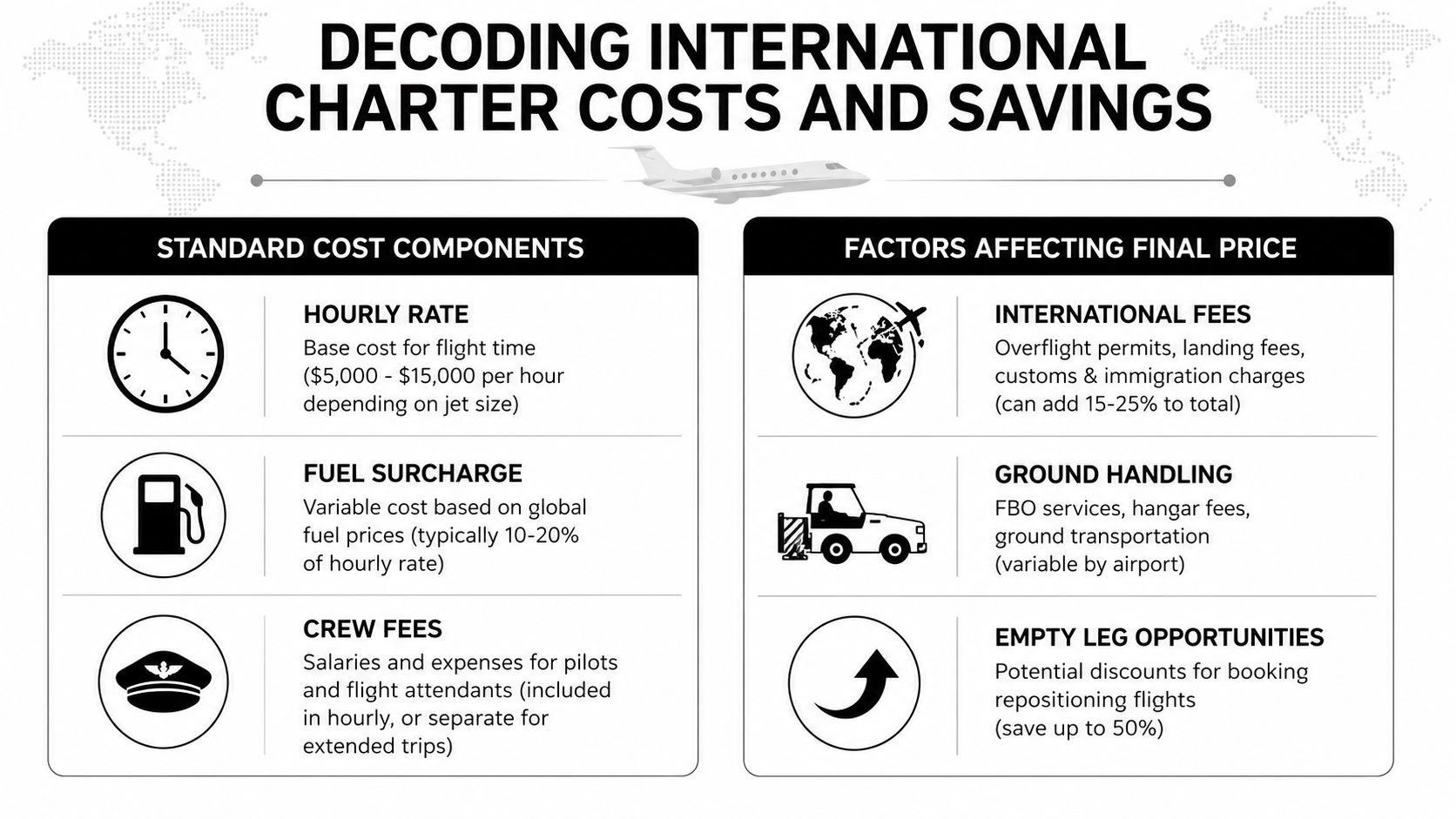
The visible number usually starts with hourly pricing, but the actual cost of an international trip depends on aircraft position, routing, overnight requirements, airport handling, permit complexity, and whether the aircraft has to move empty before it ever reaches you. That last piece is where people get burned.
What you should expect in a real quote
A proper international quote should separate the obvious costs from the conditional ones.
The obvious layer includes aircraft time and standard operating expenses. The conditional layer includes things like permits, crew logistics, and airport-specific handling. If those conditional items are vague, you don't yet have a transparent quote.
Here's the blunt version. Traditional brokers and jet card programs frequently inflate charter prices by 20 to 40 percent because they move aircraft to the client's location, while a local-sourcing model avoids that by sourcing jets based near the departure city from a network of 3,500+ owner-operators across 175 countries, as detailed in this breakdown of private jet charter cost inflation.
Repositioning is the hidden tax most clients miss
Repositioning, also called a ferry leg, is the empty flight required to get the aircraft to your departure airport. If the jet is based somewhere else, you often pay for that movement whether it's clearly labeled or not.
That's why two quotes for the same route can look close at first and land very far apart at signature. One aircraft is local. The other is not. The cabin may be identical. The economics are not.
Practical rule: Ask one question before you compare anything else: “Where is this aircraft based right now?”
If the answer is vague, keep pushing.
How to spot a padded quote
You don't need to be an aviation professional to catch weak pricing. You just need a short checklist.
- Ask for the aircraft location: If the jet is not near your departure city, expect extra movement cost.
- Request itemization: If permits, crew overnight charges, and handling are collapsed into one bucket, you can't test the quote.
- Compare exact aircraft, not just category: A “super midsize” quote tells you less than a named aircraft with an actual tail assignment.
- Watch for prepaid pressure: Jet cards can create the illusion of simplicity while hiding route inefficiencies.
If you want a cleaner baseline before you evaluate any proposal, review this private jet charter cost guide. It gives you the right framework for asking sharper questions.
Where savings actually come from
Cheap charter doesn't exist. Efficient charter does.
Savings usually come from one of three moves:
Local sourcing
This is the biggest lever on international charter because it cuts out unnecessary aircraft movement.Flexible one-way planning
Empty leg options can make sense for travelers with schedule flexibility, especially when the route already aligns with an operator's repositioning needs.Avoiding rigid access products
Memberships and jet cards can fit some travelers, but they often prioritize program structure over trip-by-trip efficiency.
I'll be direct here. The industry talks endlessly about hourly rates because hourly rates are easy to market. The smarter question is total mission cost. If the aircraft isn't close to you, the rate can be “competitive” and still be a bad buy.
Choosing the Right Aircraft and Operator for Your Mission
Most clients spend too much time choosing the jet and too little time choosing the operator. That's backwards.
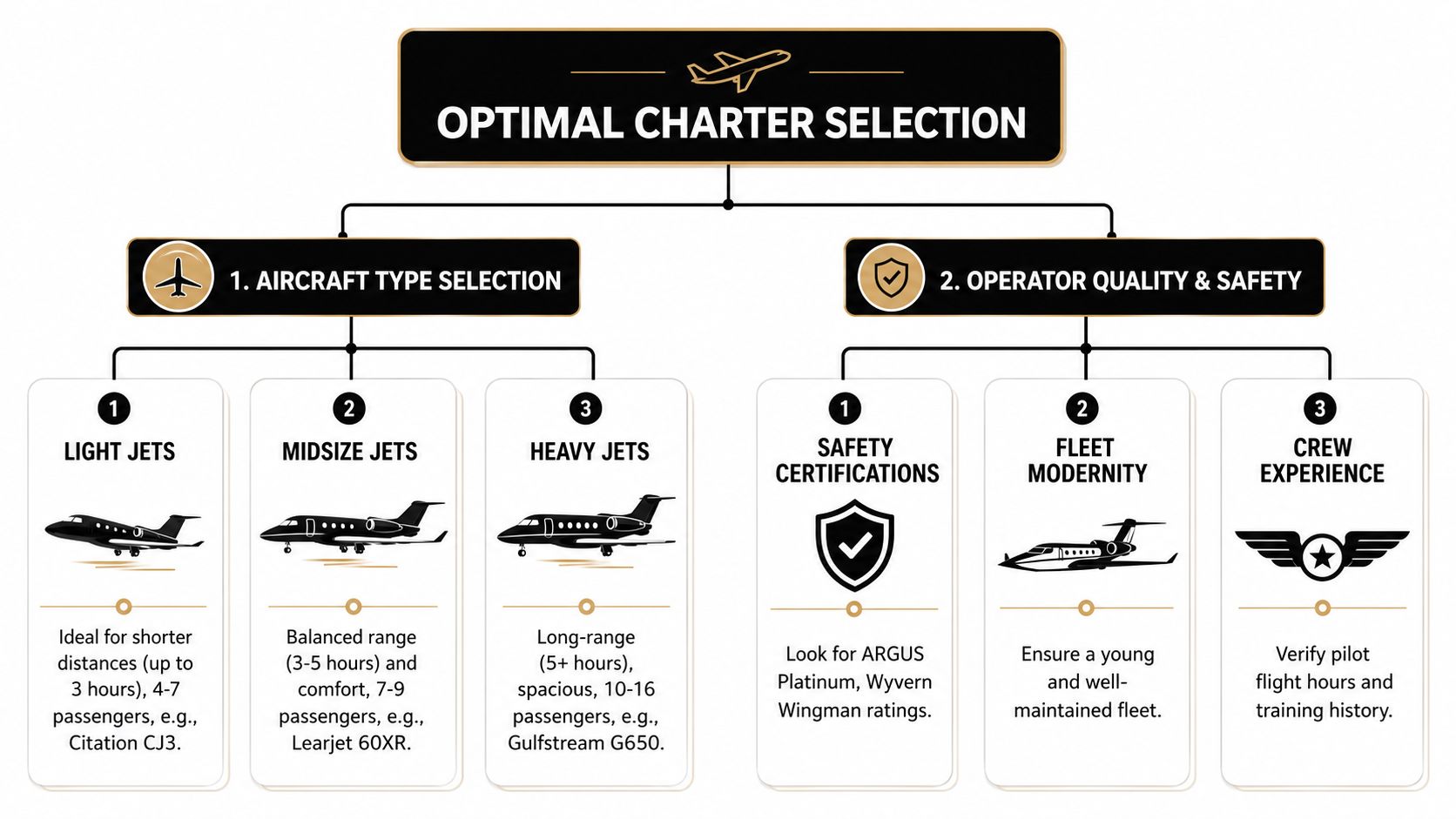
Aircraft selection matters, of course. You need the right range, payload, baggage space, and cabin layout for the mission. But if the operator's standards are weak, the aircraft model won't save you. For international flights, operator quality is the decision.
Match the aircraft to the mission
I'd think about aircraft in terms of mission profile, not prestige.
| Aircraft type | Best use |
|---|---|
| Light jet | Shorter international sectors, smaller groups, lighter baggage loads |
| Midsize or super-midsize | Balanced cabin comfort and range for many cross-border business trips |
| Heavy or ultra-long-range | Long-haul missions, larger groups, nonstop transoceanic flying, more baggage and onboard service |
If you want examples of aircraft commonly used on these missions, this review of top private jets for international travel is a useful starting point.
The wrong way to shop is “I want a Gulfstream.” The right way is “I need nonstop capability, proper luggage volume, a quiet cabin for overnight travel, and room to work.” That leads to better options.
The safety standard I won't compromise on
For international private jet rental, I care more about third-party audited operator quality than any cabin finish.
Operators holding Wyvern Wingman or Argus Gold/Platinum certification show a 99.2% compliance rate with international safety standards and are associated with a 60% lower incident rate compared to non-certified operators, according to this industry report on charter safety compliance.
That should settle the debate. If the operator doesn't hold one of those audits, I'd move on.
Don't let a glossy cabin interior distract you from the only question that matters first: who is operating this aircraft, and what independent audit have they passed?
If you want another outside perspective on how travelers compare providers, this roundup of best private jet providers is worth scanning. Use it as a screening tool, not a substitute for operator-level due diligence.
The minimum operator questions to ask
Don't overcomplicate this. Ask direct questions and expect direct answers.
- What third-party safety audit does the operator hold?
- Is this the exact aircraft I'll board, including year, make, and model?
- Who is the operating carrier?
- What's the baggage limitation for this specific mission?
- Are Wi-Fi, catering, and pet policies confirmed for this exact tail?
This is the one place where I'll mention a practical option by name. Haute Jets sources aircraft only from operator networks holding Wyvern Wingman or Argus Gold/Platinum ratings, according to its safety standards page. That's the level of screening I'd expect from any firm handling international missions.
Navigating International Compliance and Logistics
International trips don't fall apart because someone picked the wrong leather seats. They fall apart because somebody missed a permit, a visa requirement, a customs rule, or a document deadline.
That's why logistics should be treated like part of the flight plan, not back-office admin.

Start with documents, not departure time
Before you lock the aircraft, confirm the passenger side of the mission.
- Passports: Check validity early. Some countries apply stricter entry expectations than travelers assume.
- Visas: Verify every traveler, every passport, every stop. A technical stop can still create issues.
- Pets and special items: Rules can vary significantly by destination and by operator.
- Passenger manifest details: Names must match travel documents exactly.
The aircraft also has its own compliance track. Overflight permits, landing approvals, customs notifications, and airport handling all need coordination. If you want a practical reference for the arrival side of the process, this private jet customs guide is useful.
Budgeting for logistics without fooling yourself
Hourly rate matters, but it doesn't tell the whole story. Private jet charter hourly rates begin at $3,500 per hour, with turboprops at $1,500 to $3,500 per hour and ultra-long-range jets reaching up to $18,000 per hour, depending on aircraft class, route, and market conditions, according to Haute Jets pricing information.
Those numbers are a starting point. For international travel, what matters just as much is whether your operator and advisor can execute the route without creating preventable delay.
What the private terminal process actually looks like
The good news is that customs and immigration through a private terminal is usually cleaner than the commercial experience when the prep work is right.
Expect a focused flow:
- Arrive at the FBO
- Confirm identification and manifest details
- Complete customs or exit formalities as required
- Board quickly once crew and handlers clear the flight
That simplicity is earned in advance. It doesn't happen by accident.
A quick visual helps if you haven't flown through the process recently.
Last-minute changes are possible, but not magic
Clients often assume private means unlimited flexibility. It means more flexibility, not zero constraints.
If you change passenger count, pet status, destination sequence, or departure country close to flight time, the crew, permits, and handlers may all need updates. Some countries are easy. Others aren't. A disciplined charter team can often solve changes quickly, but no one can bend immigration law or slot rules.
The smoothest international charters start with one habit: verify every traveler's paperwork before you fall in love with the departure time.
The Modern Booking and Payment Process
The booking process should be straightforward. If it feels vague, it's usually because someone is hiding optionality they haven't secured.
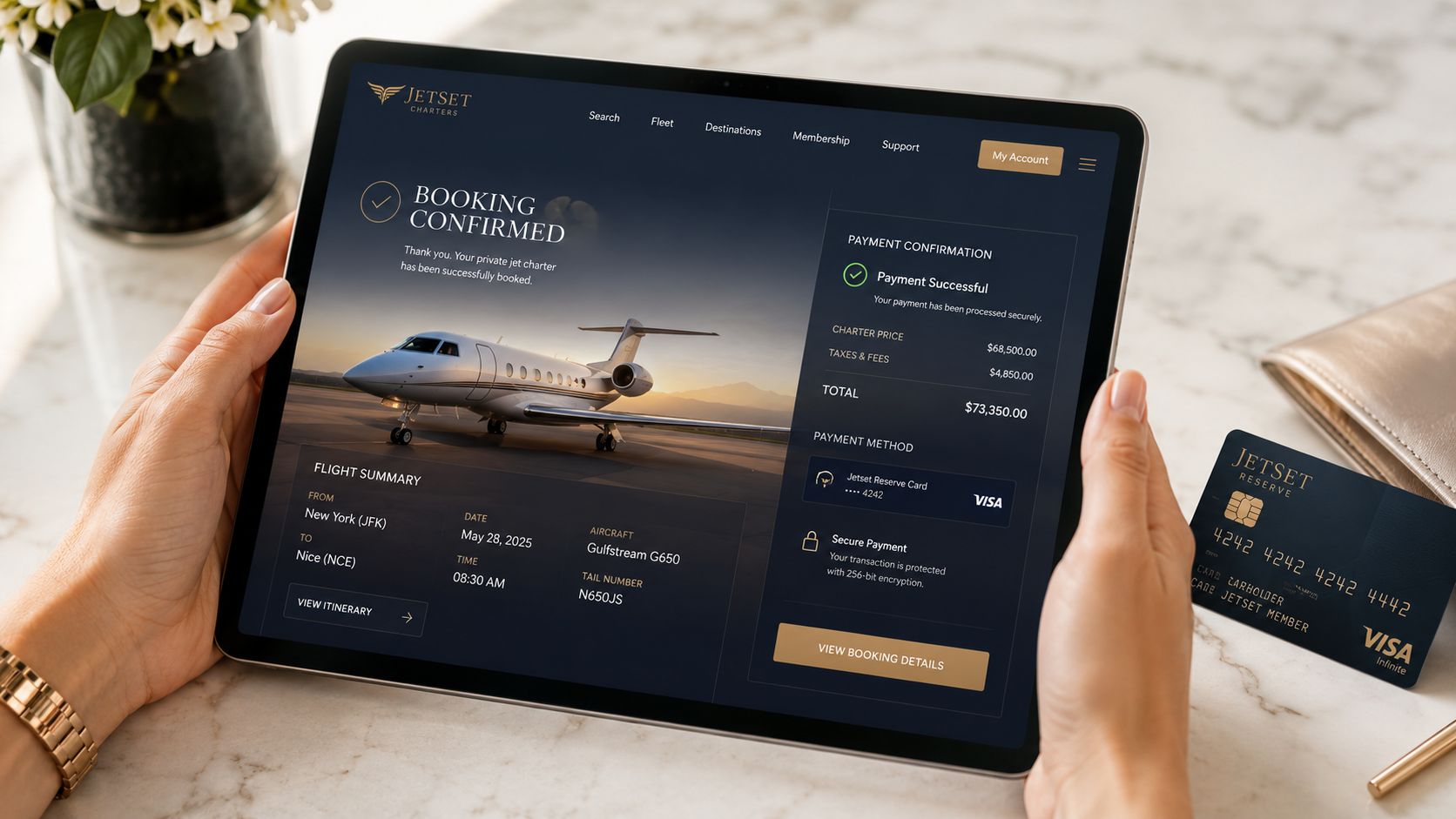
I prefer a process that moves from mission details to exact aircraft selection, then to contract review, payment, and final operational confirmation. Anything looser invites surprises.
What a clean booking flow looks like
A serious international booking usually follows this sequence:
Trip request
Share city pairs, dates, passenger count, passport mix, baggage profile, pets, and any schedule sensitivity.Aircraft presentation
You should see the actual aircraft option, not just a category label. Ask for year, make, model, cabin configuration, and operator.Quote and agreement review
Read the cancellation language, timing windows, included services, and any conditional fees.Payment
Wire transfers remain common. Credit card availability varies. Some travelers also want digital asset flexibility.Final trip confirmation
You should receive the definitive itinerary, tail number, crew details, and passenger documentation check before departure.
Why exact aircraft matters
A lot of clients still assume charter means buying a class of aircraft, like booking a midsize SUV from a rental desk. That's outdated thinking.
For international private jet rental, the exact aircraft matters because baggage volume, onboard connectivity, pet acceptance, cabin layout, and maintenance status all affect the trip. If your advisor can't confirm the actual tail with confidence, you don't yet have a finished booking.
Payment is getting more flexible
Many high-net-worth travelers want more than one settlement option. That's reasonable, especially for time-sensitive bookings or clients who manage liquidity across multiple channels.
If you're evaluating digital asset payment tools more broadly, this guide to compare crypto card options for flights is a practical resource. It won't replace legal or accounting advice, but it helps frame the payment side for travelers who already use crypto-linked spending tools.
The contract still matters more than the payment rail. Review what triggers extra charges, what happens if the operator changes aircraft, and what recourse exists if the mission has to be reworked. Clean documentation protects both sides.
Your Pre-Flight and Contingency Checklist
The final day goes well when the details were handled early. Not when everyone starts texting from the driveway.
International charter clients usually focus on the aircraft and forget the softer logistics that shape the experience. Catering timing, ground transfers, baggage limits, pet paperwork, and contact protocols matter because they remove friction from the trip.
What to confirm before you leave for the terminal
Use a short checklist. Keep it disciplined.
- Catering choices: Confirm dietary requirements and timing, especially on early departures or long sectors.
- Ground transportation: Make sure both ends are arranged. The arrival side gets missed most often.
- Luggage plan: Ask for guidance based on the exact aircraft, not assumptions from a previous trip.
- Pets: Confirm operator acceptance and destination-entry requirements before flight day.
- Traveler documents: Carry the same documents used for manifest submission.
What good contingency planning looks like
Problems happen. The difference is whether your provider has a recovery plan.
A mechanical issue should trigger immediate sourcing of a replacement aircraft if one is available. Weather should trigger rerouting, departure adjustment, or airport substitution analysis. A last-minute passenger change should trigger a fresh compliance review, not casual reassurance.
Good service feels calm because someone already built the backup plan before you asked for it.
The smartest mindset to bring
Don't shop international charter the way you'd shop a luxury hotel. Shop it the way you'd manage a complex transaction.
You want pricing that reflects the aircraft you are using. You want independently audited operators. You want a booking file that is complete before the wheels move. That's where luxury sits. Not in noise. In certainty.
If you want direct help planning a private jet rental international itinerary, Haute Jets provides on-demand charter access with exact-aircraft selection, 24-hour pre-flight confirmation, and a pricing model built around local sourcing instead of membership fees or jet cards.