
Most advice about private jet rules starts in the wrong place. It talks about dress code, baggage, or whether you can arrive twenty minutes before departure. Those details matter, but they are not the rules that protect you.
The rules that matter most are the ones you usually never see. They determine whether the flight is legal to sell, whether the crew is operating under the correct certificate, whether the aircraft is authorized for the route, and whether the operator has the oversight required for a charter carrying passengers for hire. If you're paying for a private flight, that legal framework matters more than any cabin amenity.
That's especially true because private aviation is not a niche corner of travel. One industry roundup estimated about 23,000 private jets worldwide, roughly 5.4 million private-jet flights in 2023, and about 3.5 million departures in the United States alone that year, which is why oversight and safety standards carry real weight in day-to-day operations, not just on paper (private jet safety market overview).
For clients flying private for the first time, the right mindset is simple. Don't ask only what the cabin looks like. Ask what rule set the trip operates under, who the operator is, what certifications apply, and what changes when the flight crosses a border. A solid first-time private jet guide should make that distinction clear from the start.
The Unseen Rules of Private Aviation
Luxury has created a useful illusion around private flying. The car pulls onto the ramp, luggage disappears into the hold, and you board without a terminal crowd. It can feel frictionless. But private aviation is not rule-free. It is highly structured. The difference is that the most important private jet rules sit behind the scenes.

Why the visible rules are the least important
Clients often ask whether there's TSA, whether pets are allowed, or how much luggage they can bring. Fair questions. But those are operating details, not the foundation.
The foundation is legality. A flight sold as an on-demand charter has to be operated under the proper charter authority, with the aircraft, crew, manuals, and procedures aligned to that authority. If that piece is wrong, the rest of the experience doesn't matter.
Practical rule: If you're hiring an aircraft, verify the operator before you compare the catering.
That may sound overly technical, but it's the simplest way to reduce risk. The cleanest private travel experience is built on paperwork, approvals, maintenance discipline, and operational control. The luxury is real. It just rests on compliance.
What experienced buyers look at first
A seasoned charter buyer usually starts with a short checklist:
- Operating category: Is this trip being conducted as private use or for-hire charter?
- Operator identity: Which certificate holder is flying the aircraft?
- Safety oversight: Has the operator gone beyond the legal minimum with independent audits?
- Route legality: Does the planned mission require permits, customs handling, or special equipment?
Those questions cut through a lot of marketing language.
A good charter process should make the answers easy to understand. If an operator or broker gets vague when you ask who is operating the aircraft, that's not a small issue. It's a sign to slow down.
The Regulatory Foundation FAA and EASA Frameworks
The cleanest way to understand private jet rules is to think in categories, not aircraft types. The jet itself does not tell you the legal standard. The operation does.
Part 91 and Part 135 are not interchangeable
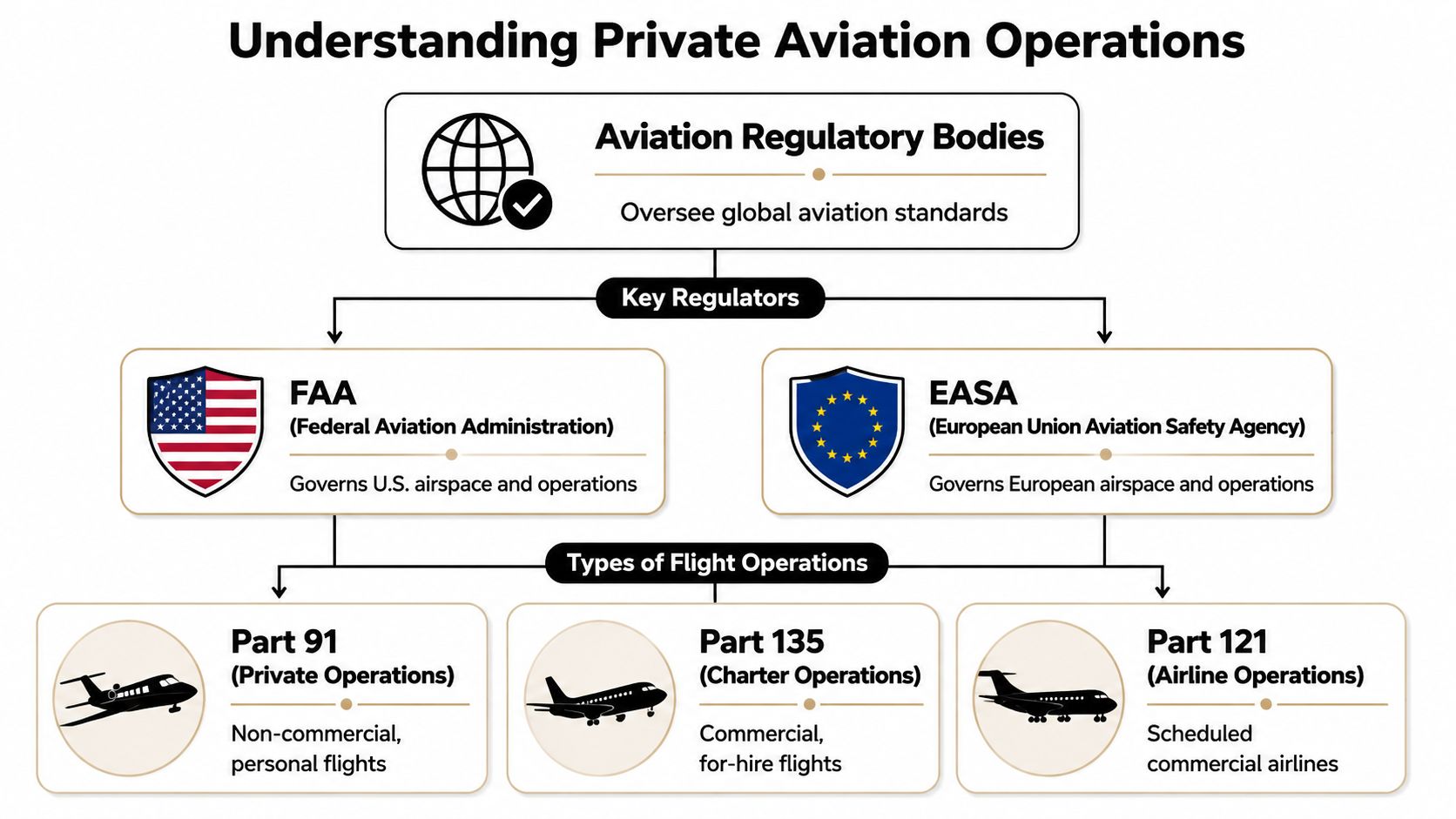
The most important distinction in U.S. private aviation is FAA Part 91 versus FAA Part 135. Part 91 governs private operations. Part 135 governs for-hire charter. That split is the bedrock rule because charter operators are subject to stricter oversight and operating requirements, and Part 135 flights are generally limited to 19 passengers before more stringent rules apply (FAA charter and private operations overview).
The simplest analogy is this:
| Operation type | Everyday comparison | What it means |
|---|---|---|
| Part 91 | Driving your own car | Private, noncommercial use |
| Part 135 | Hiring a professional chauffeur service | Carrying passengers for hire under a commercial charter framework |
| Part 121 | Scheduled airline service | Higher airline-level standards for scheduled operations |
That distinction changes real-world requirements. Crew training, maintenance systems, operational control, and dispatch discipline are not handled the same way across those categories.
For a practical explanation from the client side, what FAA Part 135 means for charter flyers is worth understanding before you book.
What certification actually involves
A proper charter operator doesn't declare itself “safe” and start selling flights. For paid charter in the U.S., the operator goes through a formal certification process that includes an operations manual, maintenance program, training program, document review, and at least one observed proving run before an air carrier certificate is issued (private jet safety regulations and certification process).
That matters because it shows how charter legality works in practice. The certificate isn't just a document. It represents an approved system.
Later, when clients ask why one quote is higher than another, this is often part of the answer. A compliant charter operation carries more structure and more responsibility than a privately operated aircraft. That should be reflected in how the trip is managed.
A short explainer helps frame the hierarchy visually:
Where EASA enters the picture
For European operations, the conversation expands beyond the FAA. EASA oversees the European framework, and for operators flying into Europe from outside the region, TCO authorization may be required. In plain terms, a legal international charter may need to satisfy both the home-state regulator and the destination-region regulator.
If the route changes jurisdictions, the compliance burden changes with it.
That's why “Can this aircraft make the trip?” is not the same as “Can this operator legally and smoothly conduct this mission?” Aircraft range is only one piece. Regulatory fit is another.
Decoding Operator Safety Standards Wyvern and ARGUS
Government certification is the floor, not the ceiling. That's the part many buyers miss.
A legal charter should operate under the proper authority. But discerning clients usually want one more layer of confidence. They want to know whether the operator has invited outside scrutiny of its safety systems, pilot training records, and operational discipline.
Why third-party audits matter
A useful way to frame this is simple. The law tells you whether an operator can sell the flight. Independent audits help you judge how seriously that operator runs the business.
That distinction matters because, as noted in an industry explanation of charter legality, the most important rule isn't passenger etiquette but operational legality, and for-hire charter flights must operate under a specific FAA air carrier certificate rather than the lighter private-use framework (Part 135 legality and safety context).
Third-party programs such as ARGUS and WYVERN are commonly used across private aviation to verify operator safety management and training practices. In practice, those names function as a second screen. They don't replace regulation, but they help clients separate basic compliance from stronger operational culture.
What discerning clients should ask
When I review an operator for a charter request, I'm not looking for a glossy brochure. I want clarity on the following:
- Audit status: Is the operator current with a recognized independent safety review?
- Operational discipline: Are training, maintenance, and crew records handled in a way that stands up to outside inspection?
- Fit for mission: Does the operator routinely fly the kind of trip you're booking, including any route or airport complications?
Those questions give you more signal than cabin photography ever will.
One useful client resource is this breakdown of Wyvern and ARGUS safety ratings, which explains why these audit frameworks matter when comparing charter options.
A polished booking process doesn't prove a safe operation. A disciplined operation usually produces a polished booking process.
The practical takeaway is straightforward. Don't stop at “Is it legal?” Ask, “Who else has examined how this operator works?”
Navigating Charter Contracts Fees and Terms
A charter contract is where operational reality turns into commercial reality. Within its terms, many clients discover that private jet rules also exist in pricing, scheduling, and liability language. If the contract is vague, the trip can get expensive very quickly.
What a quote should make clear
A sound charter quote should tell you what is included, what may change, and what triggers extra charges. Clients often focus on the top-line number. That's understandable, but the terms matter just as much.
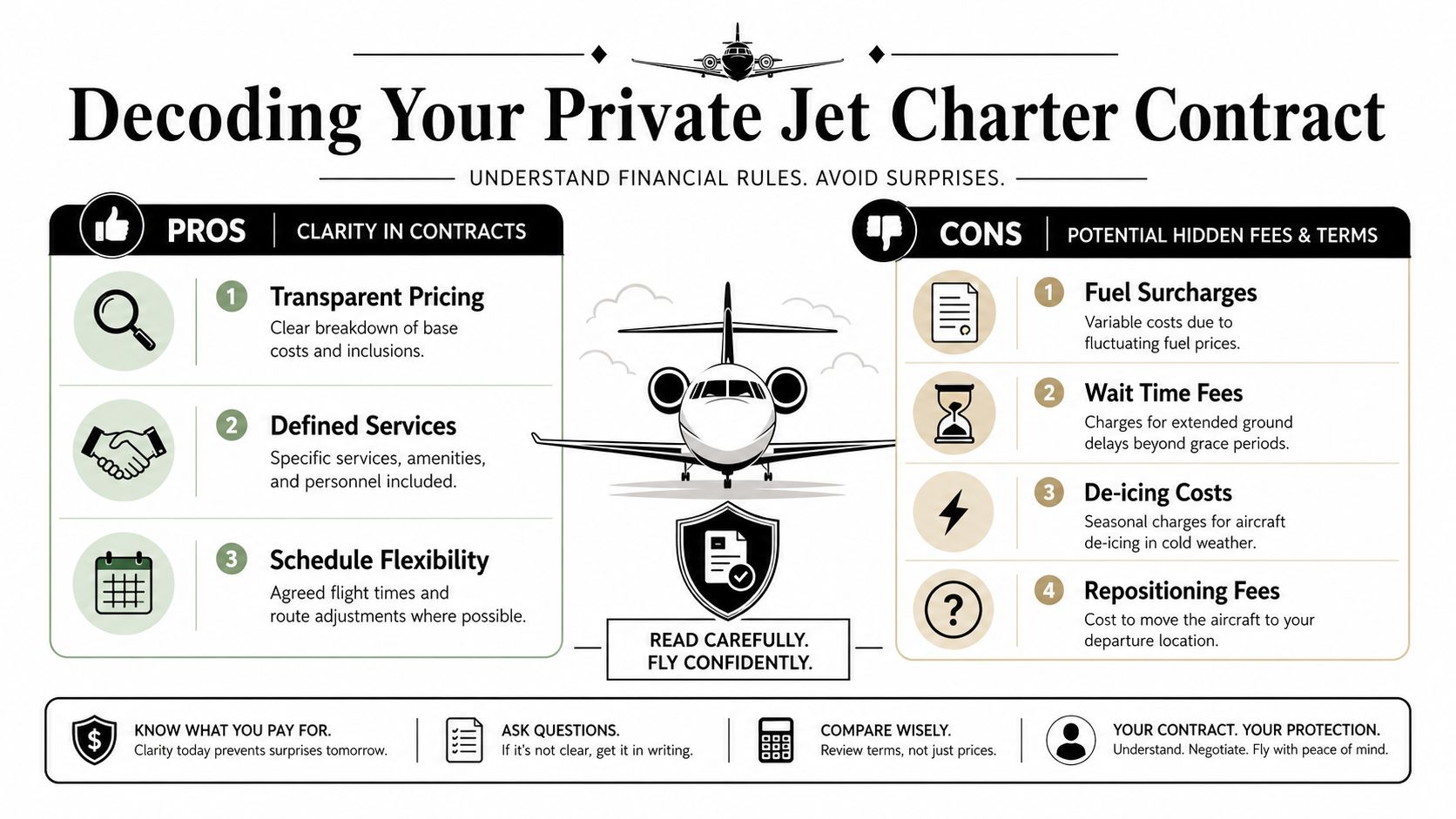
A well-built quote usually clarifies items such as:
- Base flight pricing: The core amount for the planned mission.
- Airport-related charges: Items tied to the departure, arrival, or handling environment.
- Operational variables: Costs that may depend on weather, schedule changes, or aircraft positioning.
The trouble starts when those categories are buried in dense language or left open-ended.
Fees that catch first-time buyers
The most common surprises are not exotic. They're operational.
| Contract area | What to check | Why it matters |
|---|---|---|
| Repositioning | Whether the aircraft must move into place before your departure | This can materially change the total cost |
| Wait time | Whether same-day delays trigger extra charges | Flexibility isn't always free |
| De-icing and weather | How seasonal operating costs are handled | Necessary safety measures can affect the invoice |
| Schedule changes | What happens if departure time or routing shifts | Last-minute changes can change crew and aircraft logistics |
Repositioning deserves special attention. If the aircraft isn't already near your departure point, someone has to pay to bring it to you. In a traditional model, that cost often lands on the client.
Haute Jets is one market option built around local sourcing from nearby owner-operators, which is intended to reduce or avoid the repositioning issue when suitable aircraft are available near the departure city. That's less about branding than mechanics. The closer the aircraft starts to your trip, the fewer moving pieces there are before wheels-up.
Contracts should answer operational questions
Good contracts don't just allocate cost. They clarify responsibility.
Client-side test: If you can't explain the cancellation, delay, and repositioning terms in plain English, ask for the contract to be rewritten or summarized before you sign.
That's not being difficult. It's basic risk management.
The best private jet rules for contracts are simple: know who is operating the flight, know what can change, and know which changes cost money.
From FBO to Takeoff The Ground Experience
The day of departure usually feels easier than first-time clients expect. That's one reason private aviation keeps loyal users. The airport process is simpler, but it is not casual in the operational sense. It is structured behind the scenes and simplified in front of the passenger.
What the FBO actually is
Most private flights use an FBO, or fixed-base operator, rather than the main commercial terminal. Think of it as a private terminal built around business aviation. The FBO coordinates ramp access, lounge space, ground handling, and the handoff between passenger and aircraft.
From the client side, the flow is straightforward. You arrive by car, check in with the desk or concierge team, and the crew or staff confirms the passenger manifest. Luggage is typically handled directly from vehicle to aircraft through the ground team.
What the departure flow feels like
A normal departure often looks like this:
Arrival at the terminal
You pull up to the FBO rather than a crowded airline curb.Identity and trip confirmation
Staff confirm the names on the trip and coordinate with the crew.Luggage transfer
Bags go directly to the aircraft, subject to aircraft capacity and any special-item limitations.Boarding call
When the aircraft is ready, you're escorted across the ramp.Crew greeting and seating
The pilots or a flight attendant, if applicable, greet you and review the immediate details of the flight.
There's a calm rhythm to it. The experience feels quick because the work was done before you arrived.
What clients should confirm before leaving for the airport
The smoothest departures happen when the basics are locked in ahead of time. I usually tell clients to verify four items before they get in the car:
- Passenger names exactly as submitted
- Baggage count and any large or unusual items
- Pet arrangements if an animal is traveling
- Ground transport timing on both ends
A disciplined charter process also gives you the operating details in advance, including the aircraft identity and crew information, so the terminal experience is predictable rather than mysterious.
The best ground experience feels effortless because someone handled the friction the day before.
That's what clients should expect. Quiet efficiency, not improvisation.
Crossing Borders International Flights and Customs
International private flying is where many assumptions fall apart. No TSA line does not mean no border control. It means the procedures are handled differently.
Permits drive the schedule
For domestic flights, clients often think in departure times. For international flights, operators often think first in approvals.
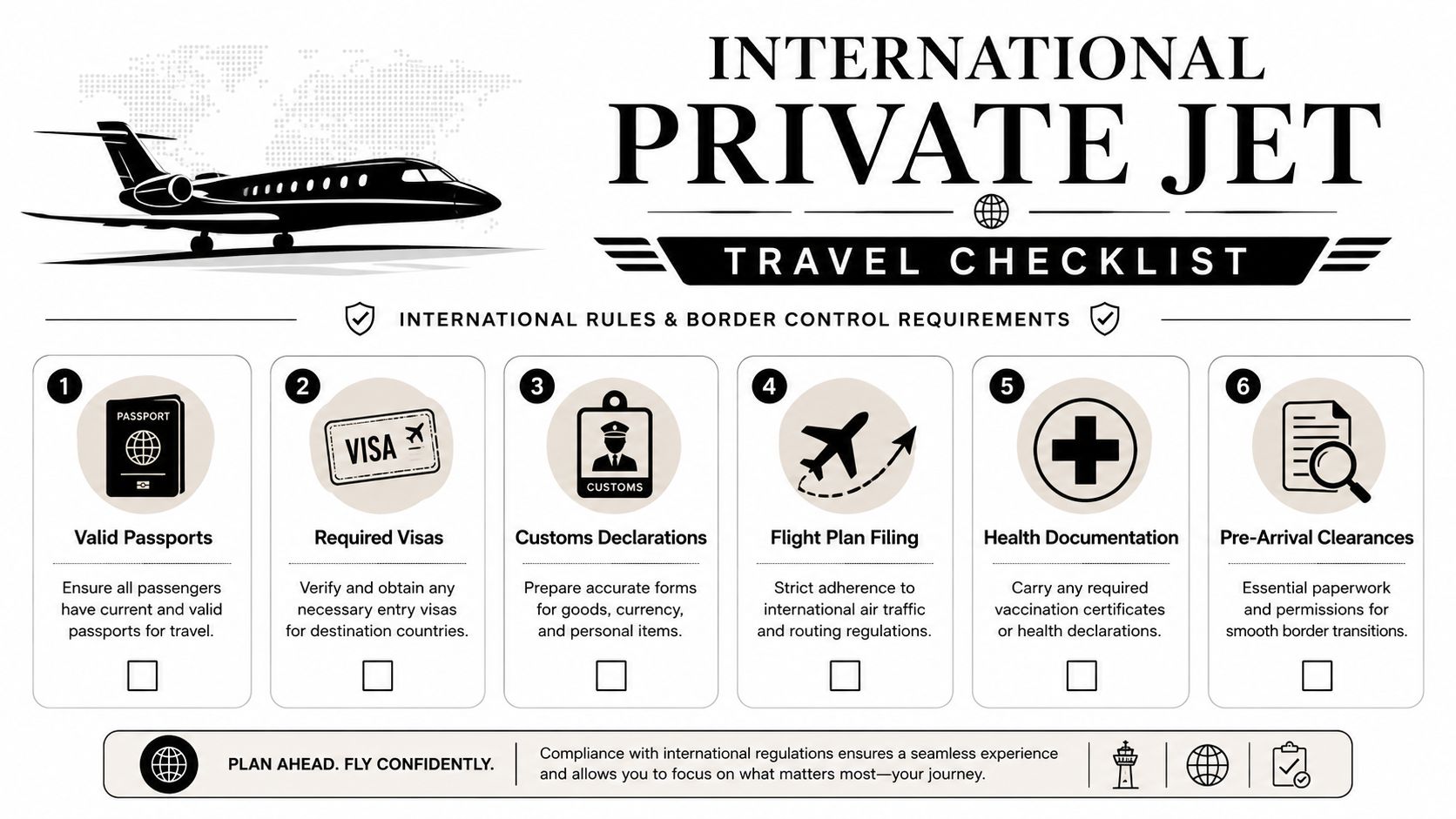
International private jet operations are permit-driven, not just schedule-driven. Operators must secure overflight permits for each foreign airspace transit and landing authorizations from the destination authority, which means route planning directly affects dispatch time and delays can happen if permits or documentation are not filed correctly (international private jet permit requirements).
That has practical consequences. A route with multiple jurisdictions may create multiple approval points. A short-notice request can still be possible, but possibility depends on paperwork, permissions, and local procedures, not just aircraft availability.
What passengers must have ready
From the passenger side, the rule is simple. Bring the documents the countries involved require.
That generally means:
- Valid passports for all travelers
- Required visas where applicable
- Health documentation if a destination requires it
- Accurate passenger information submitted early enough for the operator to process properly
This is one area where small errors create outsized disruption. A name mismatch, missing visa, or delayed passport copy can hold up a trip that looked ready on the aircraft side.
Route rules still matter over water and on arrival
Some private jet rules become visible only when geography forces the issue. One example cited in industry explanations is the long-standing FAA rule that private aircraft generally should not fly more than 50 nautical miles from land unless equipped with life rafts, life jackets, and an ELT. That helps explain why some routes track coastlines rather than cutting more directly across open water (why some private jets fly along coasts).
That's a useful reminder that route planning is not just about speed. Equipment, approvals, and legal operating conditions all shape the flight path.
Arrival procedures also vary by country. Some destinations process passengers in a private facility. Others require a more formal customs and immigration sequence. The polished private experience remains, but border control still exists and still has to be respected.
On international charters, the hidden work is usually permit work.
Clients who understand that tend to schedule more intelligently. They send documents early, ask about routing constraints, and leave room for regulatory lead time when the mission is complex.
In-Flight Etiquette and Passenger Guidelines
Most passenger-facing private jet rules are common-sense rules. They're there to make the trip smooth for everyone on board and to avoid surprises for the crew and operator.
Baggage, pets, and special items
Baggage is one of the most misunderstood parts of private flying. Clients assume a private aircraft can always take whatever fits in the car. That's not how it works. Baggage capacity depends on the specific aircraft, how the compartment is shaped, how many passengers are traveling, and sometimes the route itself.
Pets are often welcome on private charters, but they still need pre-coordination. The operator needs to know the type of animal, size, kennel needs if any, and any destination rules that apply. For international travel, pet documentation can become a separate planning track.
Special items require even more care. Firearms, oversized sporting equipment, production gear, and high-value items should never be treated as a last-minute note. They need to be disclosed early so the operator can confirm whether they're permitted and how they must be handled.
Cabin conduct that keeps the trip easy
The cabin environment is relaxed, but a few rules are nearly universal:
- Follow crew instructions: The flight crew's direction on boarding, seatbelts, and safety procedures isn't optional.
- Ask before bringing outside alcohol: Alcohol service is often tied to operator procedures and licensing considerations.
- Expect no smoking or vaping: Most operators prohibit both onboard.
- Confirm catering requests early: Special meals are easy to arrange when requested in advance, less so when added at the last minute.
These aren't restrictions in the commercial-airline sense. They're coordination rules. Private aviation works well because details are prepared in advance.
The right way to think about etiquette
If you're new to charter, don't overthink etiquette. Be punctual, communicate clearly, respect the crew, and disclose anything unusual before departure. That covers most of it.
The larger point is that passenger etiquette sits at the outer edge of the subject. The essential private jet rules are still the invisible ones discussed earlier: legal operating authority, safety oversight, route permissions, and documentation. Get those right and the onboard experience usually feels easy.
If you want help reviewing an operator, comparing charter terms, or booking a compliant on-demand flight, Haute Jets can help you evaluate the aircraft, operator credentials, and trip logistics before you commit.