

For 2026 planning, a private jet from New York to Miami costs approximately $12,000–$18,000 for a light jet, with roughly $17,000–$27,000 as a benchmark for light through midsize aircraft. The final quote depends on aircraft location, availability, repositioning, fees, and itinerary.
Those starting points serve different purposes. The lower light-jet band comes from a published Miami–New York one-way estimate, making it a useful reverse-direction reference rather than a guaranteed southbound fare. Broader aircraft-category estimates can run considerably higher.
For readers of Haute Jets Journal, the useful question isn't which aircraft has the lowest advertised rate. It's which available aircraft can carry the actual passengers and baggage, meet the schedule, and deliver the lowest defensible all-in trip cost.
What Determines the Private Jet Cost New York to Miami
Consider a traveler reviewing competing charter proposals for the same itinerary. One shows a lower hourly rate; the other offers an aircraft already near the departure airport. Choosing by hourly rate alone leaves an important question unanswered: how much flying, handling, and crew expense does each proposal charge?
New York–Miami is a major domestic private-aviation corridor, typically roughly 950 nautical miles, equivalent to about 1,090–1,100 statute miles, with representative nonstop estimates of approximately 2 hours 35 minutes to 2 hours 50 minutes. Routing, weather, congestion, and taxi time can change the total duration, according to this route-distance and flight-time analysis.
The cost comparison starts with identifying what sits behind each total.
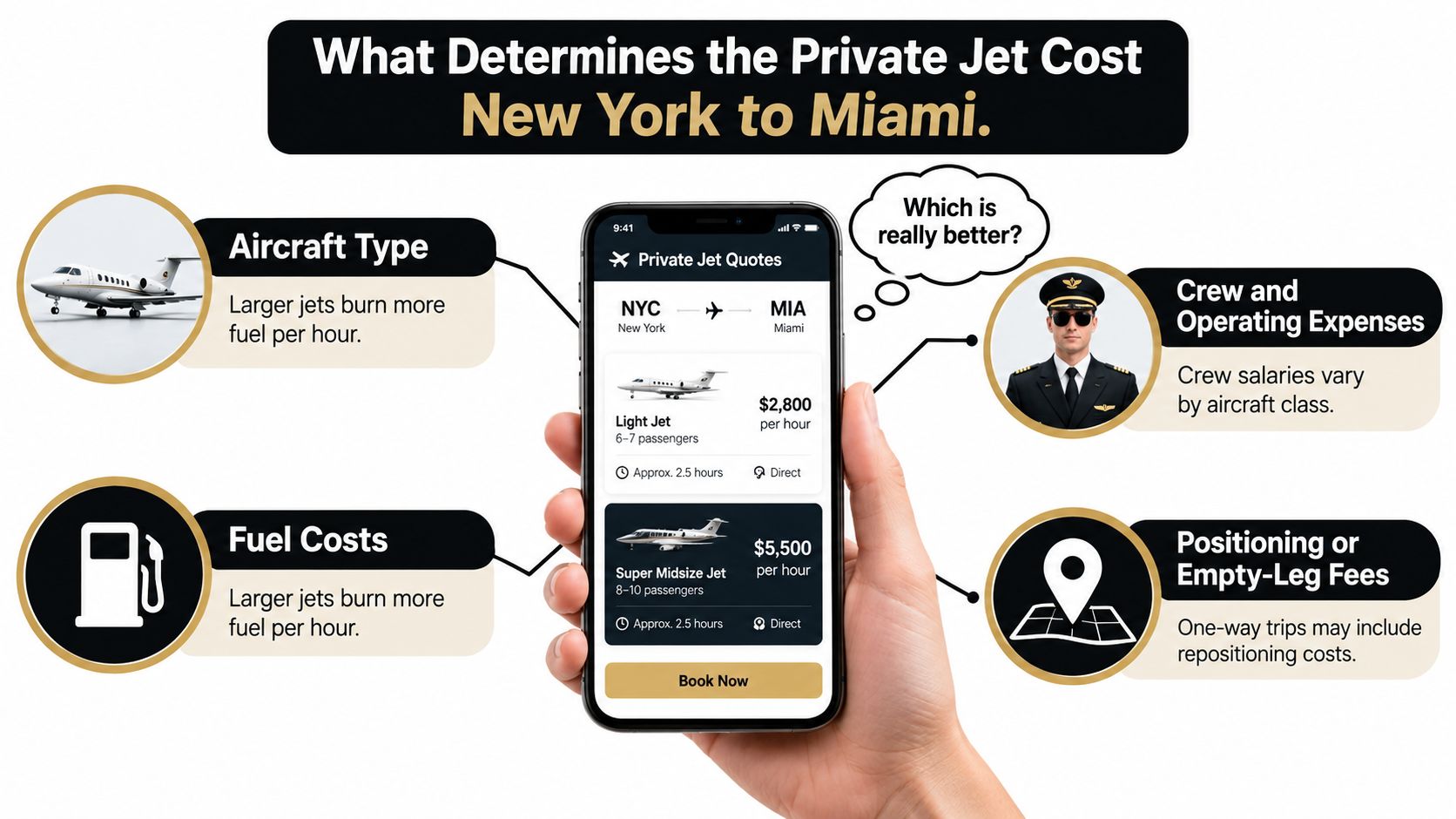
The itinerary costs more than airborne time
Airborne time describes the passenger flight, not necessarily every hour invoiced. A proposal can also account for positioning, minimum-hour requirements, crew costs, airport handling, landing charges, catering, and taxes. Passenger count and baggage needs influence the suitable aircraft, while departure and arrival airports affect the operating plan.
For the hypothetical traveler, the lower hourly rate could still produce the higher total if that aircraft must fly empty to collect the group. Conversely, an aircraft near departure isn't automatically cheaper if its cabin category or other charges exceed the alternative.
Practical rule: Compare the price of completing your itinerary, not the price of an isolated aircraft hour.
Use a private jet charter cost breakdown to organize proposals into comparable components. Ask where the aircraft will be before departure and whether the price includes bringing it to you.
Local sourcing matters because it can reduce that requirement. It should be tested against the written quote, not treated as a savings guarantee.
New York to Miami Route and Operating Profile
The route doesn't ordinarily require a heavy aircraft merely to cover the distance. Light, super-light, and midsize aircraft are practical candidates, which means buyers can make cabin and sourcing decisions without automatically paying for long-range equipment.
The operating profile below helps distinguish the passenger journey from the broader charter assignment.
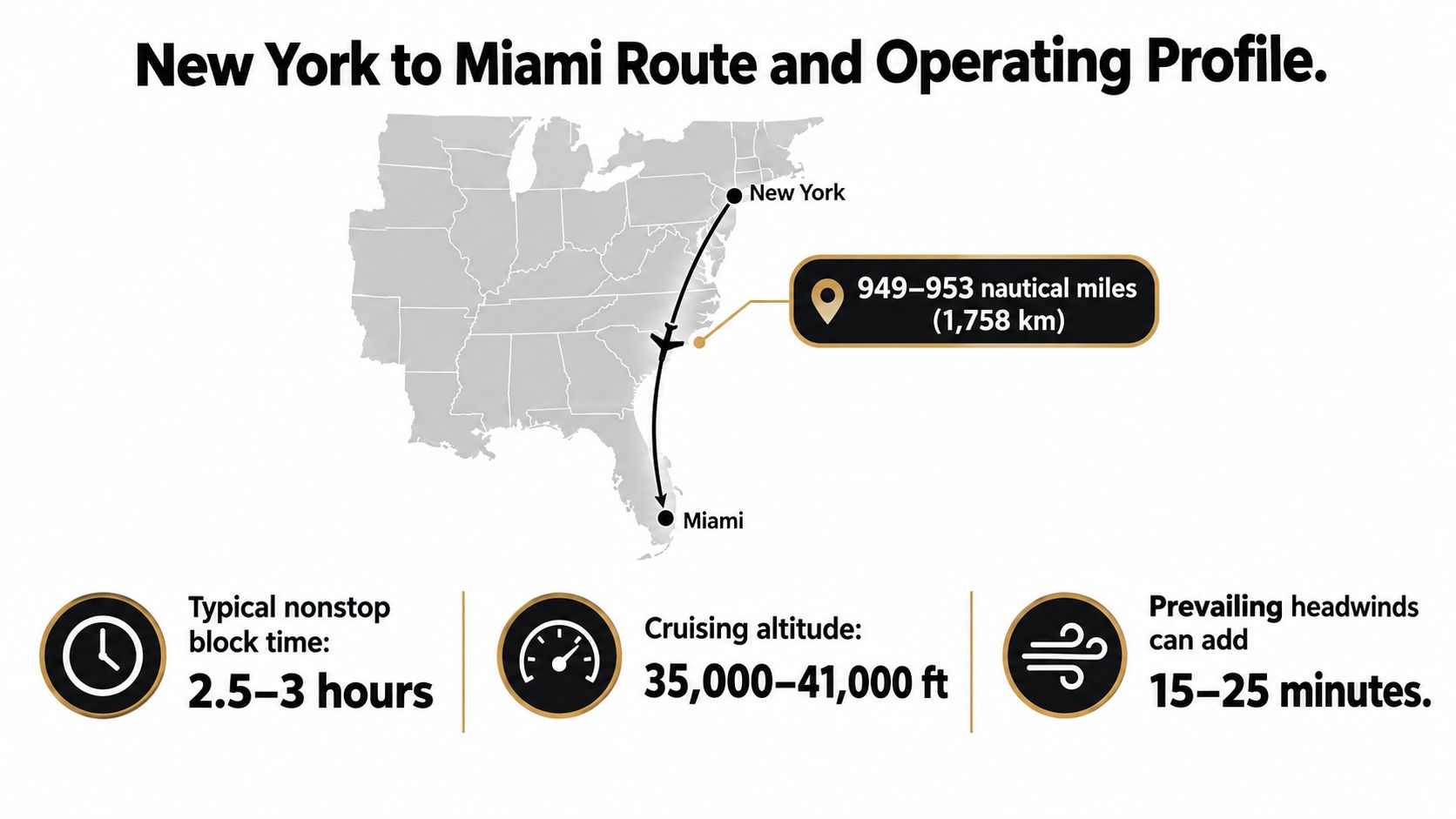
For detailed planning, the route is approximately 949–953 nautical miles, or 1,758 kilometers, with typical nonstop block times of about 2 hours 28 minutes to 2 hours 55 minutes; listed examples include a Citation CJ3+ at roughly 2 hours 38 minutes, a Citation Excel/XLS at 2 hours 33 minutes, and a Challenger 350 at 2 hours 28 minutes, depending on operating conditions in the aircraft-specific route estimates.
Those estimates aren't interchangeable with an operator's confirmed schedule. Block time includes ground movement associated with the passenger sector, whereas airborne time excludes it. Neither figure, by itself, tells you whether the quotation contains additional positioning sectors or contractual minimums.
Operational suitability requires a load check
A representative itinerary might connect Teterboro Airport (TEB) with Miami-Opa-locka Executive Airport (OPF). The operator should evaluate the actual airports, passenger manifest, baggage, winds, and routing rather than approve the trip solely from a city-pair distance.
- Light and super-light candidates: Ask whether the proposed aircraft can perform the intended nonstop mission with your actual load.
- Midsize candidates: Evaluate the cabin and baggage improvement, not just the scheduled arrival.
- Super-midsize candidates: Consider additional payload, runway, and headwind margin when the passenger load makes those factors relevant.
The accompanying video provides another visual reference for the travel discussion.
The analytical distinction is straightforward: route capability establishes eligibility; the actual operating plan establishes suitability. Buying a larger aircraft for a small scheduled time difference alone deserves scrutiny when the more meaningful benefit may be cabin space or operational margin.
Aircraft Class Comparisons for the Route
Aircraft-category pricing is a screening tool, not an offer to supply any aircraft in that category at the bottom of its range. Published estimates differ because operators, aircraft locations, seasons, and included fees differ.
New York to Miami aircraft comparison
The following 2026 one-way planning ranges, light-jet capacity of about 6–8 passengers, and broader larger-aircraft capacity of approximately 8–14 passengers come from the New York–Miami aircraft pricing comparison. The larger-aircraft capacity band isn't a seat guarantee for every category or cabin layout.
| Aircraft category | 2026 one-way planning range | Approximate capacity | Best fit | Key trade-off |
|---|---|---|---|---|
| Light jet | $12,000–$24,000 | About 6–8 passengers | Smaller parties prioritizing total cost | Check baggage fit and cabin dimensions |
| Super-light jet | $20,000–$32,000 | Confirm the exact layout | Travelers considering an intermediate cabin option | Category name alone doesn't establish usable space |
| Midsize jet | $23,000–$38,000 | Confirm seats against the manifest | Groups prioritizing cabin comfort and baggage | Additional space can increase the total |
| Super-midsize jet | $35,000–$60,000 or more, combined published band with heavy aircraft | Within the broader larger-aircraft band, model dependent | Fuller groups needing cabin and operating margin | More capability than a small party may need |
| Heavy aircraft | $35,000–$60,000 or more, combined published band with super-midsize aircraft | Within the broader larger-aircraft band, layout dependent | Larger parties or substantial cabin requirements | Higher estimated total for a mission smaller jets can perform |
Light jets deserve the first look when a smaller party wants the lowest practical aircraft cost. Their suitability depends on the luggage and seating arrangement, not merely whether the passenger count fits the advertised maximum.
A super-light jet is worth comparing when the light-jet proposal appears restrictive but the buyer doesn't yet need the full midsize proposition. Request the actual cabin plan and baggage allowance before assuming the category change resolves either problem.
Pay for usable differences
Midsize aircraft can provide additional cabin space, baggage capacity, and stand-up comfort. For an executive group, those features may be more useful than a marginal difference in the route's scheduled duration.
For super-midsize and heavy aircraft, identify the requirement that justifies the larger cabin. It might be passenger count, baggage, payload margin, or the ability to use the cabin as intended. It shouldn't be an unexamined assumption that larger always means better.
A category upgrade has value only when the proposed aircraft solves a passenger, baggage, comfort, or operating requirement.
The overlapping price bands also merit attention. A locally available aircraft in a larger category may warrant consideration against a less conveniently positioned smaller jet, but only a normalized quotation can establish the result. Don't turn that possibility into a promise that an upgrade will cost less.
How Passenger Count Changes the Value Equation
The cheapest aircraft total and the most attractive group economics aren't necessarily the same choice. A charter buyer pays for the aircraft assignment, so dividing an acceptable total among the actual travelers provides a different comparison from ranking cabin categories by price.
For example, a $24,000 light-jet charter carrying six travelers equals $4,000 per passenger, while a $48,000 larger aircraft carrying twelve also equals $4,000 per passenger; a published Challenger 350 example with ten passengers gives approximately $1,400–$3,500 per person per leg, as reported in the group-charter cost analysis.
Compare the real group, not a full-cabin assumption
These examples don't establish a purchasable per-seat fare. They show how travelers can allocate a quoted aircraft total, with the result still dependent on itinerary and operating costs.
The visual below illustrates the group-sharing principle; use the sourced route examples above, rather than illustrative graphic amounts, for budget planning.
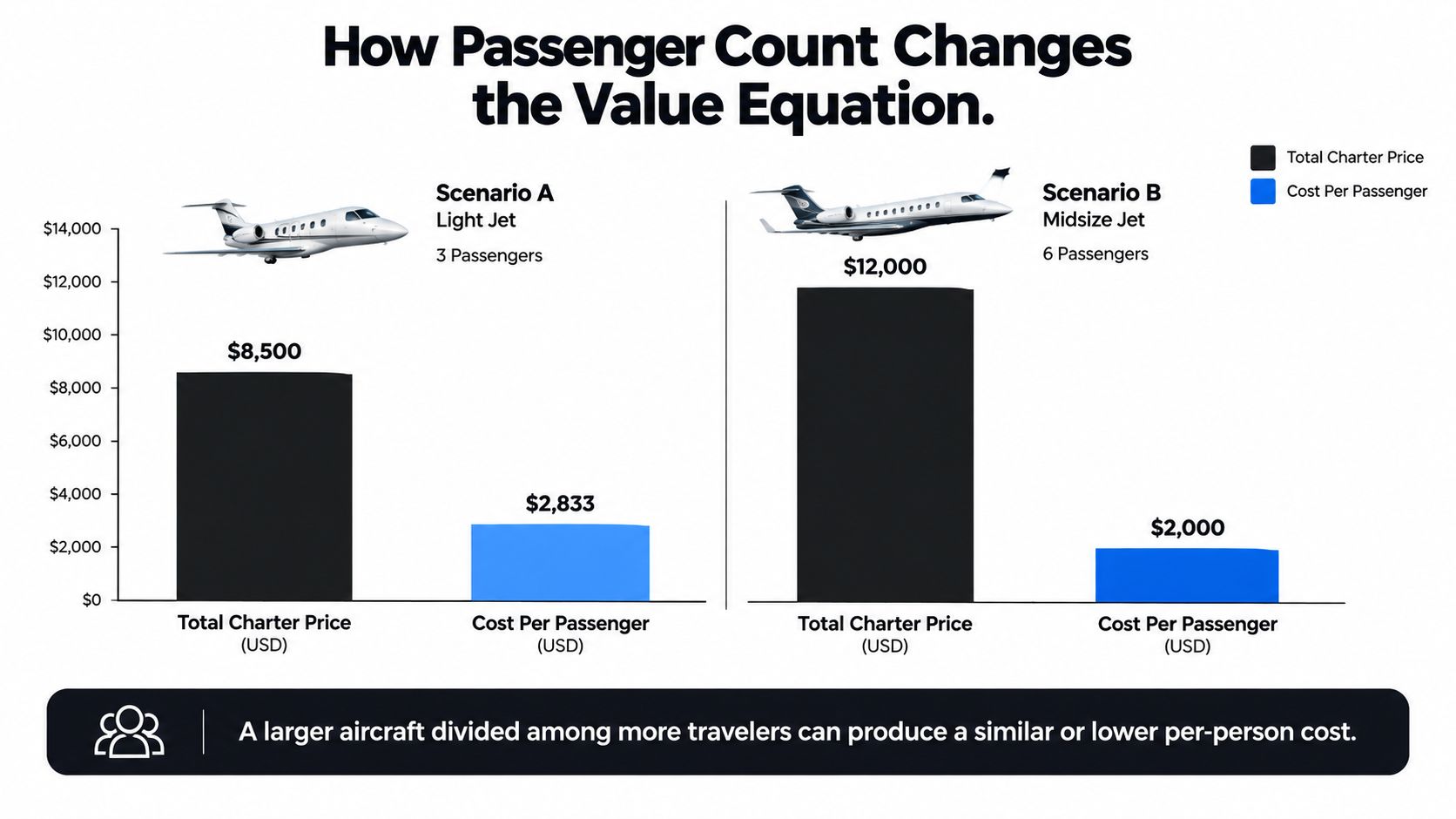
A travel manager should calculate cost per person using the confirmed manifest, not every installed seat. If colleagues don't share the same departure window or arrival requirements, combining them may not create the itinerary the business needs.
- Passenger fit: Confirm that the seating arrangement works for everyone, including any passenger-specific needs.
- Baggage fit: Submit the actual luggage description instead of assuming an available seat implies spare baggage capacity.
- Cabin use: Decide whether travelers need to work together, sit separately, or prioritize comfort.
A private jet passenger-capacity guide helps frame those questions, but the selected aircraft's layout remains the relevant document.
The deeper conclusion is that occupancy improves the allocation of a suitable charter cost; it doesn't make an unsuitable aircraft suitable. A favorable per-person calculation shouldn't override load approval, baggage fit, or the group's actual schedule.
Local Sourcing Versus Traditional Broker Pricing
Aircraft location is a procurement issue as much as an aviation issue. Before negotiating the rate on a particular jet, ask whether a suitable aircraft closer to departure could complete the assignment with less non-passenger flying.
Haute Jets states that its direct-to-owner model sources from 3,500+ owner-operators across 175 countries, and that local sourcing can eliminate repositioning fees that inflate prices by 20–40% with traditional brokers and jet-card programs; it also advertises per-flight pricing without annual fees, prepaid hours, or blackout dates under its published charter model. These figures describe the provider's stated benefits. Whether they hold on a specific New York to Miami booking depends on the actual quote.
The sourcing comparison should separate aircraft logistics from payment structure.

Compare the sourcing method and the contract separately
| Approach | What to examine | What not to assume |
|---|---|---|
| Locally sourced, pay-per-flight charter | Aircraft location, trip total, exact equipment, and positioning requirements | Proximity guarantees the lowest price |
| Traditional broker proposal | Operating carrier, sourcing options, included costs, and contractual responsibilities | Every broker uses the same pricing structure |
| Jet-card proposal | Applicable rate, prepaid commitment, availability conditions, minimums, and restrictions | A headline hourly rate equals the complete trip cost |
A traditional broker may also find a locally positioned aircraft. A jet-card proposal has to be judged under its actual agreement rather than a generic description of memberships or prepaid flying.
What matters is whether the arranger identifies suitable inventory, discloses the operating assignment, and presents terms the buyer can compare, regardless of whether the model is direct sourcing, a broker, or a jet card.
An owner-operator network explanation can help buyers understand the sourcing proposition. For a specific departure, ask which available aircraft supports that proposition and whether its current location is reflected in the quote.
Buyer's test: Ask the arranger to explain the aircraft assignment behind the saving rather than relying on the advertised pricing model.
Any actual advantage still depends on timing, availability, requested equipment, and the final contract. A network's breadth matters only when the arranger can turn it into an appropriate option for your trip.
How to Compare a Private Jet Quote
Normalize the trip before comparing the price. Send each arranger the same airports, departure window, passenger details, baggage description, and service requirements, then request a written response against that specification.
A useful quotation identifies both the aircraft and the commercial assumptions. If a proposal leaves either uncertain, flag it before approving payment.
Establish exactly what you're buying
- Aircraft identity: Request the year, make, model, cabin layout, and exact tail number where available. Ask how any substitution would be handled.
- Operating assignment: Identify the carrier flying the trip and request its safety credentials, rather than relying only on the arranger's branding.
- Time calculation: Obtain total block time, positioning sectors, and any minimum-hour or minimum-day charges.
- Complete price: Confirm landing and handling fees, fuel surcharge treatment, taxes, catering, crew overnight expenses, and whether deicing remains conditional.
- Passenger services: Verify Wi-Fi availability and charging, pet policies, ground transport, and any special catering requirements.
- Contract terms: Read cancellation provisions, itinerary-change terms, and the treatment of costs that remain payable as incurred.
The reason for this detail isn't administrative neatness. A missing service can make a cheaper proposal incomparable, while an unspecified aircraft leaves you unable to assess whether the cabin meets your needs.
Verify the pre-flight handover
Haute Jets states that its 24-hour pre-flight confirmation includes the tail number, crew biographies, weather briefing, and passenger manifest. It also states that it charters exclusively from Wyvern Wingman or Argus Gold/Platinum-rated operators. Treat those stated processes as verification points for the specific booking, not universal industry guarantees or substitutes for checking the assigned carrier.
Ask who will deliver the confirmation and how changes will be communicated. If the aircraft or operator changes, request the updated information before accepting the replacement.
Finally, separate included, excluded, and conditional charges on your comparison sheet. An all-in quotation should make the foreseeable trip cost clear while identifying circumstances that could still change the invoice. Don't assume an omitted line means the service is included or the charge has been waived.
Which Aircraft Fits Your Trip
Start with the smallest aircraft that can meet the complete requirement, then compare the actual available alternatives. That approach avoids paying for unnecessary capability without treating minimum cabin size as a goal in itself.
Published route benchmarks place light jets at about $17,000–$20,000, super-light jets at $20,000–$23,000, and midsize jets at $23,000–$27,000; the same pricing discussion describes a broader light-through-midsize span of roughly $15,000–$27,000 and another midsize benchmark of approximately $24,500–$27,000, illustrating the variation in New York–Miami charter estimates.
Match the aircraft to the constraint
- Solo travelers and smaller parties: Begin with light or super-light options if total cost is the priority. Request a larger category only when a specific requirement justifies it.
- Business groups: Consider midsize aircraft when cabin comfort, stand-up room, baggage, or the intended onboard working arrangement matters.
- Larger parties: Compare super-midsize and heavy proposals against the confirmed manifest and usable seating, not a category's broad capacity description.
- Substantial baggage: Give the arranger an itemized luggage description early. Ask for aircraft-specific approval before treating any proposal as suitable.
Schedule flexibility also belongs in the selection process. Tell the arranger which elements are fixed and which can change, rather than requesting flexibility in general terms.
A useful recommendation should explain both why the aircraft fits and why the next cheaper available option doesn't. That makes the upgrade decision auditable for a travel manager and understandable for a private client.
The right answer isn't automatically the largest cabin or the lowest advertised amount. It's the available aircraft whose passenger fit, operating plan, and written price align with the trip you intend to take.
Questions That Can Change Your Final Quote
Why do similar proposals still differ?
Ask what remains provisional. Aircraft availability, positioning assumptions, included services, and contractual exposure may differ even when the headline itinerary looks identical. Request a written explanation of the difference rather than assuming either proposal is overpriced.
Does the stated duration match the billed duration?
Have the arranger identify whether the displayed time describes airborne time, passenger-sector block time, or the complete billable assignment. The distinction matters most when a proposal presents a short flight duration prominently but leaves its pricing calculation less visible.
Is the group comparison based on confirmed travelers?
Check whether the per-person presentation assumes passengers who haven't committed. Also ask whether the approved load includes everyone's baggage. Attractive group arithmetic is useful only after the actual trip has been defined.
What does all-in exclude?
Request an explicit list of conditional and optional expenses. Ask which services are confirmed, which are merely requested, and what happens if an itinerary change alters the operating assignment.
Would an empty leg preserve the itinerary?
An empty-leg opportunity may reduce price but offer limited control over timing and routing, a trade-off discussed in this Miami charter-cost analysis. Ask whether the available departure, airports, and aircraft meet your needs before comparing it with a schedule-controlled charter.
The lowest headline price isn't the best value if accepting it means giving up something the trip requires.
Before committing, ask the arranger to restate the exact aircraft, operating carrier, included services, remaining conditions, and final payable amount together. That final reconciliation is more useful than another isolated hourly-rate comparison.
Haute Jets offers pay-per-flight aircraft sourcing and aircraft-specific selection for travelers comparing New York–Miami charter options. Visit Haute Jets with your preferred airports, departure window, passenger count, and baggage requirements to request a route-specific quote and clarify positioning, included services, and cancellation terms before booking.